Olive oil


Many people associate olive oil with a healthy diet.
That this cannot be taken for granted is shown by the information behind the following link:
CONSUMER CHECK BY THE TV CHANNEL SWR (German)
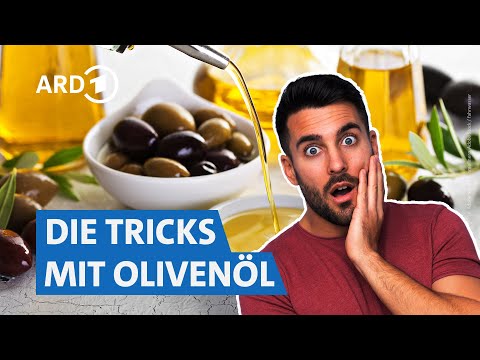
Do supermarket oils deliver what their labels promise?
A reporter from the German consumer programme “Marktcheck” shows how supposedly high-quality olive oils are adulterated and sets out on the trail of the counterfeiters. In Italy, several olive oil producers are under investigation for allegedly mislabelling and selling inferior oils. “Marktcheck” meets Raffaele Guariniello, the public prosecutor who initiated the investigation. In Italy he is a famous anti-doping investigator who now wants to tackle olive oil fraud. A reporter accompanies a police raid that keeps uncovering mislabelled oil. “Marktcheck” reveals how inferior oil and a few additives are turned into a supposedly high-quality oil that fools even experts. Broadcast date: 27 May 2017 (video in German).
Another piece of information that few people are aware of comes from FOCUS: Ernte in der Nacht – Millionen Vögel sterben, damit unsere Oliven besonders gut schmecken (Harvesting at night – millions of birds die so that our olives taste particularly good, German).
We know an alternative: dáVida

I was kindly put in touch with Fred and Edith (dáVida) by Alda Koller of the Alvital association (German). A good example of cooperation that works!
dáVida olive oils are produced in the Beira Alta region in north-central Portugal. Here, at the foot of the Serra da Estrela, which rises to almost 2,000 m, the climate offers ideal conditions for growing olives. The traditional variety cultivated exclusively in this area is called Galega, and it has a special reputation among connoisseurs. Its fruit is relatively small and, because of its low yield, it is not suited to intensive cultivation such as in the large monocultures in the south of Portugal, for example. Nor would that be possible on the small farms, often on difficult and partly terraced land.
Because the olive groves are small and, above all, because of the ideal climate with frosty winters and dry summers, the dreaded olive fly – in whose puncture holes fungi develop that make the fruit rot – hardly stands a chance. So, almost without exception, the trees are not treated with fungicides (not even those permitted in organic farming!) or insecticides. This applies both to our non-certified – but de facto organic – olive oil and to the certified organic one. (Fred, the producer)
The latter comes from a somewhat larger quinta (equivalent to a Spanish finca) about 100 km away on the slopes of the Rio Coa, for which the expensive organic certification is worthwhile. It is extracted at a maximum of 22 °C, the non-certified oil from our immediate surroundings at 30 °C. Since the devastating forest fires of 2017, we ourselves have only about 10 fruit-bearing olive trees left, and, like many other smallholders, we take our harvest to the nearby Ponte do Cobral oil mill (www.azeitesdocobral.com), from which we buy the oil. Twice a year we bottle it together with the family who run the press, with whom we have built up a friendship over the years. The route to our customers in Germany and Austria is therefore a direct one, so they can be sure of receiving the pure, unadulterated original product.
Thanks to the mountain climate mentioned above, the unique taste of the oils can generally be described as mild and balanced, with the typical soft yet intense aroma of the Galega olive (and sometimes of the similar Cobrançosa). They have all the flavour components of a quality oil, from green and fruity to slightly bitter or peppery – which is not noticeable in salads or cooked food, however, and indicates a high polyphenol content (desirable natural antioxidants). The acidity is usually a remarkable 0.1 to 0.3%, far below the legal limit of 0.8% for extra virgin olive oil, and makes the oil easy to digest. (The producers)
Enquiries about buying
This offer dates from autumn 2020 and was aimed at readers in Austria; prices and availability may have changed.
Anyone interested in this olive oil, please get in touch with Günter Hubmeier or me, gottfried herrmann. We will gladly put you in contact with the producers Fred and Edith in Portugal and can supply you with the high-quality non-certified – de facto organic – olive oil from a local store. We look forward to your enquiries! Individual handovers are arranged by phone.
The available sizes are:
- 1-litre glass bottle at EUR 14.00
- Box of 6 x 1-litre glass bottles at EUR 78.00 (6 x EUR 13.00)
Notes on content provided by authors
Comments
Loading comments …
Become a member to comment publicly. GAIA members write comments in the members' portal — under their nickname, visible to everyone.