Car Pi – electric mobility 2.0

Car Pi – revolutionary electric mobility
With a team of scientists at a wide range of centres around the world, the Neutrino® Energy Group is working on new technologies for converting invisible radiation spectra into electrical energy we can use. The name “Car Pi” combines the English word “car” with the mathematical constant “π” – known worldwide as a symbol of infinity.
“The Pi is not a specific car, but a fundamentally new way of thinking about e-mobility. Any electric car from any manufacturer can also be a Model Pi if it uses neutrinovoltaic technology. As the Neutrino® Energy Group, we do not want to manufacture the vehicles ourselves in large numbers later on; for scaling up we are seeking to join forces with the international automotive industry, gladly also here in Germany.”

Holger Thorsten Schubart
CEO | Neutrino® Energy Group
Latest information
The π-Car (Car Pi)
Car Pi animation video, as of 03/2023

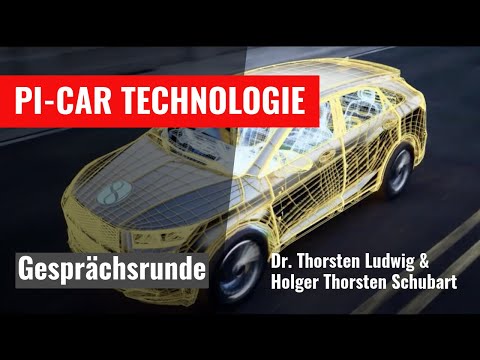
Interview with Dr Thorsten Ludwig and Holger Thorsten Schubart, 03/2023

In 2016, groundbreaking work in physics was honoured with the Nobel Prize, which for the first time proved beyond doubt the existence of an invisible atomic particle radiation throughout the universe. Among other things, this radiation contains so-called high-energy “neutrinos” with mass, which not only strike the Earth’s surface incessantly but apparently also penetrate deep into, or even right through, our planet with ease. Based on this work, it has even been possible to set a material available on Earth – GRAPHENE – into constant vibration by these neutrinos. As various renowned laboratories for fundamental research found, these tiny vibrations can be converted into clearly measurable electrical energy. Compared with the well-known photovoltaics, neutrinovoltaics uses almost exclusively this energy from invisible radiation fields.
Details as far as known, as of 03/2023
- Charging: approx. 100 km of range per hour while parked
- Use: conceptually feasible in any electric vehicle
- Technology: graphene layered two-dimensionally between silicon layers in the shape of the car body
How it works according to the manufacturer, as of 02/2023
The principle is based on neutrinovoltaics. The silicon-graphene layers are embedded in the car body, where – just as in the Neutrino® Power Cube – they generate usable electrical energy. Depending on the ambient temperature, the vehicle can thus recharge up to 100 km of range via its body while parked – without a cable, by converting radiant energy invisible to our eyes. The resulting possibilities for mobility are manifold and fundamentally revolutionise the manufacture of electric cars. Recharging vehicles with external electricity is no longer necessary. The energy needed for driving is recharged automatically right in the vehicle, on the surface of the body. As soon as industry is ready to implement this technology in its fleets, electric mobility can develop further. In India, the starting signal has already been given through the cooperation with C-MET. Other manufacturers are invited to follow this upswing.
Further reading, continually expanded
News & updates
Subscribe to GAIA news for news & updates on this and other topics, such as planned events.
The Neutrino Energy Group
The Neutrino Energy Group is a German-American research group whose aim is to harness the power of invisible radiation spectra. Since fossil fuels are limited and climate change makes the development of alternative and CO2-neutral energy sources necessary, this research group is dedicated to an urgent current problem. The team has succeeded in creating a dense substance that interacts in a particular way with neutrinos and other invisible radiation. This unique substance is used to build the first neutrinovoltaic cells for generating electricity. Layers of silicon and doped graphene are vapour-deposited onto a carrier layer to make the end product. The thickness of these layers is in the nanometre range. When neutrinos and other invisible radiation strike this substance, they generate both horizontal and vertical impulses. It is crucial that the doped materials have the right layer thickness, because at the optimal layer thickness the atomic vibrations caused by the impulses are brought into resonance. As a result, an electrical current can be detected in the substrate material. The hypothesis is that the amount of energy that can be “harvested” depends on the distance covered in the process. With this approach it will soon be possible to charge electrical devices anywhere in the world without needing a socket or a cable. Simply “collecting” energy from the environment is a viable option. As a result, humanity will have access to an endless supply of clean energy, which will help to slow down or even stop global warming.