Why the “old” money system must collapse
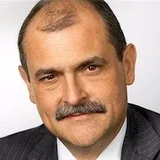

The end of the old money system – and the beginning of a new economic logic
When I look at our financial system today, I see a construct that has been based for decades on illusions, statistical tricks and accounting errors. Many people sense intuitively that something is wrong but cannot name it. That is why it was important to me, in conversation with Alex Quint, to reveal the mechanics of this system in an understandable way. Right at the beginning Alex said: “Please explain the difference in relation to inflation” – and that is exactly where the real enlightenment begins: The current money system is mathematically unstable because every newly created unit of money automatically creates a debt – in fact, owing to an accounting approach that has always been misinterpreted, a double one. This fundamental error ensures that the amount of debt always grows faster than real economic output. We are not talking about mismanagement but about a built-in system error. For decades, attempts have been made to slow this process down through bailout packages, interest-rate policy and regulation, but the basic logic remains:
Old debts are serviced with even more debt.
Prof. Dr. Franz Hörmann
A perpetual motion machine that only works through constant money creation – until the purchasing power of money finally disintegrates. Alex put it aptly when he said:
I don’t understand how the state can borrow from the bank that it actually has to rescue.
Alex Quint – mitgeschnitten.tv
This absurdity is the core of the problem: the state does not create money itself but borrows it from private banks, which previously created it at the push of a button. A sovereign state would never have to go into debt – it could provide its own money. In the interview we talked at length about how inflation is manipulated statistically. The official basket of goods is constantly changed so that price increases look as harmless as possible. Yet inflation does not arise from rising prices but from the money supply diverging from real goods. And this divergence is unavoidable in the privately controlled debt-money system.
Another topic I explained was the role of banks in the emergence of crises. Banks grant excessive credit, thereby creating price bubbles, and later suddenly withdraw liquidity. This creates artificial highs and lows that are determined not by the market but by the lending decisions of a few institutions. As I put it in the conversation:
Prices today are not made by the market, but by banks.
Prof. Dr. Franz Hörmann
These mechanisms are particularly evident in real estate. The value of a house does not come from building materials or location, but almost exclusively from a bank’s willingness to grant large loans. That explains why asset bubbles arise – and why they keep bursting.
Connected to this is the fractional reserve system. I explained to Alex that here the same unit – gold, money, raw materials – is sold several times over without physical backing. In the case of gold 20 to 30 times, in the case of silver even more than 300 times. The result is an artificial multiplication of claims without real values behind them. That this system will reach its limits at some point is not a prophecy but a simple logical consequence.
We also talked about the historical roots of money. The anthropologist David Graeber showed that money did not arise from barter but from structures of violence: princes needed a means of paying mercenaries and controlling the population. I took this up in the conversation because it shows why money was never a neutral tool. Money has always been an instrument of power – and has remained so to this day.
Since the USA abolished the dollar’s gold peg in 1971, the world has been in the largest experimental fiat money system in human history. Today – after the end of the petrodollar agreement – the dollar stands without any backing. The same applies to the euro, which is merely a derivative of this system. It is no coincidence that the BRICS states are forming in parallel and preparing commodity-backed currency systems. On this I said – not as a political judgement, but as a sober analysis of geopolitical developments:
BRICS will become the successor system to the UN.
Prof. Dr. Franz Hörmann
The decisive question: what can savers do now?
Alex Quint – mitgeschnitten.tv
My answer was clear: physical precious metals remain the most reliable store of value. For me, cryptocurrencies are no substitute, at most gold-backed tokens. Everything else remains part of the fiat ecosystem and is therefore also unstable. Towards the end of the conversation we discussed the changes ahead. I stressed that the structures of a new system already exist in the background.
The new has been built – the switch just has to be flipped.
Prof. Dr. Franz Hörmann
When that happens depends less on politicians than on the moment when the old system can no longer conceal its own contradiction. Alex described the situation vividly:
We are being set against each other over a scarce nothing.
Alex Quint – mitgeschnitten.tv
an apt summary of the artificial scarcity that prevails today.
In my draft of a new system, it is no longer a matter of using money as a means of exchange or an instrument of debt, but as a representation of positive achievements. If someone learns a language, loses weight or makes a social contribution, these are real values that create social benefit. So why should money creation be linked to debt instead of to positive development?
We no longer need a finance minister if money creation is based on social benefit.
Prof. Dr. Franz Hörmann
The new model would be not only fairer but also more stable, as it eliminates artificial scarcity. In the conversation I used the well-known elephant metaphor:
The elephant could break the chain on its leg, but doesn’t, because it couldn’t when it was young.
Prof. Dr. Franz Hörmann
It is exactly the same with people: they could long since have created a fairer and technologically advanced system, but they believe they are trapped in the rules of the old one. When we take this mental step, the real change begins.
We are at a turning point. Not in the sense of an abrupt collapse, but of a global paradigm shift. The combination of technological abundance, geopolitical reordering and the obvious failure of the debt-money system is leading us into an age in which money takes on a completely new function. I emphasised this in the interview from the very beginning and summarised it once more at the end:
The interview (German)
Duration: 113 min
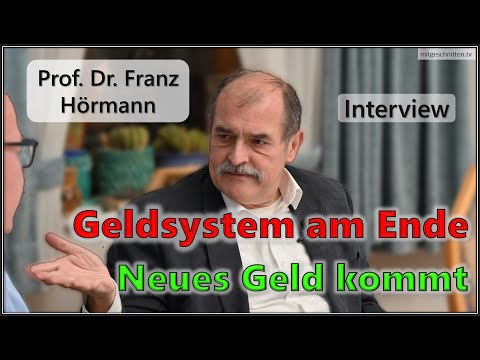
Conclusion Prof. Dr. Franz Hörmann
We are at a turning point. Not in the sense of an abrupt collapse, but of a global paradigm shift. The combination of technological abundance, geopolitical reordering and the obvious failure of the debt-money system is leading us into an age in which money takes on a completely new function. I emphasised this in the interview from the very beginning and summarised it once more at the end:
We are at the beginning of a multiple paradigm shift: economic, technological, political and psychological.
mitgeschnitten.tv Alex Quint

There are people who have not yet caught much of what is going on.
That is why we have recorded it for them.
We present in particular content that can hardly be found in other media.
Freedom of expression requires diversity of information.
Click on the icon to view the channel.
Click on the icon to view the Facebook page.
Notes on content provided by authors
Comments
Loading comments …
Become a member to comment publicly. GAIA members write comments in the members' portal — under their nickname, visible to everyone.