Perpetual motion: myth or reality?


The quest for infinite energy
The term “perpetuum mobile” (perpetual motion machine) is a concept that has long been surrounded by myths and legends and has aroused the interest of many people. In technical science, however, it carries a negative connotation. It is fascinating to take a closer look at this term. Depending on your point of view, it either provokes contempt or ignites enthusiasm. The origin of the aversion can most likely be identified as “infinity”. As human beings we simply cannot imagine such a dimensional concept – at least not within the framework of the laws of nature known to us today.
Theoretically, a “perpetuum mobile” is a machine that can run continuously without being charged or receiving energy from “outside”. It thus violates the first law of thermodynamics – also known as the law of conservation of energy – which, simply put, states: “Within a closed system, energy can only be converted, not created or destroyed.” Interest in the idea of a “perpetuum mobile” goes back to the 17th century, when the French scientist Bernoulli proposed building a machine that could run indefinitely without an external energy source.
Since then, many inventors and scientists have tried to build all kinds of “perpetual motion machines”. Some of the ideas realised include, for example, thermoelectric or gravity motors or various rotating mass systems. These concepts can be classed as “closed systems”, because they are clearly delimited spatially from the outside. Accordingly, these designs were either wrong or proved impractical. This may also be due, among other things, to the energy losses that occur in these machines in the form of heat, friction and other factors.
With magnetic generators, the first law becomes more difficult. To regard the source of magnetism – which, as a form of energy, underlies the mostly rotating axes inside a magnetic generator – as a spatially closed system seems implausible (to me), even if a magnet could be seen as a kind of energy store, like a battery. The claim that magnetism can be clearly traced back to the Earth’s poles also still seems scientifically disputed. With that, the discussion about what a “spatially closed system” means has finally been opened in my head. Inventors such as Muammer Yildiz and Andrii Slobodian, whom I have personally been able to meet along with their work, were able to prove very impressively that rotors with magnets turn considerably longer than they as a “device” are able to store energy themselves. So far, either mechanical (technical) defects outside the generators or simply the end of an observation period have been the limits of their rotation. Andrii Slobodian was even able to demonstrate to us – replicable at will – an output of energy to the outside that could be used by others.

Magnetic generator, Muammer Yildiz
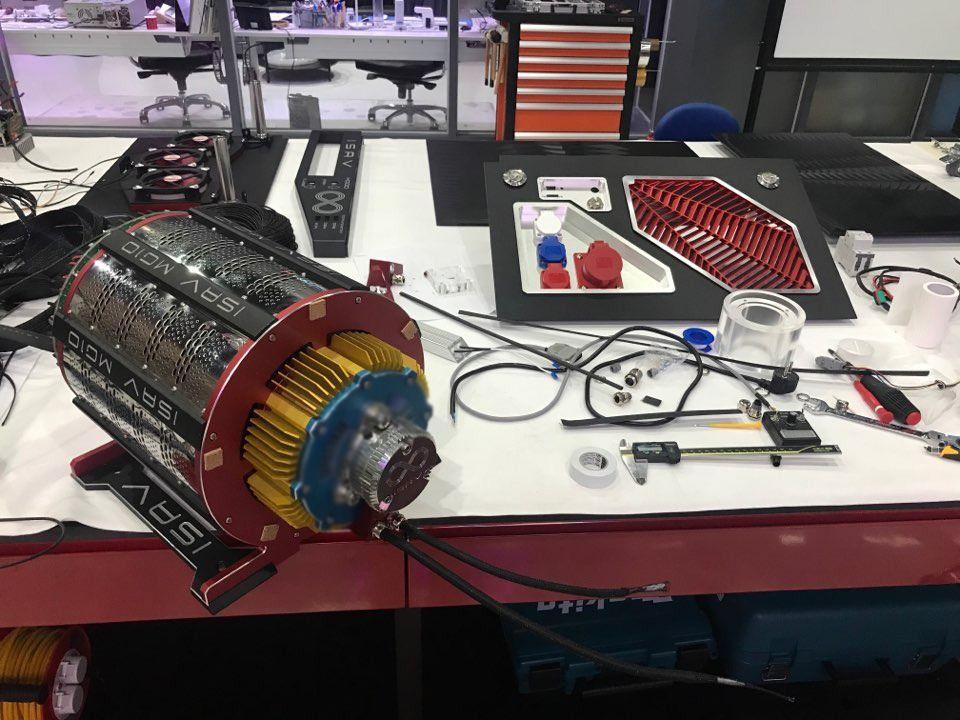
Infinity SAV, Slobodian
It becomes even more difficult when we want to assess neutrinos and other invisible energy carriers, whose origin lies far outside our planet and our perceptible time horizon, according to the law of conservation of energy. I don’t know whether anyone has ever tried to calculate the amount of energy in the universe. To me the amount of energy simply seems infinite, because the universe is known to be expanding and we do not yet have any scientifically established findings about it that we can grasp.
In my eyes, this is what makes the work of numerous scientists under the umbrella of the Neutrino Group, led by Holger Thorsten Schubart, so valuable. The team around him has demonstrably found a material composition that can convert some of these infinite, energy-carrying universal particles that pelt down on the Earth incessantly – casually speaking “as they fly past” – into usable electricity. Neutrinos and other invisible particles therefore have the revolutionary potential to create a new normal in energy generation – in infinite dimensions – at least by the human sense of time.
Neutrinos are thus a clean, infinitely usable source of energy that can be installed decentrally where it is consumed. May everyone use their imagination about what this can mean for us and our planet and look a little beyond their own horizon. I find this at least as exciting as thinking about a “perpetuum mobile”.
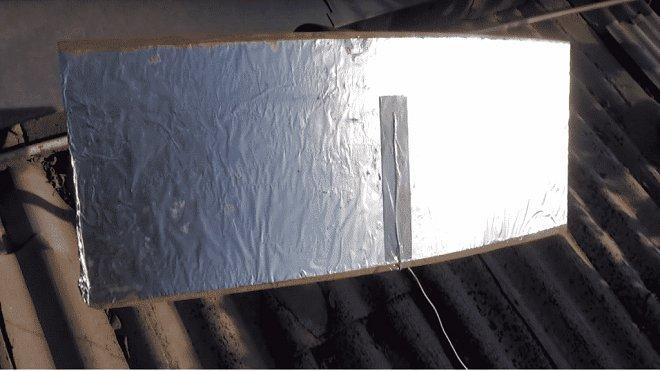
Foil with graphene
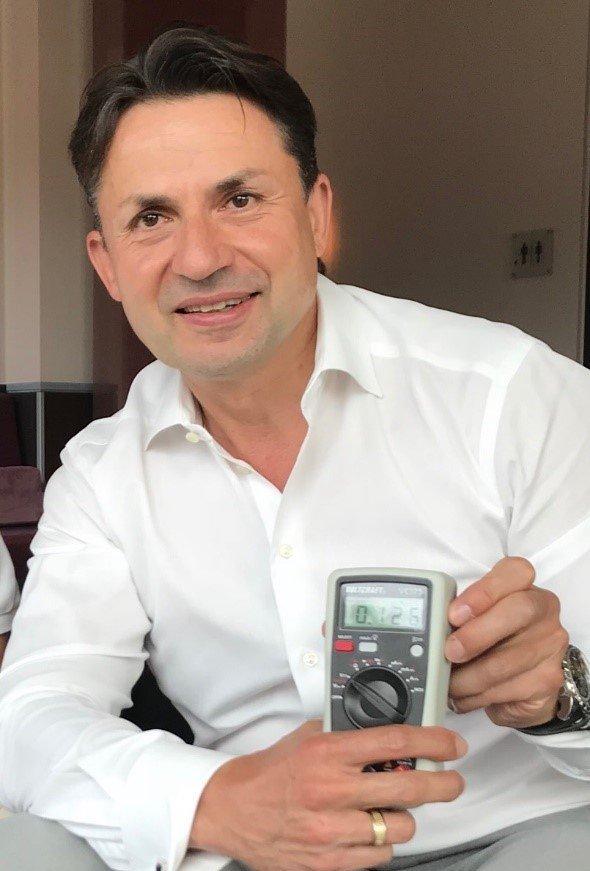
Holger Thorsten Schubart

I found the idea for these reflections here:
Notes on content provided by authors
Comments
Loading comments …
Become a member to comment publicly. GAIA members write comments in the members' portal — under their nickname, visible to everyone.