Scholé News – May 2025


Dear friends of Scholé,
Do we want war or peace? One would think that in the 21st century, given historical experience, everyone in charge worldwide would agree on the answer to this existentially important question! Peace is indeed talked about, but it cannot be meant sincerely. How else could one explain that at the same time gigantic increases in military budgets are being decided and the rearmament of nations has suddenly become a burning issue again after decades of disarmament? The representatives of the “peace project Europe” are currently calling on their member states to take on heavy debt at the expense of this and the next generations in order to become fit for war and be able to repel the imminent invasion of Russian hordes.
Whether President Putin is actually planning an invasion of Europe is questioned at least by those who, despite all warnings and bans by official guardians of truth, obtain information directly from Russia. For those in government this is obviously highly dangerous, because they have just imposed new sanctions: two German bloggers who report regularly from Russia and Ukraine, Alina Lipp and Thomas Röper, are now even being stripped of their fundamental rights as German citizens without any court proceedings. Why? Because their interviews, reports and articles from the other side of the front deny the rumour of a planned war of aggression against Europe just as firmly as the fairy tale that only Russian soldiers commit war crimes.
Propaganda lies
Every single war since 1945 – and probably most of those before – was started under false pretexts. Through false flag operations, the people were led to believe that they had to defend themselves against an inhuman enemy. The peace researcher Daniele Ganser proves this in his books and lectures on the basis of irrefutable historical documents. Wherever he appears, thousands cheer him, unless the event has already been banned by the authorities in advance. In the mainstream media, the gentle peace researcher is happily presented as a dangerous enemy of the state, because not even harassment and threats stop him from calling things by their name. Tirelessly he reminds his audience of something each of us knows in the depths of our heart:
There is no just war. No state in the world has the right to sacrifice its citizens on the battlefield. Killing a human being is always murder. Every person is part of the human family, regardless of nationality, gender, political or religious orientation. Every child understands this message. It is immediately obvious and convincing to anyone who loves peace.
Inciting peaceful citizens to the point where they are willing to murder one another on command requires targeted brainwashing. One of the most popular methods is to spread hair-raising horror stories about a group declared to be the mortal enemy. The resulting outrage is consistently stoked through constant repetition until enough people consider a violent punitive action necessary and justified. Turning recruits into soldiers who overcome their natural inhibition against killing requires targeted re-education, and before a combat mission they are often put under the influence of drugs or alcohol.
Drugs for the ordinary citizen
The drugs for ordinary citizens, who have to finance all these wars, are called national pride and a sense of belonging. Through flags, uniforms, marching music, monuments to war heroes, soldiers’ songs and moving stories of heroic campaigns from mythical times or the recent past, the false image of the just, or at any rate unavoidable, war is passed on from generation to generation against all reason. Those who take part feel morally uplifted and secure in the community of fate of those willing to fight and die for the just cause. Anyone who opposes this supposedly unavoidable narrative is branded a traitor to the fatherland, an enemy sympathiser, a crazy crackpot or a dangerous dreamer. How much longer?
In the first decades after the Second World War, the peace movement received a great boost from the atomic bomb. The fact that it had now become technically possible to wipe out the population of entire continents at a stroke made wars seem pointless. In a nuclear war there could be no winners, only losers – that was clear.
But with cunning and guile, the warmongers succeeded in the following decades in diverting the attention of the masses to entirely new war aims: the war on terror, looming wars over drinking water, war on CO2 or on pathogens. However, it is becoming increasingly difficult to maintain such narratives. The players at the levers of power can hardly keep up with their fear propaganda. Climate panic is subsiding, as is willingness to be vaccinated, and since the USA has had enough of its role as world policeman, NATO is de facto only a paper tiger.
Unwelcome diversity of voices
What no longer works as smoothly as in the good old days is the total alignment of the media that every war requires. Alongside the leading media, interested citizens now have access to an unstoppably growing number of alternative channels. They publish extremely unwelcome information – rebuttals, secret documents, studies kept under lock and key, etc. – and so far have been neither neutralised by infiltration nor by continually tightened censorship.
As a result, more and more people are learning what goes on behind the scenes and are beginning to understand how the game really works: enemy images are needed to distract from one’s own failures and crimes and at the same time to create an outlet for negative feelings. The powerful depend on staging wars in order to stay in power! It allows politicians to exert even more control over citizens, and the strongest players on the global markets earn just as handsomely from selling surveillance tools, weapons and military equipment as from rebuilding destroyed bodies, souls, towns and villages.
What does peace mean?
So wars arise when lies and enemy images are planted in people’s minds. Peace spreads when people begin to listen to their heart and feel the truth light up in their innermost being: peace means acknowledging the sanctity of life and serving it in all its forms. Peace means recognising oneself in the other:
Do not do to others what you would not want done to you.
Peace means discerning instead of judging. Preserving instead of conquering. Peace means doing everything so that people and their fellow creatures can lead a good life in freedom and self-determination here and now. Peace means renouncing once and for all the satanic lie that, for a better future, more human lives must be sacrificed, more towns and villages devastated, more and even more dangerous weapons produced and more and even more efficient control systems installed!
The miracle of forgiveness
Between war and peace lies a decisive step that, in its incalculable effects, amounts to a quantum leap: FORGIVENESS. To heal the wounds of the past and avoid relapsing into the fatal vicious circle of perpetrator – victim – rescuer, I need to forgive myself and others, because inner peace is the precondition for peace outside. Forgiveness is a blessing for others and a gift to myself. It allows me to look back on past experiences without anger and without regret.
Forgiveness frees me from identifying with the roles of perpetrator or victim, as well as from the illusion of having to rescue others. It takes from me the heavy burden of old worries and pain, gnawing feelings of revenge or false expectations. It lets me trust that the laws of the universe infallibly ensure compensating justice. It no longer puts limits on my love and thereby brings me into my true greatness and freedom as a self-determined human being. Forgiveness heals the painful separation from the divine within me and around me.
A beautiful Buddha legend tells what can happen when someone truly masters the art of forgiveness: the Buddha met an evil man who spat at him and insulted him with a smile and friendly composure. This unexpected reaction shook the man so deeply that he returned the next day to apologise for his behaviour. “I cannot forgive you,” the Buddha answered him. “The person who insulted me out of ignorance no longer exists. Before me stands a good and honest man.”
With the warmest wishes for peace, Alexandra
More Scholé news
2nd edition of “Lernen ist wie Atmen” (Learning is like breathing)
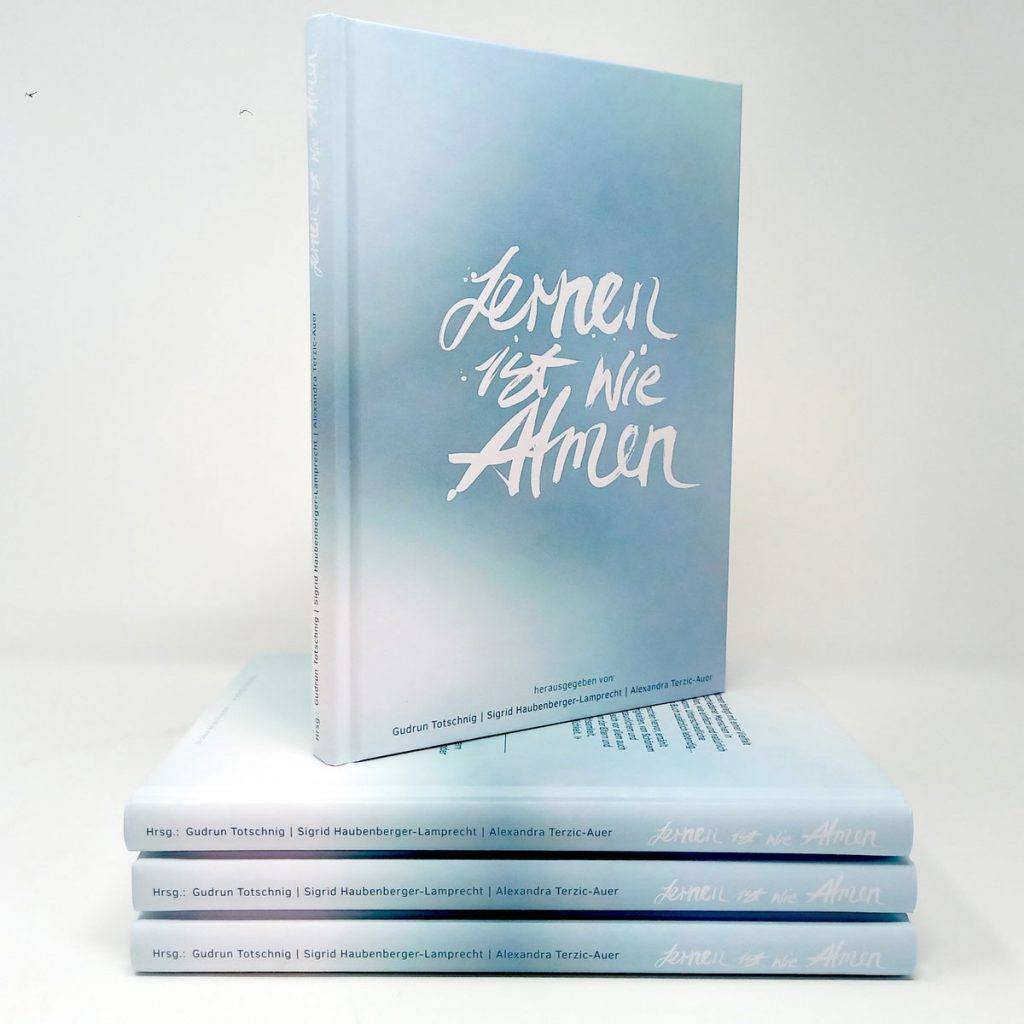
The 2nd edition of our book meets a completely changed readership.
In 2017, the idea that learning outside school was possible at all was considered the eccentric notion of a few outsiders. Since then, all parents, whether they wanted to or not, have had to deal with forms of learning outside school.
The number of children withdrawn from school has exploded since then, and alternative learning projects are springing up like mushrooms.
Buy the book (2nd ed., German)
Notes on content provided by authors
Comments
Loading comments …
Become a member to comment publicly. GAIA members write comments in the members' portal — under their nickname, visible to everyone.