Albumin carrier therapy | Against cancer


Albumin carrier therapy is a low-side-effect form of treatment for tumours, metastases and inflammation.
The active substance is coupled to albumin, a protein found in the blood, and is thus transported naturally and directly into the tumour cells. Basically, this form of therapy is based on the idea of a “Trojan horse” – it is minimally invasive and highly effective.
In the 1950s, US scientists recognised that albumin, a protein found in the blood, can be used to transport drugs into tumours. At the end of the 1990s, Dr Hannsjörg Sinn and his team at the German Cancer Research Center (DKFZ) in Heidelberg succeeded for the first time in using this carrier medically. Dr Sinn was unable to see his life’s work through to approval. We, Petra and Michael Denck, are now pursuing this goal with the private initiative Albumin-Carrier-Therapie.
Targeted therapy for tumour diseases
A tumour consists of degenerate, uncontrollably growing cells that proliferate into the surrounding healthy tissue. Tumour cells multiply very quickly and therefore need much more energy and nitrogen compounds than healthy cells. To meet this need, the cancer cells take up a particularly large amount of protein from the blood, especially serum albumin (HSA), whereas healthy cells do not.
MTX-HSA – the beginning of albumin-bound active substances
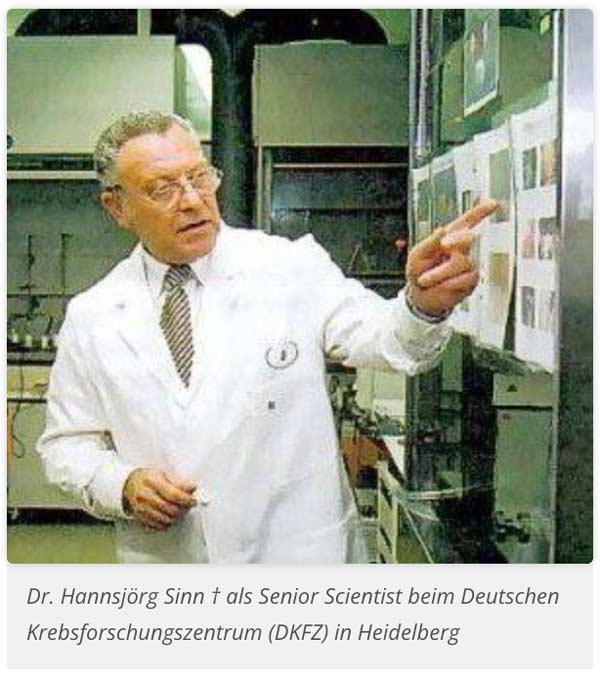 Dr Hannsjörg Sinn † worked as a senior scientist in radiochemistry and radiopharmacology at the German Cancer Research Center (DKFZ) in Heidelberg. He discovered a way of successfully coupling already approved active substances, such as methotrexate (MTX), to albumin as a carrier in order to smuggle them into tumour cells according to the Trojan principle. This ideal carrier conceals the active substance until it is released enzymatically at its destination, the tumour. In this way, the diseased tissue can be treated in a targeted manner.
Gentle and longer-lasting effect
Because the substance accumulates selectively in the tumour, the wide range of serious side effects is reduced. Thanks to the coupling in MTX-HSA, the active substance also remains in the body’s entire bloodstream for much longer. The pharmacological half-life of MTX-HSA is around 19 days. This means that MTX-HSA acts around 150 times longer than MTX administered on its own – whose half-life is between half an hour and three hours.
Effect on various solid tumours and metastases
In preclinical studies from 1996 onwards and in several clinical phase I/II studies, the albumin conjugate MTX-HSA showed a good tolerability profile and, in some of the tumour types tested (especially renal cell carcinoma and pleural mesothelioma), a tumour-inhibiting effect that could not have been expected from treatment with conventional methotrexate. No effects were seen in diseases of the blood-forming system.1,2,3,4
 Owing to restructuring at the pharmaceutical company involved, industrial approval of MTX-HSA has not been pursued to this day, according to the German Cancer Research Center on its website.5
Since albumin is returned from tissues and organs to the circulation via the lymphatic vessels and MTX-HSA behaves like natural albumin, lymph node metastases can also be reached by systemic administration of such a combined compound.
In conventional chemotherapy, pure MTX is used in combination with other drugs for various tumour diseases, for example breast cancer or cerebral lymphomas.
Inflammatory processes / rheumatoid arthritis
In the course of its research, the DKFZ team also recognised that MTX-HSA can be used successfully for inflammatory processes such as rheumatoid arthritis.
Legal basis / tumour therapy with MTX-HSA
MTX-HSA is the coupling of two substances that are already approved (methotrexate and albumin). The conjugate can be produced by pharmacies that meet the relevant requirements under the German Medicinal Products Act.
Making MTX-HSA possible as an accompanying therapy
In a phase I study in 2002, weekly application for two to three weeks appeared to be well tolerated.2 The treatment of patients has shown that administering MTX-HSA often leads to a disease-stabilising effect, without the known side effects of chemotherapy.
Intraoperative tumour diagnostics
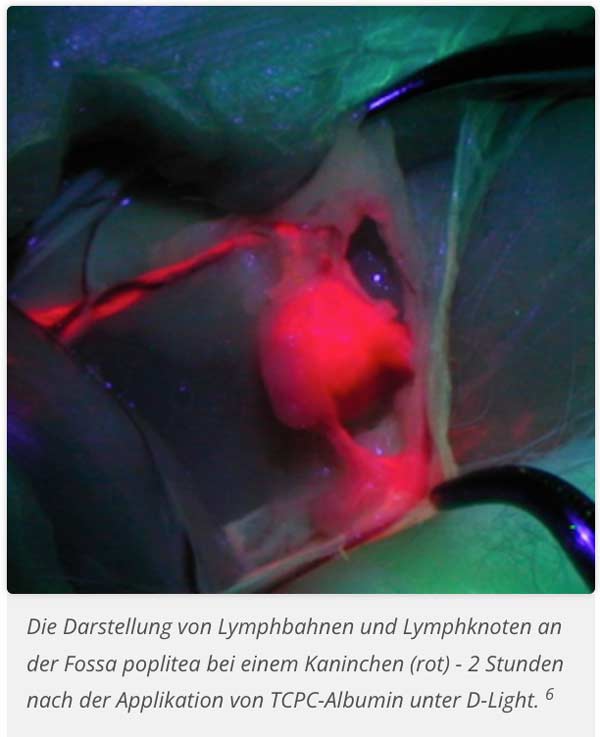
In parallel with coupling MTX to HSA, the team at the German Cancer Research Center in Heidelberg developed a method of loading albumin with fluorescent dye at the end of the 1980s. This created the possibility of positive tumour diagnostics.
An albumin-bound fluorescent dye that was investigated in a phase I/II study in intraoperative diagnostics of malignant tumours showed high contrast, little bleaching and – owing to its binding to albumin – a long intracellular residence time in the tumour.1
This fluorescence, which can be made visible with UV light, is a further option for intraoperative imaging and for monitoring during surgery. The tumour affinity of the fluorescence-HSA conjugate is visible proof that the concept of using albumin as a carrier substance works.
Favourable properties of albumin conjugates
 The dominant pharmacokinetic properties of albumin are decisive for the behaviour of the conjugates. Binding active substances to the macromolecule albumin leads to more targeted uptake in tumours. This is based on the favourable kinetics of albumin, with a plasma half-life of about 19 days3, its high accumulation in solid tumours and the importance of albumin as a tumour nutrient. As the dominant plasma protein, albumin is the most important mobile source of nitrogen and energy for tumours and inflamed tissue.
The properties typical of albumin are retained after coupling. This prevents rapid elimination of the active substances from the circulation by the reticuloendothelial system4. Like the carrier molecule, the conjugates are not immunogenic. Owing to its long presence in the bloodstream and its macromolecular structure, the conjugate can accumulate in tumours.
These pharmacokinetic advantages are responsible for making the conjugate’s alternative route of uptake into the cell much more efficient. After endocytosis, lysosomal release of the active substance inside the cell offers the possibility of bypassing conventional resistance mechanisms and specifically attacking cells with a potentially high protein requirement.
Application
Until preparations for industrial production have been completed, patients and doctors can obtain the active substances of albumin carrier therapy from pharmacies. We can recommend the pharmacy in Freiburg without reservation. MTX-HSA can be administered intravenously by any doctor in private practice (oncologist).
To expand the network, we are still looking for interested doctors and pharmacies, especially in Austria.
In the meantime, we recommend contacting the doctors and pharmacies already listed here:
(The list is constantly being extended. We hope the offer will expand quickly.)
 Zentrum für Gesundheit
Dr. Walter Surböck Hauptplatz 10 8630 Mariazell
Austria
Tel: +43 (0)660 3830 10 Fax: +43 (0)3830 4159 Email: office@gesundheiten.at
Surgery hours: Mon–Fri 8 am–1 pm
 Practice
Dr. med. Helmut B. Retzek Oberbleichfleck 2 4840 Vöcklabruck Austria
Tel: +43 (0)7672-2370-0 Fax: +43 (0)7672-2370-12 Email: heli.retzek@ganzemedizin.at
Surgery hours: appointments by arrangement
Ordering and costs
To the best of our knowledge, the costs for 50 mg of ready-to-administer MTX-HSA are EUR 200 and for 100 mg EUR 330; they are not covered by the statutory health insurance funds.
A phase 1 study found that MTX-HSA has a half-life of 19 days, so a repeat dose of 50 mg per body surface area of MTX-HSA should also be given at 19 days. Depending on the size of the tumour and its blood supply, the doctor can adjust the necessary dosage. At the time of the DKFZ studies, stomatitis was the first thing reported when the dosage had been too high.
On request, we are happy to send interested pharmacies the formula for its preparation. We are currently trying to negotiate with contract manufacturers in Germany, as the therapy is being used more and more often.
You can already obtain MTX-HSA – made according to Dr Sinn’s gentle formula – from the following pharmacy.
CareCept Versorgungsapotheke Apotheker Clements Alber e.K. Order desk: Christina Sommer
Bötzinger Str. 55, 79111 Freiburg Germany
Tel. +49 (0)761 – 611 669-0 Fax: +49 (0)761 – 611 669-11 Email: bestellungleitstelle@rieselfeld-apotheke.de
Petra and Michael Denck | About us
Why we are committed
At the end of 2015, my wife and I set up the Albumin-Carrier-Therapie foundation so that in future more patients and doctors would get to know this gentle tumour therapy and be able to use it.
We both met Dr Hannsjörg Sinn, inventor of albumin carrier therapy and biochemist at the German Cancer Research Center, in 2006. After his retirement from the DKFZ, he continued to refine his research results privately. I supported him in this and continued his life’s work after his death.
In 2013, my wife Petra then developed a malignant brain tumour. Her treatment used the drugs curcumin i.v. and MTX-HSA. This almost side-effect-free treatment led to complete remission of the tumour recurrences.
With the first donations, the foundation commissioned a legal opinion according to which individual therapies are possible under certain conditions under the German Medicinal Products Act. The Albumin-Carrier-Therapie foundation relies above all on a broad spectrum of active substances. Renowned laboratories were commissioned to couple further active substances to albumin, such as doxorubicin, curcumin and – for fluorescence diagnostics – aminofluorescein (AFL-HSA). The results of the couplings with further active substances are all positive.
All expenses up to this important milestone were financed by donations and made possible by a great deal of voluntary commitment from many supporters. Today we continue our commitment privately as an initiative.
Questions about the therapy
Link collection on albumin carrier therapy
References
- 1 Eschen N, Bauder-Wüst U, Frei E, Schrenk HH, Sinn H, Kremer P, Kiprianova I, Hartung G. Aminopterin-human serum albumin conjugate (AP-HSA): uptake and cytotoxic effects in tumor cell lines, In: Int. J.Clin .Pharmacol.Therapie, 2002
- 2 Hartung G, Kremer P, Stehle G, et al., Phase I study of methotrexate-albumin in a bi-weekly intravenous bolus regimen in cancer patients, In: Proc. ASCO 19, 2000
- 3 Phase II study to assess the efficacy and tolerability of methotrexate-albumin (MTX-HSA) in the first line chemotherapy of patients with advanced malignant mesothelioma, 2002
- 4 Vis AN, van der Gaast A, van Rhijn BWG, Catsburg TK, Schmidt C, Mickisch GHJ. A phase II trial of methotrexate-human serum albumin (MTX-HSA) in patients with metastatic renal cell carcinoma who progressed under immunotherapy. Cancer Chemotherapy and Pharmacology 2002; 49:342-5.
- 5 DKFZ, 28 May 2010: http://www.dkfz.de/de/praeventive-onkologie/pharmakologie.html, saved on 25 February 2015 (German)
- 6 Kremer, P, Albumin als Carrier zur laserinduzierten Fluoreszenzdiagnostik und Chemotherapie maligner Tumoren. Habilitation thesis, Heidelberg University Hospital, Department of Neurosurgery, 2002
Notes on content provided by authors
Comments
Loading comments …
Become a member to comment publicly. GAIA members write comments in the members' portal — under their nickname, visible to everyone.