E-Cat SKLep 2022: 100 watts from a box – once there are a million orders

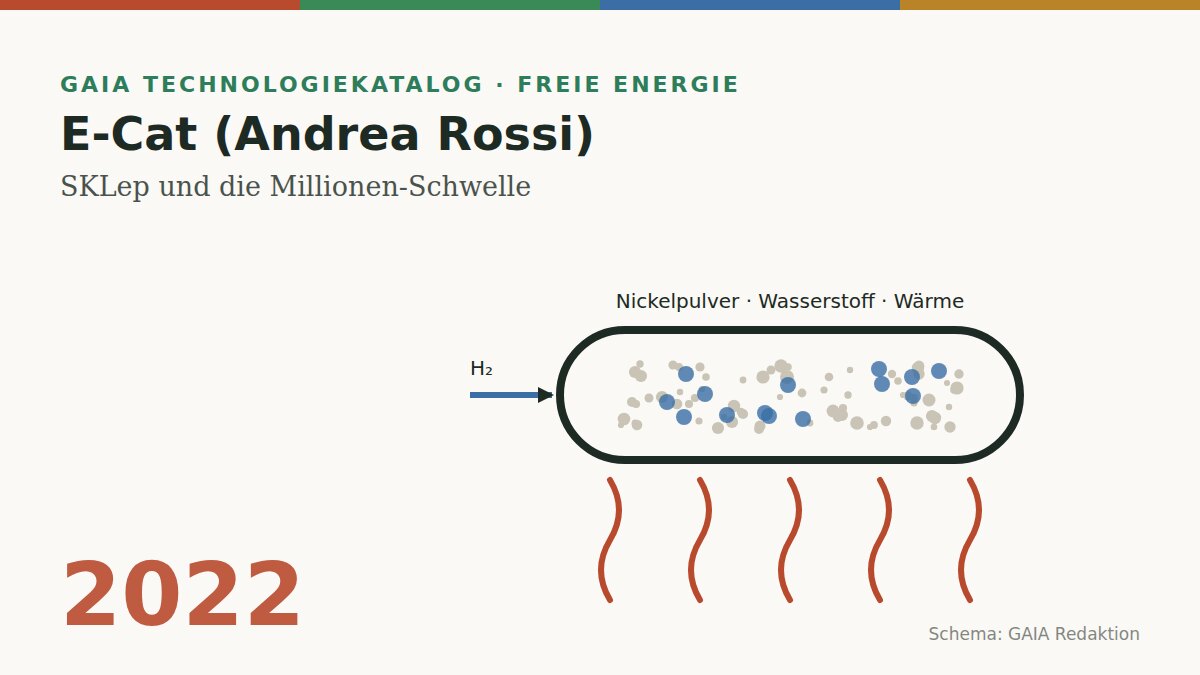
For months, Andrea Rossi, as director of Leonardo Corporation, had announced that on 9 December 2021 he would present two products for mass production. Because of the coronavirus, the presentation took place online.
Two products
The first was an LED lamp, the SKLed. According to the company, it was to produce 10,000 lumens from 4 watts of power. According to the NET-Journal, this figure could not be confirmed; nor did an analysis by the University of Bologna linked in the video support it. Demand remained low and the SKLed was soon no longer offered.
The second was a small electricity generator, the SKLep – named after the late Swedish researcher Sven Kullander; LEP stands for “Low Energy Power”. The company’s data:
- Size 7 × 7 × 9 centimetres, weight 250 grams
- Output 12 volts DC, 8.3 amperes, i.e. about 100 watts
- Input 83 milliamperes at 12 volts, i.e. about 1 watt – a power ratio of 100 to 1
- Price 250 US dollars, service life 100,000 hours, three-year warranty
The measurements at the demonstration were said to have been confirmed by Dr Giuseppe Levi of the University of Bologna. Several devices connected together were to be able to supply a household as well.
The million threshold
The condition was unusual: production would only start once a million pre-orders had been received. Five days after the presentation, Leonardo Corporation reported 100,000 orders, and around 800,000 by February 2022. In autumn 2022 the number stagnated at about 900,000.
The editors of the NET-Journal, who have known Rossi since 2011, were asked to help with the last 100,000. They found a German investor who wanted to order, and pay a deposit on, ten 1-megawatt plants with 10,000 SKLeps each. After initial enthusiasm, Rossi announced that his lawyer had rejected the investor.
Assessment
A device that delivers 100 watts from an input of 1 watt would be comparatively easy to test independently – over a long period, with open measurement of input and output. No such test took place. Tying production to a million-order threshold pushed any proof in practice into the future. And the SKLed figures, which could be checked, did not stand up to scrutiny.
The series: the E-Cat (Andrea Rossi) in the NET-Journal
- 2011: The nickel-hydrogen demonstration in Bologna
- 2018: A one-centimetre reactor in Stockholm
- 2019: Heat on lease instead of a power plant to buy
- 2022: 100 watts from a box – once there are a million orders (this article)
- 2024: The Twizy comparison in Latina
- 2025: Production plans – and what can be seen of them in 2026
Sources: NET-Journal (Jupiter-Verlag) 1/2 2022, pp. 4–7; 11/12 2024, pp. 4–5. Text and diagram: GAIA editorial team.
Notes on content provided by authors
Comments
Loading comments …
Become a member to comment publicly. GAIA members write comments in the members' portal — under their nickname, visible to everyone.