Free energy through kinetic energy and gravity


Hermann Lidlgruber’s water wheel does not work as he presented it. We tried it and we warn against it.
Obtaining energy from a water wheel is an age-old basic idea and is undoubtedly one of the greatest discoveries of Greek engineers in the fourth century BC. The idea marks a milestone in the development of technology, because the use of water power made mechanical energy usable. What if the water for the drive no longer came from the river but from a water tank?
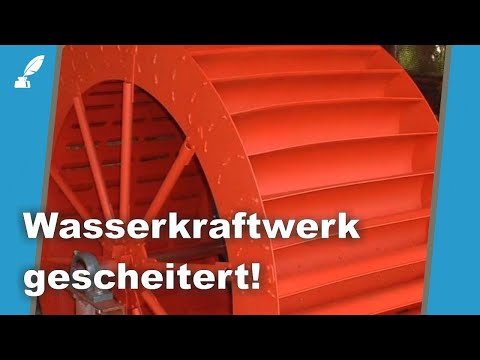
The principle
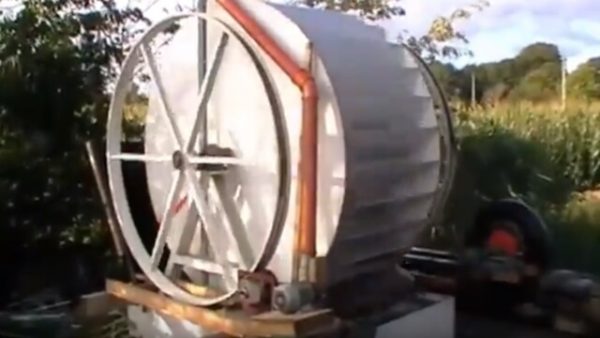
The basic idea is to use a pump to transport enough water upwards for its weight to turn the water wheel. The force must also be sufficient to drive an electricity generator. In principle, you can consider whether the pump should be driven electrically or mechanically. In both cases, a braking force acts against the water wheel – either on the generator side or on the pump side.
The requirements and the set-up
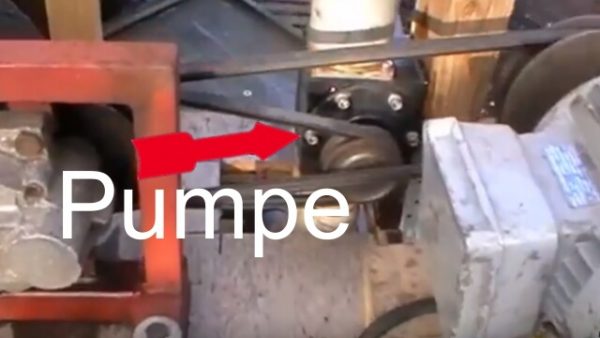
The film above shows an electric motor driving a pump. It turned out, however, that the electric motor had a very hard job with the pump. A vane pump was driven, with a plastic pipe of 100 mm diameter fitted as a riser. Via a gearbox, the pump was to reach higher speeds in order to generate the necessary pressure in the two-metre riser. The electric motor was a 3,000 watt three-phase motor started via a frequency converter. Initially, the electric motor was fed with 380 V three-phase current from the socket. Only at full speed could enough water be transported upwards for the water wheel gradually to gain momentum and drive the generator. However, the buckets were not nearly full, at most a quarter full.
The sober truth – did we make mistakes?
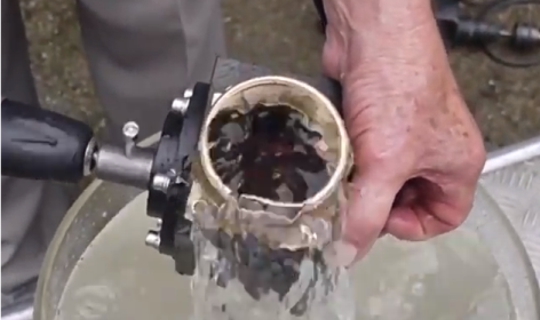
Now the generator had to show its output. The 380 volt output was connected to the electric motor’s frequency converter. Unfortunately, the system then collapsed. The force still available for the generator was too low to get any output from it. The water wheel was braked to a standstill. Even further attempts at optimisation on the mechanical side were unsuccessful, because the pump simply did not deliver enough water. At low speeds it may look as if a lot of water is being pumped. But as soon as atmospheric pressure acts against the two-metre column of water, the pumping capacity of this pump drops considerably.
The pumps
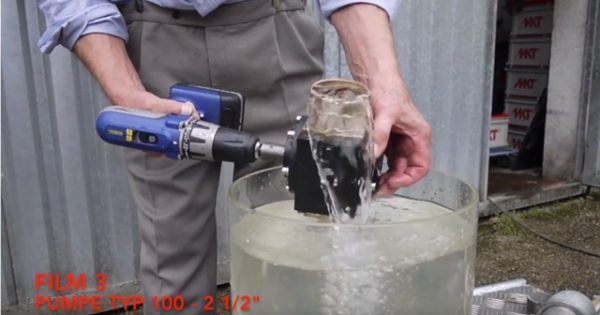
Even high speeds could not compensate for this, because water has a high moment of inertia. A larger vane pump with a diameter of 200 mm in the riser finally overwhelmed the electric motor completely, so that its windings began to scorch. A test by hand, with a crank fitted to the pump, showed the problem: the water pressure is too high. In conclusion, it must be said honestly that it is not possible to obtain electrical energy with a water wheel using these pumps. In addition, these pumps are subject to heavy wear. The rotary vanes have strong friction on the inside of the pump and in their slots. In short-term operation the pump can last many years, but not in continuous operation. It is therefore unsuitable. Another way must be found. Research continues.
Important note: the water wheel shown in this video, which drives a water pump that supplies the water wheel with water from above, does not work!!! Hermann Lidlgruber, the inventor of this idea, is a fraud and has taken large sums of money from many people with it! We expressly warn against doing business with Hermann Lidlgruber.
To the article on my website (German)
“Das geht anders – Blog für Freie Energie” (There’s another way – blog for free energy)
Notes on content provided by authors
Comments
Loading comments …
Become a member to comment publicly. GAIA members write comments in the members' portal — under their nickname, visible to everyone.