Ghost Light Observatory: Observe instead of believe

Technical transparency taken further
With “Ghost Light”, we at the Neutrino Energy Group have already created an approach to make the effect of our technology visible and comprehensible. With the “Ghost Light” Observatory we want to take this idea further: from mere visibility to long-term documented observation with measurement data, system boundaries and, in perspective, a traceable energy balance.
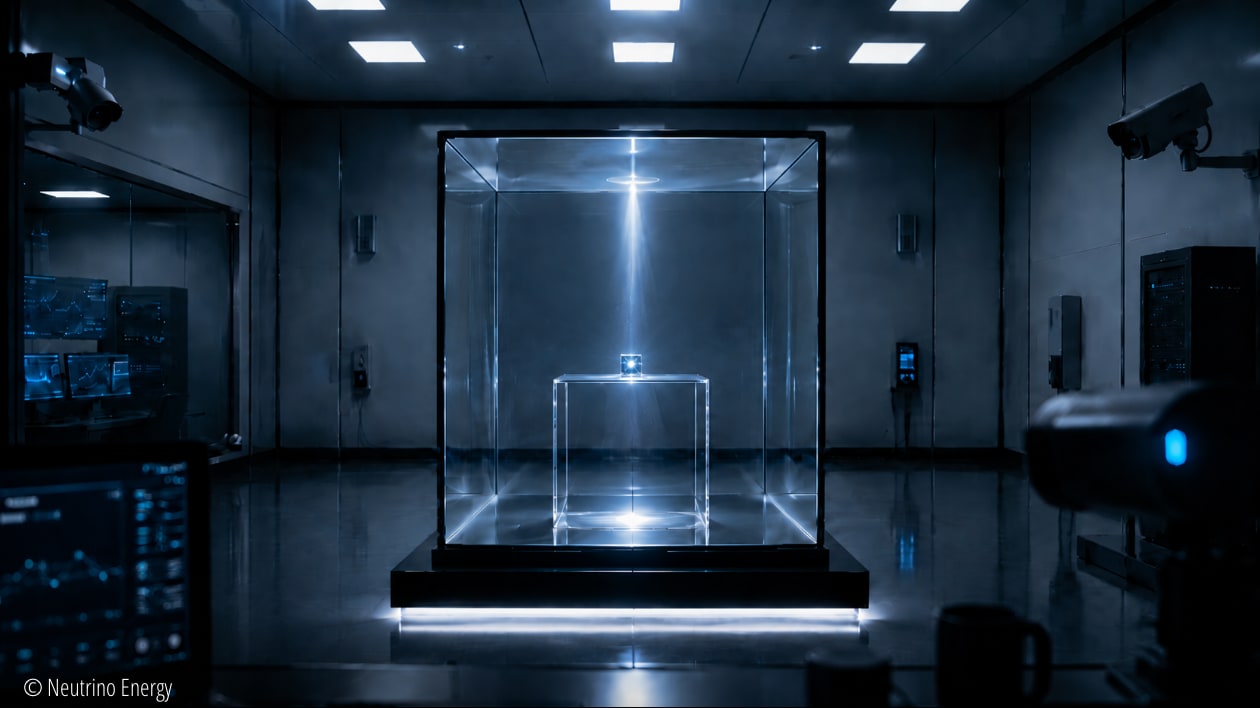
The transparent cube with its light source symbolises what, in our view, distinguishes neutrinovoltaics: making energy conversion visible where the underlying processes themselves cannot be perceived directly.
“Ghost Light” as a proof of concept
Our next possible step in developing the neutrinovoltaics project is the “Ghost Light” Observatory – a permanently operated, fully monitored and publicly accessible observation and measurement environment.
- Not as a trade-fair installation.
- Not as a staged short film.
- Not as a one-off demonstration.
But as long-term technical observation.
A sealed room with an open view
Our idea is a completely closed laboratory room under controlled conditions. At its centre is the “Ghost Light” system on a transparent glass desk, protected by a further glass enclosure.
The room remains sealed during regular operation.
- No staff in the picture.
- No presenter.
- No cuts.
- No special effects.
Permanently installed cameras & sensors enable continuous observation from several perspectives:
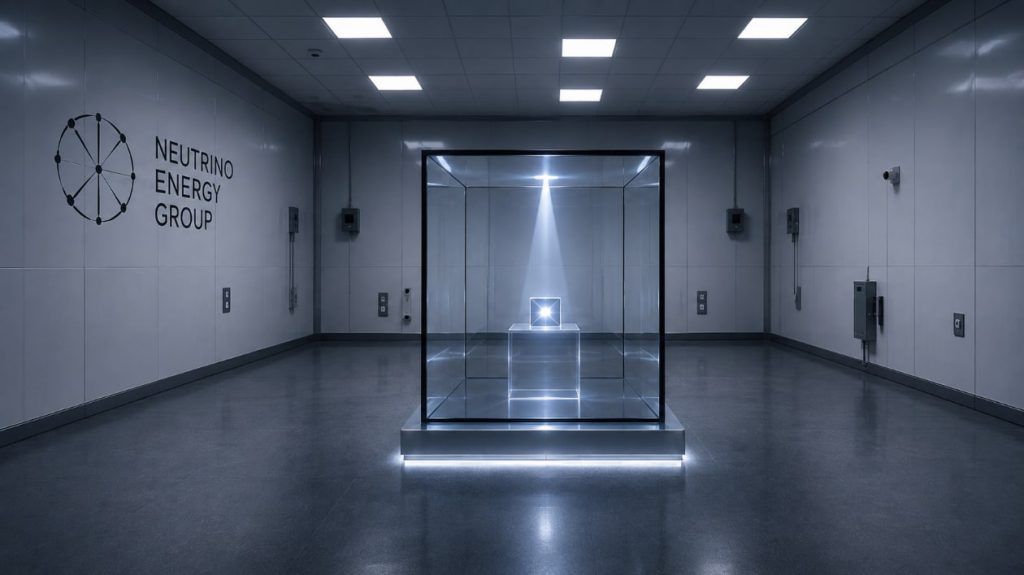
Overall view of the laboratory
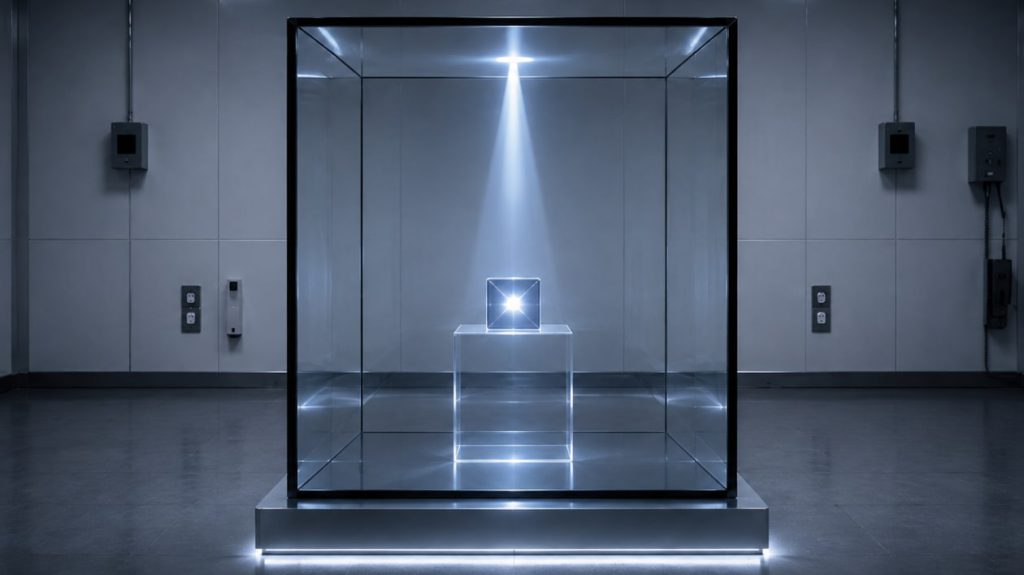
Front view of the “Ghost Light” cube
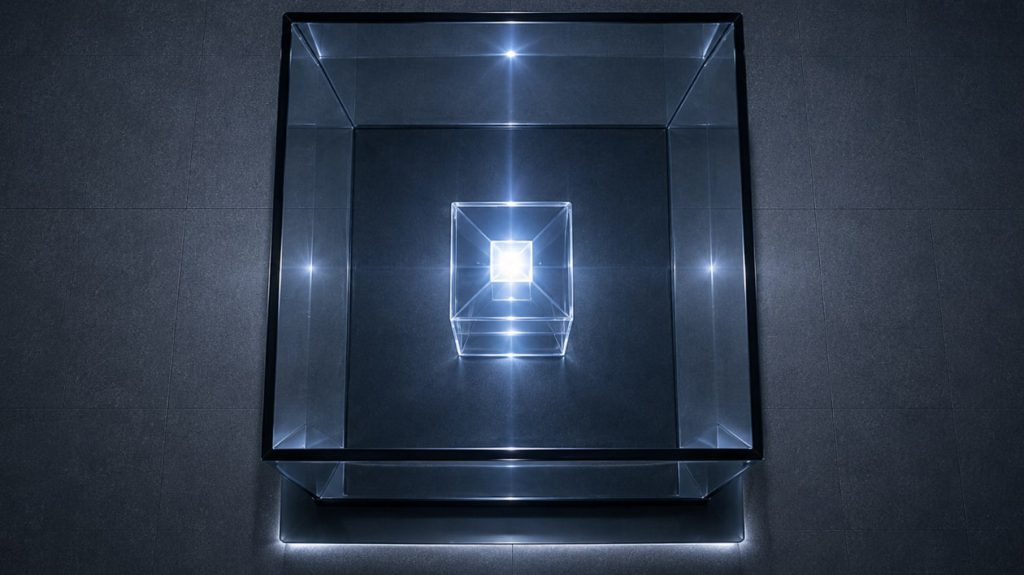
View from above
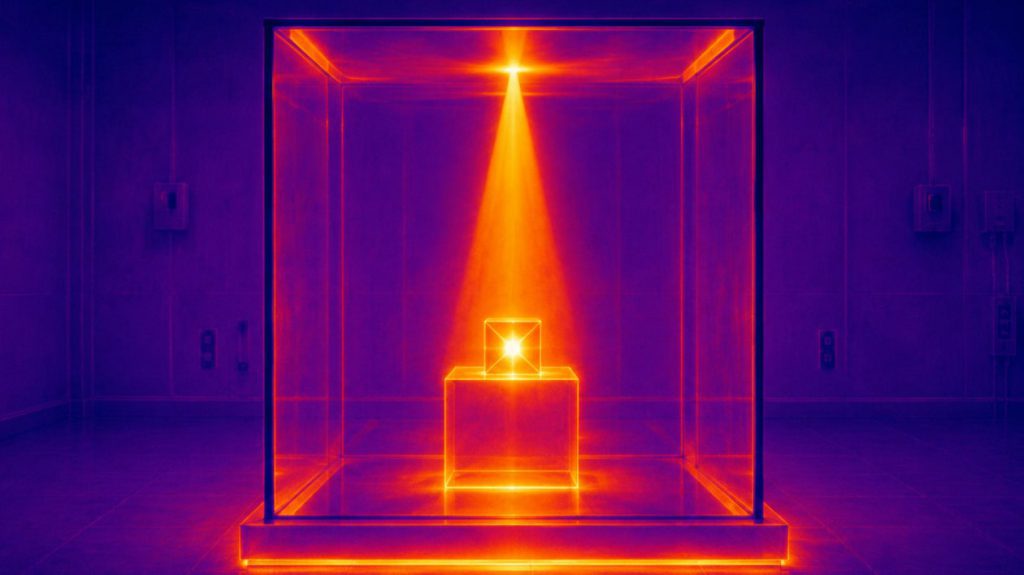
Thermographic view
From these and other ideas for planned views – such as a detailed view of the measuring instruments – the result is not a single picture but a continuously verifiable technical state.
Live data instead of a snapshot
Alongside the camera image, a live dashboard is to display the relevant operating values permanently. These include:
-
operating status of the installation
-
total running time since commissioning
-
current output voltage
-
current output current
-
electrical output power
-
cumulative electrical output energy
-
cumulative energy generation
-
documented external energy inputs
-
internal temperature in the outer glass cube
-
ambient temperature in the test area
-
humidity in the test area
-
time of the last calibration
-
time of the last maintenance
-
collection of historical measurement data
It is important to us that the measuring instruments themselves remain visible.
Viewers should not only see numbers on a screen but be able to understand where this data comes from, how it is recorded and how the measuring chain is set up.
Public integrity status
In addition to the livestream, a publicly visible integrity status could document the state of the entire experimental set-up. This would make visible not only ongoing operation but also the integrity of the observation itself. Conceivable details include:
- Room sealed since: [TIMESTAMP]
- Uninterrupted camera recording since: [TIMESTAMP]
- Measuring chain last calibrated: [TIMESTAMP]
- Last intervention in the system: [TIMESTAMP]
- Data continuity: [PERCENTAGE]
- Last independent inspection: [TIMESTAMP]
The livestream would thus also become a public technical logbook.
Time becomes part of the documentation
A technical demonstration can impress. A permanently running system can do something else: it creates continuity. With every further hour, every further day and every further month, the extent of the documented observation grows. Scientific significance does not arise from duration alone, but from the combination of continuous observation, a documented measuring chain, historical raw data, clearly defined system boundaries and a traceable energy balance. A demonstration becomes a long-term installation. A snapshot becomes a history.
For us, the main potential of the “Ghost Light” Observatory is:
A claim becomes a continuously verifiable state.
The decisive question is then no longer just: “Does the system light up?” But: “Where does the electrical energy measured over weeks and months come from?”
Independent supervision as a further step
A livestream alone does not replace scientific testing. That is why, for us, this concept also includes the possibility of independent supervision. It is conceivable that external scientists, experts or testing organisations document the experimental set-up and check it regularly. This includes in particular the electrical wiring, possible external energy paths, the defined system boundaries, the measuring devices used, the calibration procedures and the integrity of the historical measurement data. Changes to the set-up should also be logged traceably.
Our goal is not to demand trust through words. Our goal is to make observation possible.
Our approach: transparency instead of staging
Technological innovation is always under scrutiny – especially when it challenges existing ideas. We do not see this as a disadvantage. On the contrary. If a technology is to convince in the long term, it must submit to observation.
This is exactly where we see the real potential of the Ghost Light Observatory.
Conventional communication about technologies often follows the principle:
Trust us.
Our approach is meant to be different:
See for yourself.
Outlook
The Ghost Light Observatory is currently a concept and a vision for the next stage of our communication and demonstration. It combines three things that belong together for us:
Technology, measurability and transparency.
Implementing this concept would not just be a showcase for “Ghost Light”. It could become a permanently accessible technical observation station through which people worldwide can follow operation, measured values and system integrity themselves.
Conclusion:
The “Ghost Light” Observatory – a concept suggested by GAIA – stands for an approach that we at Neutrino Energy want to pursue consistently: not only explaining technical innovation, but making it permanently observable and comprehensible.
No need to believe. Able to observe.
Notes on content provided by authors
Comments
Loading comments …
Become a member to comment publicly. GAIA members write comments in the members' portal — under their nickname, visible to everyone.