Prototype of a wave power plant


How more electricity can be obtained from the sea
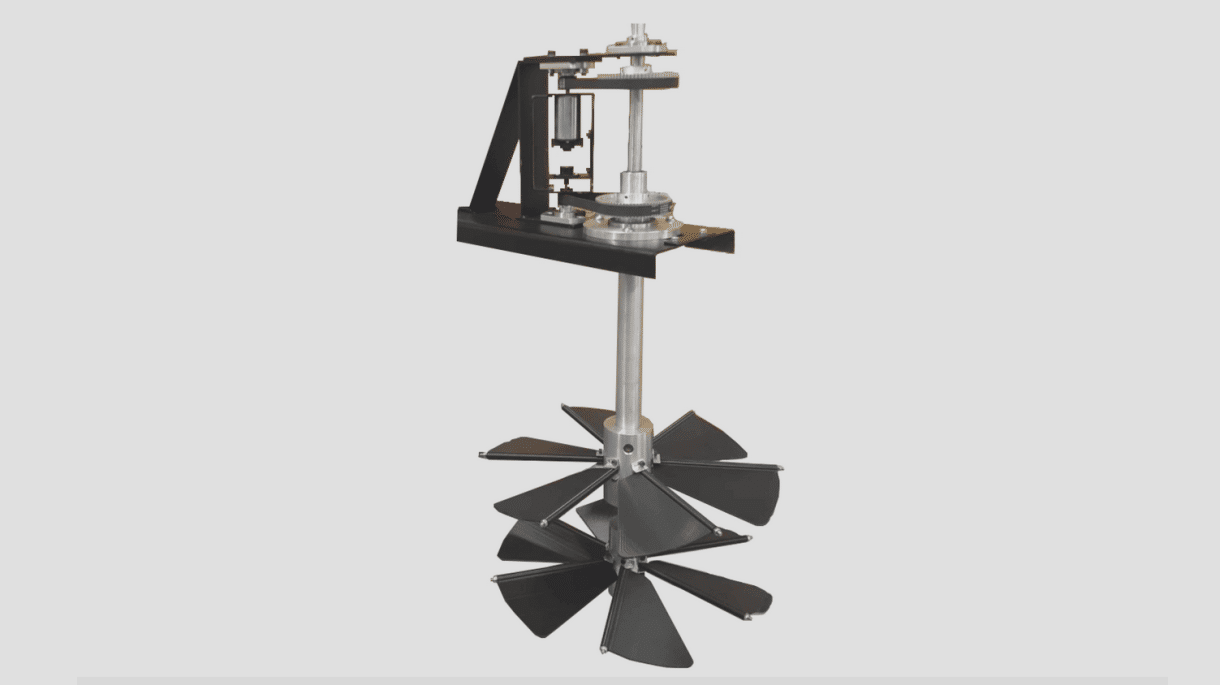
A small prototype of a wave power plant with two counter-rotating propellers achieves a very respectable efficiency in the laboratory.
(Image: RMIT University)
Waves strike the coasts along the oceans incessantly. Their kinetic energy is large enough to cover – purely mathematically – about a tenth of electricity demand in Europe alone. Numerous concepts and prototypes for ocean wave power plants have already been developed. But so far nobody has made the leap to series production.
Point absorber gains more power
Australian scientists from the Royal Melbourne Institute of Technology are now pursuing a new approach to low-maintenance and powerful wave power plants. Initial laboratory tests show that their type of so-called point absorber could generate twice as much electricity as previously designed wave power plants.
A buoy floating at one point forms the heart of many wave power plants. In them, a buoyant body is moved up and down by the wave motion. This movement can drive a generator via a simple gearbox, which produces electricity around the clock. Xu Wang and his colleagues also use a buoy, in which they installed a generator – safely shielded from the seawater. But it is driven by two counter-rotating propellers that dip into the wave-moved water on a double axle. The upper propeller is firmly connected to the rotating axle sleeve, the lower one to a second axle integrated into this sleeve. In this way, both directions of rotation can be used simultaneously to drive the generator.
Laboratory tests successful
“Thanks to these two counter-rotating turbine wheels, the prototype can double the electricity yield from ocean waves,” says Xu Wang. This makes ideal use of the vertical flow movement within a wave. So far, however, the prototype is of modest size. The propellers have a diameter of just under half a metre. With buoy and generator, it weighs a little over 13 kilograms in total. But it was sufficient for first tests in a small wave tank in the laboratory. The prototype worked best at a wave amplitude height of 80 millimetres and, with an output of 25 milliwatts, achieved a remarkable efficiency of almost twelve per cent. What sounds like little is extremely respectable, as these are small-scale laboratory results.
“The next step is to scale up this technology and test it under real conditions in the ocean,” says Wang. Such a pilot plant could consist of propellers many times larger on a buoy roughly the size of a person. Wang is now hoping for investors from industry in order to venture out of the laboratory. Then it will be decided whether the concept of counter-rotating propellers really could lead to more efficient wave power plants.
Copyright: heise.de
Notes on content provided by authors
Comments
Loading comments …
Become a member to comment publicly. GAIA members write comments in the members' portal — under their nickname, visible to everyone.