AMO cycle: Are PV and wind yields shifting?


The Atlantic helps determine our energy yield
The energy transition is mostly discussed in technical terms: more photovoltaics, more wind power, more grids, more storage. But one central question often remains in the background: how stable are the weather and climate patterns on which the expected yields are based? This is where the Atlantic Multidecadal Oscillation, or AMO for short, comes into play. It describes long-term fluctuations in sea surface temperatures in the North Atlantic.
Research often also speaks of Atlantic Multidecadal Variability (AMV), because it has not been conclusively clarified whether this is a genuine, regularly recurring oscillation or a complex interplay of various climate factors.
The core remains relevant nonetheless: over decades, the North Atlantic shows warmer and cooler phases. UCAR/NCAR describes the AMO as coherent natural variability in the North Atlantic with an estimated periodicity of around 60 to 80 years. NOAA also points out that the AMO is linked to changes in precipitation in North America and Europe, droughts and the intensity of Atlantic hurricanes. At the same time, it is scientifically disputed how cleanly an independent AMO signal can be separated from the forced global warming signal.
For energy planning, this uncertainty is no reason to ignore the topic. On the contrary: if the North Atlantic moves into a different phase in the coming decades, wind, cloud cover, precipitation and solar radiation may also shift. It is precisely these factors that determine the real yields of photovoltaics and wind power.
The course of the AMO: a background signal
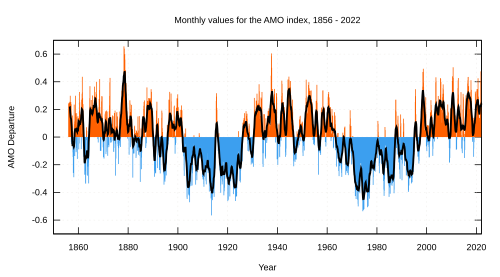
Historically, AMO data show a recurring pattern: a cooler phase around the early 1900s, a warm phase from the 1930s to the 1950s, a cooler phase in the 1970s and early 1980s and a renewed warm phase from the mid-1990s into the 2010s.
The last pronounced AMO minimum was around 1978. The most recent maximum is likely to have been in the 2010s. If this historical rhythm continues, a transition to a more neutral or cooler AMO phase could emerge in the 2030s. A possible next minimum would then be closer to the middle of the century.
This is not an exact forecast. Climate cycles do not run like clockwork. Individual years can still be very warm. The North Atlantic itself has also been exceptionally warm in recent years. What matters, therefore, is not the claim that it will now simply get “colder”. What matters is the question of whether the yield patterns of weather-dependent energy sources can change.
The critical factor: not just the sun …
Photovoltaics is often regarded as a relatively predictable source of energy. The daily and seasonal path of the sun is known, the technology is mature and the yield models are well developed. Nevertheless, real PV yield depends significantly on cloud cover, aerosols, humidity and temperature.
High temperatures can reduce the output of PV modules, while heavy cloud cover reduces irradiation. A Nature study on climate extremes and PV yields explicitly names high temperature and clouds as factors that can worsen the electricity yield of photovoltaics.
A possible AMO shift could therefore have several consequences for Central Europe. If large-scale weather patterns change, cloud cover and precipitation patterns could also shift. A cooler AMO phase could contribute to different westerly weather patterns, wetter periods or more changeable weather in parts of Europe. For PV this would be particularly relevant in the winter half-year, as yields in Austria and Germany are low then anyway.
In summer, a cooler or more changeable phase could lower module temperatures, which would be slightly advantageous technically. But this advantage would be limited if there is more cloud cover at the same time. For security of supply, what counts is therefore not only the annual yield, but above all the question: when is the yield produced?
A PV system that delivers high surpluses in summer does not automatically solve the winter problem. If an AMO shift favours wetter, cloudier or more changeable winter patterns, the seasonal difference between summer surplus and winter shortage becomes even more important for the energy industry.
Wind power: even more dependent on large-scale weather patterns
Wind power reacts less to temperature, but all the more strongly to pressure distribution, storm tracks, the position of the jet stream and regional circulation. Even small shifts in the North Atlantic atmosphere can have major consequences for wind speeds and wind power yields.
This means: a changed AMO phase would not automatically make wind power worse or better. It could shift yield areas. Some regions could experience windy conditions more often, others calms more often. North-western and Central Europe are particularly sensitive here, because many wind patterns are shaped directly or indirectly by the North Atlantic.
This question is particularly relevant for offshore wind in the North Sea and near the Atlantic. Installed capacity can continue to rise, but firm capacity remains weather-dependent. If storm tracks shift or longer periods with little wind occur more frequently, the real system requirements change. Then it is not enough to look only at average annual production.
The decisive question is: how often do longer periods with little wind occur, and do they coincide with low PV production?
The core question
Dunkelflaute: the real stress test
The most problematic case is not a single weak day. The real stress test is the “Dunkelflaute” (dark doldrums): longer periods with little wind and little sunshine. They are particularly significant in winter, when PV yields are low and electricity demand remains high due to heating, lighting and industry.
Recent research on European dark doldrums describes such phases as a central challenge for climate-neutral energy systems based on variable wind and solar energy. A study of 38 historical weather years showed that the characteristics of such events depend strongly on the chosen threshold. Particularly extreme events can determine longer discharge phases of long-term storage. For a perfectly interconnected Europe, the extreme event of winter 1996/97 was given as 55 days; the average availability of the renewable portfolio was still 47 per cent of the long-term average.
These figures show two things. First: spatial interconnection and a mix of wind and solar help. Second: even a large, well-connected system remains dependent on storage, reserve capacity and flexible demand.
An AMO shift would not necessarily intensify these dark doldrums, but it could change their regional and seasonal patterns. That is exactly why historical yield years, long-term climate cycles and extreme events must be considered together.
The mistake in thinking: simply extrapolating the yields of the warm phase
Many expansion plans for PV and wind are based on weather and yield data from past decades. But these decades lay largely in the modern warm phase of the North Atlantic. If this phase is not representative of the coming decades, yield assumptions can be systematically distorted.
This does not mean that PV and wind power are unsuitable. It means that they must not be planned as static quantities. A plant with a certain annual yield on the historical average may in future show different seasonal profiles, different fluctuations and different extreme risks.
For robust energy planning, the following is therefore decisive:
- Annual yields are less important than availability in critical weeks.
- Summer surpluses do not replace a winter strategy.
- Wind and PV expansion needs long-term storage, controllable consumers and regional reserve concepts.
- Climate cycles such as AMO/AMV should not be ignored in yield and grid models.
Conclusion Energy autonomy needs climate realism
The AMO cycle is no proof of coming global cooling. But it is a serious indication that the North Atlantic can change its patterns over decades. For Europe, this means that the yield patterns of photovoltaics and wind power can also shift.
A responsible energy transition must therefore not only count installed capacity. It must secure the weak phases. What matters are storage, decentralised structures, local energy communities, controllable loads, emergency power capability, hydropower, biomass, thermal storage and a realistic approach to dark doldrums.
This is the central point: PV and wind can be important building blocks of a free energy future. But they must not become a new dependency if they are planned without storage, without regional resilience and without regard to long-term climate cycles.
Independence does not come from maximum feed-in on ideal days. It comes from security of supply in those weeks when sun, wind and weather do not deliver what models promise on average.
Our conclusion
Notes on content provided by authors
Comments
Loading comments …
Become a member to comment publicly. GAIA members write comments in the members' portal — under their nickname, visible to everyone.