Scholé news February 2018

Dear friends of Scholé, for some time now I have been thinking hard about how we could get unschooling legalised.
The new government’s announcement that it will bring back marks from the first year of primary school has now confirmed what had already become apparent in conversations and constellations:
This is not only about unschoolers, but, in a much more general sense, about EDUCATIONAL FREEDOM, because that is the only way to take account of the diversity of different needs and circumstances.
My heart still beats for the unschoolers, because it was among them that I came to know the most essential thing: unconditional respect for the child and its natural impulses. But many parents and teachers are also on the way to self-determined living and learning, working with great personal commitment in all kinds of progressive schools. Is it not time for ALL those inside and outside the school system who have a different vision of living with young people than training them to be functioning subjects to stand up together for the HUMAN RIGHT to free education?
INITIATIVE FOR EDUCATIONAL FREEDOM
We live in a time of upheaval. Nobody can predict which qualities, knowledge or skills will be particularly important in the world of tomorrow. If anyone has intuitive antennae for future developments, it seems to be young people themselves! Many of today’s younger adults are a convincing example: even as children they were far more skilled with electronic media than their parents and teachers. Who taught them these skills? Nobody! They developed them themselves through play, thrilled by the experience of their own power – they were born “digital natives”! With tireless curiosity they explored everything such a device could do, swapped experiences with each other and patiently tried to explain the simplest functions to slow-witted adults…
Unschooling parents have similar experiences in every field: their children need no instructions at all, only attentive support for their own projects. With the sureness of a sleepwalker they always find the right fields to experiment in, where, following their individual inner plan of development, sometimes alone and sometimes with others, they can gradually live out all their talents and gifts in playful earnest.
The curricula of mainstream schools have traditionally put the main emphasis on training the intellect. More and more scientists and practitioners are recognising, however, that this is not enough. Progressive schools have many years of experience with a more holistic understanding of education, which is why, for example, demand for Montessori classes or schools keeps rising even within the mainstream system.
But if such progressive schools are to develop their methods further for the common good – or return to their roots – they urgently need freedom of action instead of ever more restrictive regulations!
In alternative and state schools alike, many committed teachers are already focusing on appreciating what is there or has been achieved instead of shaming children by hunting for mistakes. The “Stärkenschatzsuche” (treasure hunt for strengths) developed by a Viennese teacher at a compulsory school, for instance, will soon be freely available as an app to all interested educators.
So there are growing signs of a fundamental change in the education system (“Schule im Aufbruch”, potential-focused teaching and many other initiatives). But this change is also calling up opposing forces, as the measures planned by the new Austrian government (numerical marks from the first year of primary school and so on) prove. Our hope: that this will finally set in motion the long-overdue resistance of civil society…!
OUR VISIONS
- A CIVIL-SOCIETY INITIATIVE CAMPAIGNING FOR COMPREHENSIVE EDUCATIONAL FREEDOM IN LINE WITH HUMAN RIGHTS AND ON THE MODEL OF THE ENGLISH-SPEAKING COUNTRIES, where the free choice between state school, private school, free school or unschooling has always been an inviolable civil right, and where the work of alternative educational institutions is not hampered by state requirements. Perhaps we might even manage to include Germany and Switzerland…
- NO EXAMS DURING THE PHASE OF EDUCATION Free education means ALLOWING and valuing the natural, self-directed PROCESS OF GROWTH in each individual child, instead of using comparisons and assessments to create a fictitious ranking that is incompatible with the dignity of EVERY child. Setting general performance targets and marking children on how quickly and perfectly they reach them is, seen in this light, utterly absurd: what serious gardener would think of setting his plants performance targets and then holding THE PLANTS responsible for whether they meet these targets very well, well, satisfactorily, adequately or inadequately?! If a gardener is dissatisfied with a plant’s “performance”, he can at most ask himself whether it was the weather, or whether he himself made mistakes in choosing the soil, sowing, watering, fertilising or harvesting?! And you don’t have to be a gardener to know that it is no use pulling at a blade of grass to make it grow faster – you will only damage it… How much more complex and unpredictable than the development of a plant is the development of a child! What adult could presume to steer and judge it?
- EXTENDING EXISTING APTITUDE TESTS OR ENTRANCE EXAMS FOR YOUNG PEOPLE AT THE START OF THEIR TRAINING Once the sensitive phase of education – which serves to discover and develop individual aptitudes – is over, a young person will sooner or later express the wish of their own accord to begin TRAINING for something. Only then, in our view, do exams – in the form of aptitude tests or entrance exams – make sense! Such tests may well make high demands on candidates for a profession or a course of study, but it should be possible to retake them as often as necessary.
- SOLIDARITY IN A COMMITMENT TO DIVERSITY A single form of education that meets all the demands of parents and children is simply inconceivable, given our ever-growing individual differences. The diversity of people and of their personal circumstances requires a diversity of possible educational paths. We therefore ask all supporters of alternative educational settings – whether Waldorf, Montessori or free schools, the Weinbergschule, home educators, unschoolers, perhaps even open-minded representatives of mainstream schooling – to put aside what divides them! Everyone who is willing to take responsibility for their children’s education themselves should stay with the model that is currently closest to their heart, or to which the children themselves feel most drawn! (Such preferences may of course change over time, since a human being is not a lifeless object but a living PROCESS!) At the same time, though, PLEASE let everyone remember what UNITES them: the wish for genuine freedom of method, for independence from restrictive, educationally questionable requirements or harassment – and the commitment to diversity. The more peacefully and cooperatively the various individuals, alternative schools and unschooling movements support each other and share their experiences, the richer, more beautiful and more surprising the blossoms and fruits that the longed-for EDUCATIONAL FREEDOM could bring forth!
Anyone who would like to join this initiative or contribute something is warmly invited to do so!
Please raise the subject of educational freedom among the people around you, because I am sure that a great many people – young people, parents and grandparents – can relate to it! Democracy cannot be imposed by decree; it rests on the personal commitment of many individuals willing to cooperate. And a democracy truly worthy of the name begins with the right of all people to self-determination, regardless of their age.
Everything still lies frozen under ice and snow, which makes the anticipation of the thaw all the greater, Alexandra and the Initiative for Educational Freedom
Now I am asking for your support! Please leave your opinion on the initiative as a comment, or send registrations, comments and suggestions to me by email with the subject “Initiative für Bildungsfreiheit”.
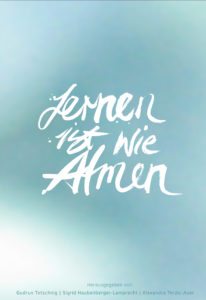
Book tip – “Lernen ist wie Atmen” (Learning is like breathing)
Together with two unschooling mothers, Gudrun Totschnig and Sigrid Haubenberger, we published it ourselves.
We all feel that the time is ripe for this many-voiced account of how unschooling can be lived in practice. Let the reading sample inspire you, or order your own copy on the GAIA marketplace, with a 10 % discount for members. The book is in German.
Notes on content provided by authors
Comments
Loading comments …
Become a member to comment publicly. GAIA members write comments in the members' portal — under their nickname, visible to everyone.