Scholé News – November 2023
“I don’t know what to do any more!”
“My six-year-old daughter is wearing me out. When something at school doesn’t suit her, she flips out. She becomes aggressive! The teacher has summoned me yet again because she threw a pen in another child’s face. Now I have to give at least two phone numbers of people who can come and pick her up immediately if something like that happens again …” Worrying diagnoses are in the air: autism spectrum? ADHD?
The little girl is in despair: she was only defending herself against the girl sitting next to her, who was interfering yet again because she was supposedly doing something wrong while writing. And a few days ago she had to stand up for a classmate who was being bullied in an underhand way by two others. But the teacher never believes her. Yes – because, unlike the child, she does not listen to her heart but judges by appearances, the teacher, like so many, mistakes vigour for aggression!
The little one is the youngest in the class, her mother explains. Because the child cannot sit still, she had applied for another year of pre-school anyway. But the authorities decided that the girl had to start school, since she turned 6 shortly before the school year began and had passed the school entry test well. The kinesiological test confirms that there is nothing at all wrong with the child. On the contrary, she has more than others: more self-esteem, more perceptiveness, more sense of justice, more compassion. She is highly sensitive!
I could tell you about many far more dramatic cases. I say “cases” because high sensitivity is still regarded as a mental disorder, a pathological deviation from normality. An army of psychiatrists and school psychologists is paid to adapt highly sensitive children to the norm, to make them fit for school. But mostly high sensitivity is not recognised as such at all; instead it is defined as a physical or mental illness on the basis of whatever “symptoms” appear. Lately, progressive therapists have been suggesting more and more often that the young person feels unwell because he is in the body of a boy although he feels like a girl, or vice versa … A diagnosis with dramatic consequences!
Do you remember the poster campaign in support of “butterfly children” (children with epidermolysis bullosa)? Striking images made it clear to the viewer what the normal world feels like to a butterfly child: the woollen jumper like a grater, the teddy bear like a porcupine, the crayons like thorny rose stems. I think it is high time for a similar campaign in support of highly sensitive children! They are not aggressive; they act out of self-respect and an intact sense of justice. They do not need therapy – they are the most sensitive and mentally healthiest among us! These children are our greatest hope for the future! For good reason, they cannot bear the world as it is! Let us finally listen to them when, through their silent or loud protest, they draw our attention to how inhuman our society really is!
No animal would wrench its young out of sleep unless they were in danger. The organism of a small child who is jolted out of sleep releases exactly the same stress hormones as that of a young animal woken by its mother because it has to flee in haste from an immediate danger! For the young animal this happens only very rarely, and it can break down the stress hormones straight away through the physical effort of fleeing. But what about a child who is regularly woken up to be taken to the crèche, the kindergarten or school on time? How much longer do we want to accept such cruelty with a shrug, without regard for the physical and emotional consequences?
Every child comes into the world with its own individual inner plan of development. But very soon it is forced, with more or less gentle violence, to leave its own path and take the path prescribed for all children. There it is assessed at every turn, compared with others, praised or reprimanded. To survive socially, it has to put its own needs aside, forget its own interests and adapt to the ruling majority. How much longer can we afford to sacrifice the creative potential of the youngest generation to an outdated system? Will the highly sensitive children manage to resist until enough parents finally understand what is really going on?
How do you recognise highly sensitive people, and what do they need? They are people who – still or once again – are connected to the source. They live in the awareness of their connectedness with everything alive, which is why they rejoice with the joyful and suffer with the suffering, be they people, animals or plants. Every thoughtless word can strike them to the heart; every loving gesture can heal them and give them wings. They know exactly what is good for them – which food, which people, which activities, which books or films. They also sense what others really need. Our hectic, noisy consumer world disturbs them, because most of them need peace and quiet, are sensitive to noise and need very little to be happy.
If our social life were shaped by highly sensitive people, we would soon have no more destruction of nature, no wars, no pandemics, no concentration of power and money in the hands of a few. All the institutions under whose “protection” we live today would dissolve quite naturally. Anonymous institutions relieve us humans of thinking, feeling and acting on our own responsibility. Ostensibly they serve the common good, but on an invisible level they are used by nameless string-pullers as instruments for influencing people unnoticed. These manipulation strategies work so well that the same people who speak of worrying aggressiveness when a six-year-old throws a pencil at another six-year-old accept hundreds of thousands of war victims without protest!
To the extent that we allow ourselves to be turned into passive objects of state administration and welfare, we lose awareness of our human greatness, our connectedness, freedom and self-determination. Humanity cannot be institutionalised! But anyone who has realised this and wants to actively take responsibility for the world around them must, for the time being, still be prepared for strong headwinds. Parents who cannot bring themselves to hand their child over to an educational institution against its will can testify to this. So can critical doctors who do not follow the guidelines of conventional medicine. Independent farmers who try to survive economically without meeting the restrictive conditions for state subsidies. Scientists who dare to engage with taboo subjects, and so on.
If education and the media were in the hands of highly sensitive people, all our eyes would be opened. We could clearly see what a crime it is to forcibly keep children from the natural unfolding of their potential and to call this “safeguarding the child’s welfare”. We would understand that so-called “protective vaccinations” are just a booming business for the pharma mafia. And that every medical intervention, however small, that is not really necessary for our well-being amounts to a robbery: to keep the laboratory, the hospital, the doctor’s practice and the luxurious life of the chief physician running, minor to fatal injuries or poisonings of patients are accepted! As a matter of course, without a guilty conscience, because most people are incapable of recognising psychopathic behaviour as such when it has made itself invisible and unassailable in the guise of state or scientific institutions …
At present only a few highly sensitive people see through the structural violence on which the power of state, church and international institutions such as the EU, the UN or the WHO rests. Their task is to expose the strategies of those in power and to uncover hidden connections. Other highly sensitive people have chosen to live love and closeness to nature in small communities. Others again already interact quite naturally with the spiritual world and thereby broaden our horizon. Highly sensitive engineers do not let themselves be stopped from working on inventions that will make us energy self-sufficient in the future. Highly sensitive therapists explore the interplay of body, mind and soul and thus arrive at a completely new, dynamic image of the human being. Highly sensitive artists leave the art reservations of galleries and museums because they would rather enrich the everyday world of their fellow human beings. Highly sensitive scientists devote themselves to fields of research that were taboo for a long time.
In the corona years, many of these resistant people were unexpectedly brought together. Since then they have been experiencing, with amazement, a feeling of deep connectedness, even though each of them continues to follow their own path. I am confident that the attempts by the establishment to divide and attack this community of kindred spirits networked around the world will ultimately only weld it more closely together. If we succeed in carefully protecting highly sensitive people who are still children now, so that they can develop their special gifts and prepare undisturbed for their special tasks, then I believe the tipping point will soon be reached. Then it could happen that many who have so far gone along for all sorts of reasons suddenly turn their backs on the system and would rather follow those who exemplify trust in God, vigour, truthfulness, kindness and compassion.
Finally, asking your indulgence for repeating myself, a quote from Goethe: “The truth must be repeated again and again, because error, too, is preached around us again and again, and not by individuals but by the masses. In newspapers and encyclopaedias, in schools and universities, error is everywhere on top, and it feels comfortable and at ease in the sense of the majority that is on its side.”
Alexandra
2nd edition of “Lernen ist wie Atmen” (Learning is like breathing)
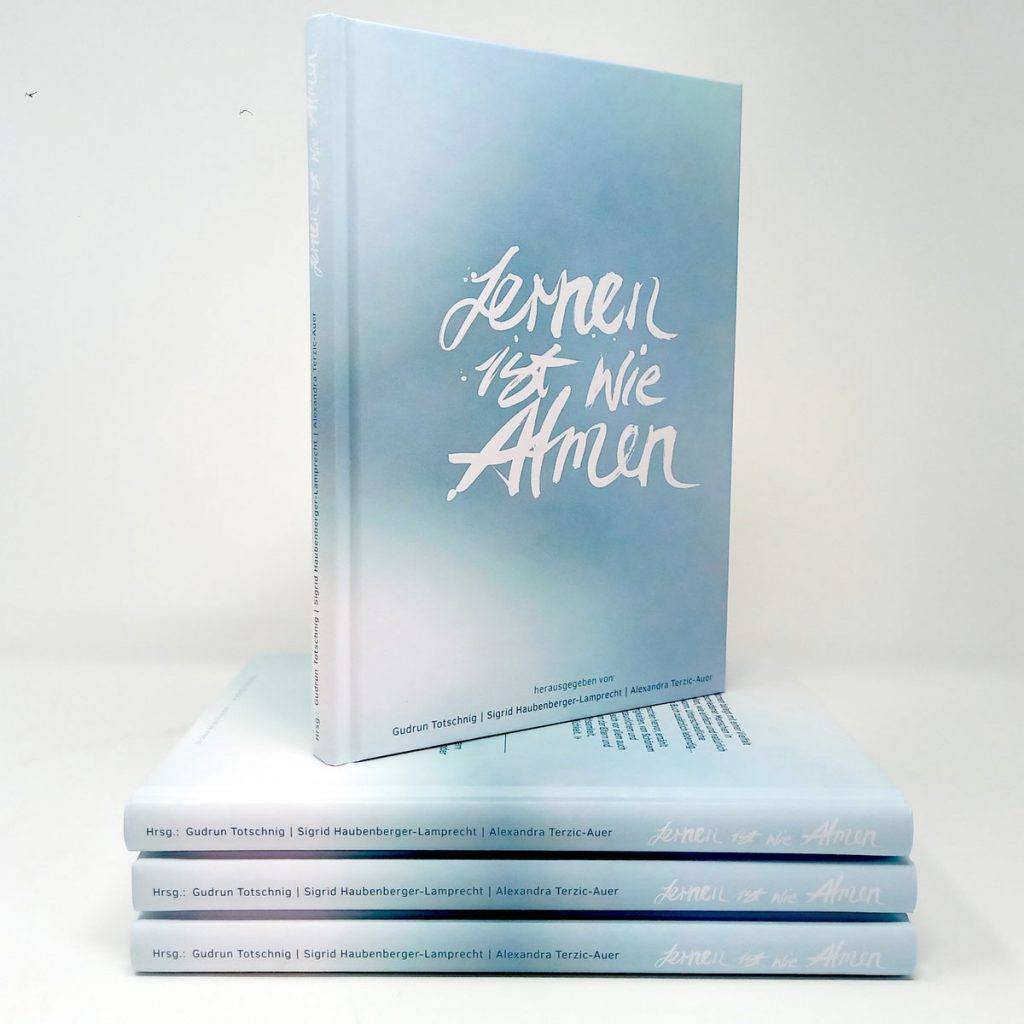
The 2nd edition of our book meets a completely changed readership.
In 2017, the idea that learning outside school was possible at all was considered the eccentric notion of a few outsiders. Since then, all parents, whether they wanted to or not, have had to deal with forms of learning outside school.
The number of children withdrawn from school has exploded since then, and alternative learning projects are springing up like mushrooms.
Buy the book (2nd ed., German)
Notes on content provided by authors
Comments
Loading comments …
Become a member to comment publicly. GAIA members write comments in the members' portal — under their nickname, visible to everyone.