Solaris 200


Desalinating seawater is usually complex and expensive. On top of that, most systems require a great deal of energy, which has to be supplied.
I have been living on Gran Canaria for 10 years and work as a developer and inventor in the field of alternative and forward-looking technologies.
Dear friends, Gran Canaria is perhaps the best place in Europe to see for ourselves the water shortage that has reached staggering proportions worldwide. On this small island alone there are around 600 km² of desert-like and fallow farmland that cannot be greened or used, partly because of the lack of water. The blame lies with the ruthless plundering and thoughtless exploitation of past centuries, right up to the late 1960s. Gran Canaria is one of the examples before our eyes showing that nature is not always able to regenerate itself. That is why deserts are spreading rapidly around the globe, and every year it becomes more difficult even to offset their renewed expansion.
The facts speak for themselves:
- The island was once considerably greener!
- The groundwater table has fallen dramatically.
- Dried-up riverbeds that still carried water 500 years ago!
- 13% of drinking water still comes from springs today!
- The inhabitants’ self-sufficiency from their own agricultural produce is 30%!
- In many places the groundwater has been becoming saline for decades!
- The list is actually much longer!
The conditions on Gran Canaria are typical of a great many places in the world.
That is why I also looked into desalination. The most widespread systems are osmosis and evaporation plants. Solar stills, dew and fog collectors, on the other hand, usually need a lot of space for little water. But many people worldwide urgently need water – people on whom we in Central Europe, too, unknowingly depend. So, true to Schauberger’s maxim “Natur kapieren und kopieren” (understand nature and copy it), I questioned how evaporation works in nature. With some know-how, the Solaris system was then created in cooperation with the GSC team and our technical and scientific friends. Claus Mertes (specialist engineer for seawater desalination plants) rated the system, on the basis of the facts, as one of the most ecological and economical in the world. Prof. Claus Turtur, likewise after 3 minutes and from a purely physical point of view, came to the same conclusion and only regretted that apparently no one had come up with the idea before.


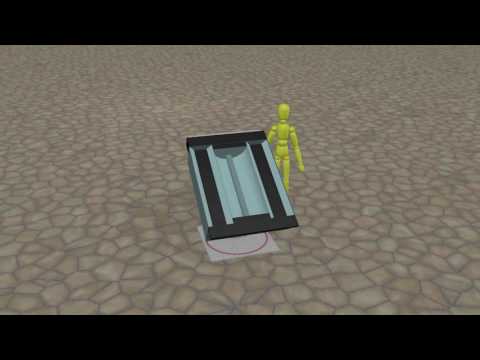
I then built the first experimental, test and process-verification models, and from them derived and developed the Solaris 200 as a pre-series prototype. The Solaris 200 is a fully self-sufficient seawater desalination unit that tracks the position of the sun by itself. With sunlight falling on an area of about 2.6 m², it desalinates about 200 litres of seawater and also produces about 7 kg of high-quality sea salt per day. The energy required is supplied by the sunlight alone, so no additional energy source is needed at all. What is more, the salt makes it possible to recoup the cost of the unit. The unit is also suitable for turning dirty, unusable river water into drinking water.
We now want to build this pre-series prototype in order to manufacture and sell the Solaris 200 here on the spot in a self-financing small-scale production. It is the most ecological and economical production and distribution system with the lowest risk. The whole venture will be run as a non-profit enterprise. With the surpluses generated, the first aim is to develop the larger siblings, the Solaris 500 l and Solaris 1000 l, as well as the large-scale plant modules of 2.5 m³ and 5 m³. In this way, nature-friendly solutions will be offered for as many problems around the world as possible. The results will then be made available to everyone as open source. But we will also – here on Gran Canaria – initiate, encourage and implement “desert greening concepts” ourselves.
My appeal
We have already made a start towards these goals. We are in the process of acquiring and building the minimum tools and machinery required. The most important tool – a table milling machine – will be finished in the next few days. A bending machine is also in progress, and further equipment is still being planned. However, we depend on donors, sponsors and investors for a total of 5,000 to 10,000 euros to start production and distribution. That is why, as a GAIA member, I am turning to the community.
For more information about Solaris and the Solaris 200, please follow the link or contact me. I am happy to answer anyone’s questions.
Notes on content provided by authors
Comments
Loading comments …
Become a member to comment publicly. GAIA members write comments in the members' portal — under their nickname, visible to everyone.