Blackout – emergency power supply

Most people have now heard of the term blackout.
What concrete options there are for supplying yourself with electricity if the grid operator’s power supply fails for days is so far known only to those who are interested.
One way of running your home on electricity independently of the grid, at least for a while, is to connect a standby generator. However, there are a number of things to bear in mind.
A group of GAIA members has been dealing with this subject quite intensively for some time and is happy to share the information collected.
First of all, you need to clarify which devices should continue to be supplied with electricity in an emergency. This gives you the power rating the standby generator must deliver.
Then you need to choose the right standby generator for the required output. Output, delivery time, availability of spare parts and service, durability and of course price are the criteria to consider. Here are a few links as an overview (German):
- www.netzvergleiche.de/notstromaggregat/…
- www.ttools.at/produkt/stromerzeuger/…
- www.josefsteiner.at/stromerzeuger/…
- www.profishop.de/generatoren
- www.ks-power.de/diesel-generatoren/…
- www.farmitoo.com/de/haus-und-hofbedarf/stromerzeuger/…
- shop.atx-motorparts.de/hyundai-diesel-generator/…
- www.amazon.de/Stromerzeuger/…
 Here is another thought from Herbert Saurugg:
“In principle, I advise against standby generators in private homes unless they are absolutely indispensable. And then you should consult a professional, because there are simply many things to consider, see www.saurugg.net/blackout/ (German). That’s why I don’t really know much about it myself. Kind regards, Herbert.”
Anyone who has nevertheless decided on a standby power supply then also needs the generator to be connected to the building installation in line with the standards. Here is an overview of the usual equipment required:
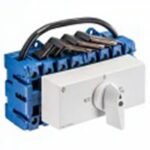
Manual changeover switch
The simplest option is manual switching between the public grid and the generator using a “mains–0–emergency” changeover switch. If there is enough space, a specialist can install this switch directly in the meter distribution board.
The rating of the changeover switch depends on the main fuse after the meter.
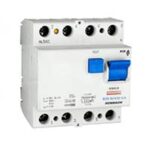
300 mA RCD, type “S”, replacing the grid-side fault protection measure
Of course, in emergency operation it must still be possible for laypeople to operate the installation safely. Protection against electric shock for people and animals, as well as protection of property, must be maintained.
Depending on the operator’s network type, an essential protective measure becomes ineffective in emergency operation – this in turn has to be provided by an additional suitable measure for “fault protection”.
Usually, or depending on the local situation, emergency power is fed into the house via an unmistakable plug-and-socket connection and a corresponding cable from the generator (positioned outdoors).
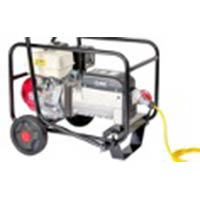
Standby generator (example picture)

Feed-in appliance plug, e.g. 32 A, 5-pole, 1h, IP44
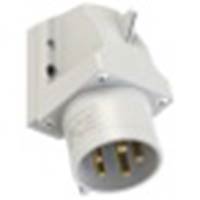
Feed-in appliance plug, e.g. 32 A, 5-pole, 1h, IP44
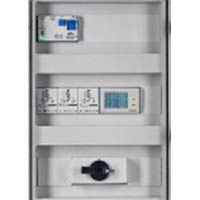
Surface-mounted distribution box IP65, transparent door, halogen-free, UV-stabilised, 1,500 V DC, −25 to max. 60 °C
If the switchgear listed cannot be accommodated in the existing meter/fuse box for lack of space, it is also possible to install everything in an external enclosure.
This offers additional design options, such as a display giving an overview of the power quality of the emergency supply (if the generator does not already have one).
Electrifying greetings from the Tulln region (Austria), Reinhard Reiser, master electrician, homeowner and family man
Get in touch
I am also happy to help with installations, depending on the local question. Numerous people from the qualified electrical trade are gathered at GAIA. As a member, feel free to comment on the post right here below or send me an email.
Perhaps other approaches or examples already implemented will come up in the discussion?
Another post may well come out of it …
Notes on content provided by authors
Comments
Loading comments …
Become a member to comment publicly. GAIA members write comments in the members' portal — under their nickname, visible to everyone.