GfKV newsletter #06 – Society for Crisis Preparedness

Blackout preparedness
In recent months, blackout preparedness has been discussed more often in the Austrian media, among other things as a result of the major disturbance on 8 January (German), which was analysed in detail in GfKV newsletter 04 (German). The Austrian Armed Forces, for example, again warned of a blackout within the next five years in their security policy outlook 2021 (German). The answers to several parliamentary questions (German) point rather to an unacceptable diffusion of responsibility. Nobody really wants to take responsibility and lead on the issue. In Germany it is even considerably worse than in Austria. As the past months have shown, for example in the catastrophic floods or the developments in Afghanistan, this does not only affect this issue.
 Nevertheless, blackout preparedness activities in Austria (German) are increasing significantly, even if they repeatedly lead to sobering results – for example, that the drinking water supply is not secured everywhere after all, as is often claimed. See, for example, a survey from Upper Austria: Without enough electricity we run out of water (German). Such findings are also known from other federal states. The point is not that everything has to be secured. But the weak points must be made known and clearly communicated now, so that people can prepare for them.
Without a water supply, crisis management is hardly possible! It is all the more astonishing that a water utility of a German city of millions states: “In the event of a widespread power failure and the resulting failure of the piped drinking water supply, the task of supplying drinking water falls within the remit of the interior authority. The emergency drinking water supply for the population is then provided via emergency wells.” Here we are clearly dealing with a dangerous diffusion of responsibility.
It is particularly pleasing that the Upper Austrian and Lower Austrian state parliaments (German) passed all-party resolutions before the summer break to tackle blackout preparedness more concretely and at all levels. The necessary personal preparedness was particularly emphasised. A cross-party approach is especially important for this issue.
The findings of a current doctoral thesis on the effects of a large-scale, long-lasting power failure on livestock in stables (German) are also sobering: comparing the required measures with the protection goals leads to the conclusion that the regulations in force so far provide a good basis for protecting the animals, especially for normal operation and short-term disruptions at the level of individual farms. In major disruptions, such as following a blackout, the existing requirements fall short. It must be assumed that in a blackout a considerable proportion of farm animals will not survive, so that carcasses will accumulate beyond the normal level. It is therefore imperative to develop a strategy for dealing with the carcasses in such an exceptional situation.
In addition, another possible crisis is looming: the gas supply in Europe (German). While gas storage facilities were already two-thirds full at this time in previous years, this year they are just one-third full. Prices are also rising extremely, which can also be observed in electricity prices (German): in the whole of July 2021 there were only 2 days with neither negative electricity prices nor prices above 100 euros. By 28 August this year there had already been 369 hours with prices above 100 euros per megawatt hour (MWh). In the whole (!!!) of 2017, the previous record, there were just 57 hours. This has also clearly exceeded 2020, which had the highest number of hours with negative prices (298 hours) so far.
Blackout simulation “Neustart” (Restart) for municipalities and crisis teams
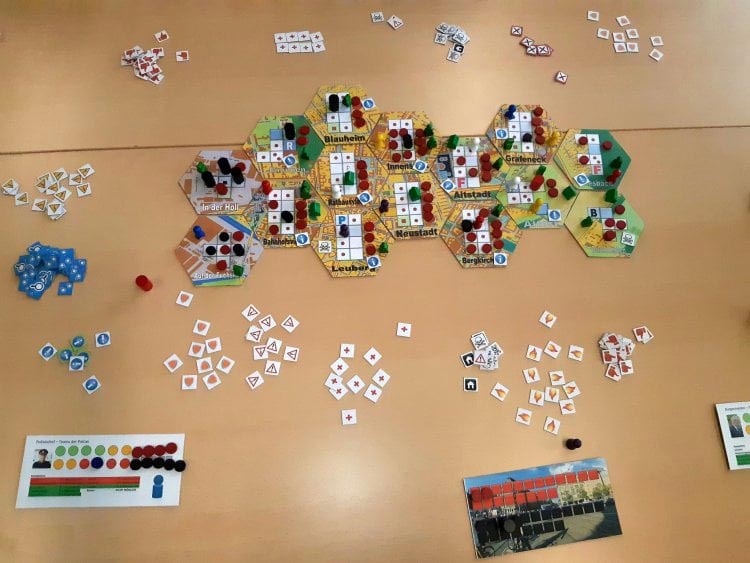
The Austrian Society for Crisis Preparedness (GfKV, German) is currently making several preparations to make Austria crisis-fit. Among other things, we are finalising the blackout simulation “Neustart” for municipalities and crisis teams (German), which will be available on the market from late autumn. It is particularly pleasing that the state of Upper Austria has already commissioned a purchase for all Upper Austrian municipalities. Further talks are under way, and there are already international enquiries.
With the simulation Neustart, a very realistic and holistic blackout response can be practised and trained using the example of a small town. And at the same time with very little use of resources. This simulation allows many conclusions to be drawn for practical blackout preparedness, and aids such as the blackout workbook for municipalities become more tangible.
Neustart is useful for any kind of crisis team, as it is about managing interconnected crises over a longer period. Only a few organisations can really afford a crisis team with multiple staffing. On the other hand, using the example of a small town, many interconnected relationships can be conveyed that are also relevant in many other areas.
If you would already like to make a reservation, simply send us a short message. You will then receive further information on an ongoing basis. More information and the final design will be presented in the next newsletter, as will details of the national preparedness campaign “Mach mit! Österreich wird krisenfit!” (Join in! Austria is getting crisis-fit!)
Psychology of a blackout
Together with the qualified psychologist John Haas, GfKV has published a white paper “Psychologie eines Blackouts” (Psychology of a blackout, German), which also sheds light on these important aspects.
Further articles and information
Blackout preparedness
- Blackout – Wenn plötzlich nichts mehr geht – Interviews with Herbert Saurugg
- „Nach der Krise ist vor der Krise – hoffentlich lernen wir gerade genug” 4Gamechangers 2021 – expert panel with Herbert Saurugg
- Blackout – Kein Plan für den Notfall – a ServusTV documentary well worth watching.
- Alle wollen importieren, nur niemand sagt, woher der Strom dann wirklich kommen soll … (Everyone wants to import, but nobody says where the electricity is actually supposed to come from)
- Wie vorbereitet sind deutsche Großstädte auf einen Blackout? (How prepared are German cities for a blackout?) – sobering
- Günseck für ein drohendes „Blackout” gerüstet – a model example of successful blackout preparedness!
- Wasserstoff als Notfall-Vorsorge: Energiezellenprojekt in Schladming (Hydrogen as emergency provision: energy cell project in Schladming) – a very interesting project, which unfortunately is also delayed due to current supply chain problems.
- Mit der Energiewende in den Blackout? – an MDR documentary well worth watching, which also covers the energy cell system in detail.
- Kärnten: Gemeinden erhalten „Leuchttürme” (Carinthia: municipalities get “lighthouses”) – another important step towards making municipalities crisis-fit.
Power supply system
- Europa auf dem Weg in die Katastrophe (Europe on the road to disaster) – a systemic look by Herbert Saurugg at the negative developments in the European power supply system that can lead to a blackout.
- Bericht Bundesrechnungshof „Umsetzung der Energiewende im Hinblick auf die Versorgungssicherheit” (German Federal Audit Office report on the energy transition and security of supply) – very critical results and hair-raising answers by way of justification.
- Hürden bei der Energiewende (Hurdles in the energy transition) – infrastructure is the most underestimated part of the energy transition.
- Stromabkommen EU-Schweiz (EU–Switzerland electricity agreement) – a very problematic situation with the potential to escalate at the technical level.
- Das Schweizer Stromnetz ist völlig ungenügend gegen Cyberangriffe geschützt (The Swiss power grid is completely inadequately protected against cyber attacks) – often only the lowest security level is reached, which is very worrying.
- A New, Deadly Risk for Cities in Summer: Power Failures During Heat Waves
- To Protect Electricity Operations from Increasing Cyber Threats
- Gier frisst Hirn und kann in die Katastrophe führen! (Greed eats brains and can lead to disaster!) – an insider story on the incidents in Germany in June 2019.
- Das deutsche Stromnetz ist so zuverlässig wie nie – wirklich? (Is the German power grid really more reliable than ever?) – the SAIDI value is unsuitable for assessing system security!
Crises / preparedness
- „Wir haben den Umgang mit Katastrophen verlernt” (We have forgotten how to deal with disasters) – a recommended interview with disaster researcher Martin Voss
- „Die nächsten 20 Jahre werden leichter für Menschen, die Unsicherheit aushalten können” (The next 20 years will be easier for people who can tolerate uncertainty) – a very interesting reflection.
- Weitreichende Infrastrukturausfälle und Störungen (Far-reaching infrastructure failures and disruptions) – collection of current events.
- Cyber-Angriffe auf Kritische Infrastrukturen (Cyber attacks on critical infrastructure) – collection of current events.
- Lieferkettenprobleme und -ausfälle (Supply chain problems and failures) – collection of current events.
- The Colonial Pipeline Hack Is a New Extreme for Ransomware
- „Weniger ist mehr” fällt schwer (“Less is more” is hard) – why we find it so hard to let go.
- Frankreich laut Experten unzureichend auf Atomunfall vorbereitet (France inadequately prepared for a nuclear accident, experts say)
- Wen rette ich – und wenn ja, wie viele? (Whom do I save – and if so, how many?) – a highly recommended risk-ethics reflection on triage / corona
- ENISA: Annual Incident Reports Telecom Sector – evaluation of outages in the telecommunications sector
Kind regards and stay healthy! Herbert Saurugg, Gottfried Pausch and Franz Hein

For years I have been publishing extensive analyses of what happens in the event of a blackout on my website.
Since 2019 also in cooperation with GAIA: my newsletters are also published here for interested readers as they appear.
Notes on content provided by authors
Comments
Loading comments …
Become a member to comment publicly. GAIA members write comments in the members' portal — under their nickname, visible to everyone.