GfKV Newsletter #09 – Society for Crisis Preparedness


Winter is not quite over yet, but the most critical phase has probably passed.
In the last GfKV Newsletter #08 (German) of August 2022 we once again encouraged you to make personal provisions for coming crises, as a number of facts pointed to a possible critical development in winter 2022/23 (German). The mild winter weather led to significantly lower gas consumption and thus also prevented the expected problems with the electricity supply. There were some problems restarting (German) the French nuclear power stations, but here too the mild weather prevented serious complications. So once again one might conclude (in good Austrian): “Guat is gangen, nix is gschehn!” (All went well, nothing happened!)
That is exactly a common conclusion: that this proves nothing bad will happen in future either. This shows the constant balancing act in risk and safety communication: at what point do people become desensitised, and how long can they still be motivated to prepare effectively for realistic crises in their own area? There are probably no simple answers to this. Feedback like this from the health sector is always motivating:
“Although we are now well prepared, we still hope that we will never have to use our concept. But it is a reassuring feeling for all colleagues to be ‘a little’ prepared.”
The topic of preparedness is now discussed much more widely in public, but on the other hand a certain polarisation between playing things down and exaggeration can be observed. More than ever we need both-and thinking (German) to deal with the increasing complexity (German) and the contradictions that come with it. Quite a few media also reinforce this polarisation. People are all too ready to talk of “scaremongering” – or to engage in it themselves. Supposed fact checks and studies like to refer to the past. Rarely are the wider connections examined in depth, or at least questioned and refuted.
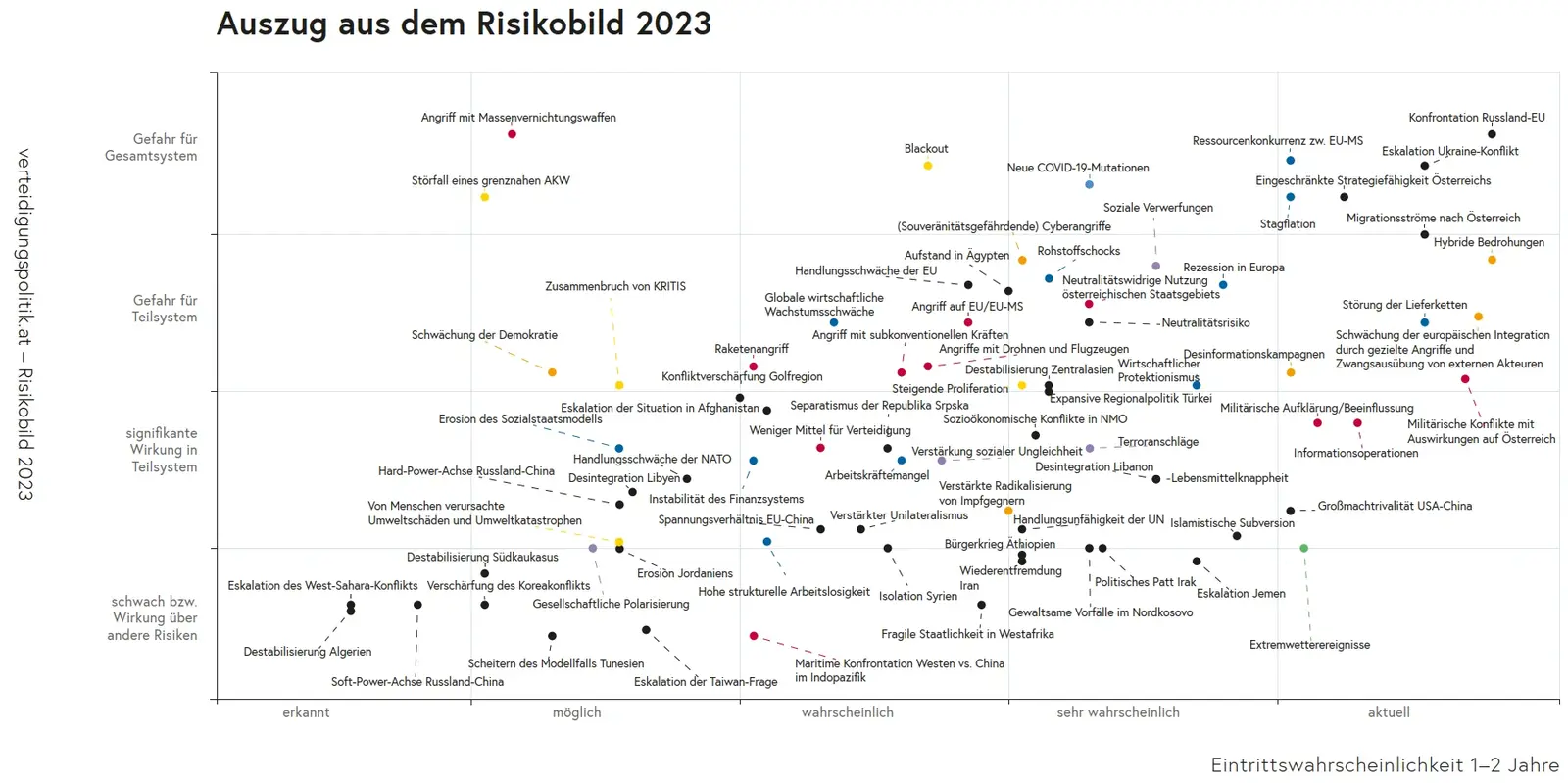
Much more often, and more willingly, people refer to wishful thinking, as Gerhard Christiner, Chief Technical Officer of Austrian Power Grid, recently pointed out very clearly at the presentation of the Austrian Armed Forces’ Risk Picture 2023 (German) (1st statement, 2nd statement, German).
However, there are now also plenty of actors constructing hair-raising connections. The internet offers a broad playground for this, too. Not an easy time to find serious orientation. But one thing should be clear: whenever someone offers simple answers to complex connections, the chances are high that they are wrong.
Attention has increased
“Each of us is a drop. But together we are an ocean.” Ryunosuke Satoro
This mass effect may help us to pay more attention to preparedness in future after all. On the positive side, despite the contradictory statements presented above, significantly more municipalities and companies are now dealing with blackout preparedness. You still have to look closely to see whether it is just headlines or whether well-founded analyses are really being carried out and effective measures taken to cope with the consequences of a supra-regional, prolonged failure of electricity, infrastructure and supplies – but raising public awareness is now increasingly succeeding. It is also gratifying that more and more German municipalities are now appealing very consistently to the population and calling on them to make effective personal provisions. The need for this is also confirmed by new research findings: No crisis management without the population (German) – something we have been advocating for a long time. The personal preparedness of the population and of one’s own staff is the central basis for successful crisis management and should have the highest priority in all considerations. We often believe what we want to believe Other research findings, such as “At present there is no reason to fear a blackout due to an energy shortfall, because there are strong and mature safety mechanisms (German)”, are more reminiscent of the turkey illusion (German), or of Edward Smith, the captain of the Titanic:
“I cannot imagine any condition which would cause a ship to founder. I cannot conceive of any vital disaster happening to this vessel. Modern shipbuilding has gone beyond that.”
Unfortunately, a similar carelessness can be seen in the “electricity shortage” scenario, as the following headline shows: “Drawer regulation” drawn up: Styria prepared for the worst (German)
Possible electricity shortage
In recent months it has repeatedly been communicated that a blackout is very unlikely but cannot be ruled out completely. The latter finding is decisive! It is assumed that a blackout – triggered, for example, by a foreseeable shortfall – could be prevented by managing an electricity shortage (“energy steering”).
What is unfortunately overlooked is that a blackout cannot be triggered a) by a single event and b) is unlikely to be triggered only by a foreseeable shortfall. The danger comes from events that coincide by chance and then reinforce each other in their effect – that is, from the observable, accumulating problems (German). The complexity trap sends its regards.
On the other hand, it is becoming clear that rolling area shutdowns to prevent a blackout are also massively underestimated. On the electricity side this should be manageable, even if we have no experience of it here (but see the experience in California or South Africa) and there are many unknowns. In Austria, each federal state is planning its own approach. There are 2 to 6 zones, each to be switched off for 4 to 6 hours – on a rolling basis if necessary. Little is publicly known about this yet, except that the shutdowns must be “non-discriminatory” and large-scale for technical reasons. That means there are no exceptions at all, which will lead to there being, as in a blackout, no more communication within 30 minutes (German) – at least in the affected areas. All rail traffic would have to be stopped. After about 3 hours, the coolant of many refrigerated display cases in supermarkets would fail, which would entail a repair process lasting weeks to months. The simultaneous shutdown in all federal states (“fair distribution”) would quickly lead to production and logistics chaos. Yes, the regulations for planned power cuts have been prepared. But so has the chaos that follows. Even if “energy steering” is the last resort to prevent the even worse scenario of an unplanned, large-scale failure, the consequences would already be similarly dramatic to those of a blackout. Especially if such area shutdowns become necessary over a longer period.
Believing in “energy steering” is a special form of self-deception
Here too, there is unfortunately a lack of open and honest safety communication so that the population, but also the various organisations and companies, can adjust and prepare. Even if, depending on the scenario, there is supposed to be a warning period of several hours to several days, this will usually not be enough to avert the expected damage without appropriate preparations. General blackout preparedness, however, would help to reduce the expected problems and to be prepared for a possible further escalation.
The biggest uncertainty factors, as in a real blackout, are information technology (IT), building management systems, process control systems etc. At least during the first shutdowns, when a considerable number of problems and damage are to be expected. Once these have been rectified and there is some experience with the shutdowns, it would work quite well – see the examples of South Africa and Pakistan.
The danger of a possible electricity shortage, as expected in several countries for this winter (German), seems to have been averted for the time being. Winter 2023/24 was described as significantly more problematic. Thanks to the still very high storage levels in European gas storage facilities, however, the situation there is unlikely to become as critical as could be expected just a few weeks ago. Nevertheless, we see no reason to give the all-clear, even if a somewhat more optimistic outlook is possible. Who knows what the weather will be like next winter or what surprises will occur before then?
War in Ukraine
As all readers are probably aware by now, more than half of Ukraine’s electricity infrastructure has been destroyed in recent months. Substations in the distribution grids in particular were attacked.
It is always surprising and admirable how quickly an emergency supply is restored after all. A collapse of society has also not occurred so far, which would actually be expected when dealing with the blackout scenario. Unfortunately, we still lack the background information needed to draw serious conclusions here.
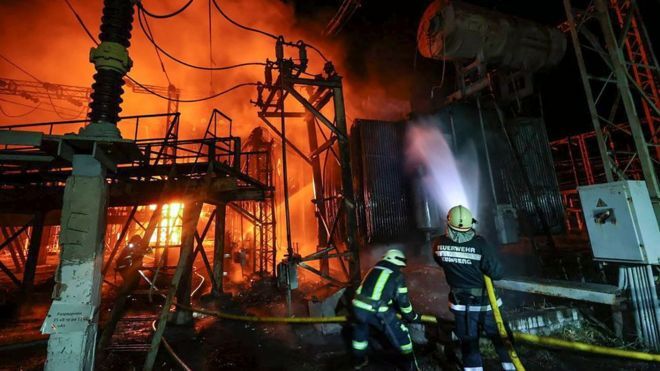
We basically assume, however, that the Ukrainian population is much better able to cope with deprivation and with the reality they experience. On the one hand, because even before the war supply and mutual dependencies were not at the level we are used to and expect. On the other, structures have probably formed in recent months to cope with such a situation. Whether we in Central Europe would manage such a rapid adjustment is doubtful. If anyone has more background information on this topic, we would be very interested.
Because of the current war situation, it cannot be ruled out that Europe, as a supporter of Ukraine, will also come into the crosshairs of possible acts of sabotage. It is not clear who was actually behind the blowing up of the Nord Stream gas pipelines, but a “red line” was clearly crossed here. We should therefore be prepared for possible further escalations here too.
On the other hand, it is to be expected that global reserves will have to be tapped to rebuild Ukraine’s electricity infrastructure. There were already supply difficulties in this safety-critical area before, which are unlikely to improve in the foreseeable future. This too could affect security of supply in the European electricity system. After all, plenty of such components are urgently needed for the energy transition as well. Unfortunately, such aspects tend to be forgotten in the current discussion.
Thinking and acting detached from reality
The Austrian federal government, for example, has set up a subsidy budget of 600 million euros for 2023 for the expansion of photovoltaic (PV) systems. This is meant to build a theoretical generating capacity of up to 2,000 MW in a single year. That is roughly the actual generating output of all the Danube hydropower stations (as if the sun shone even at night). How this can be managed in terms of materials and staff will soon become apparent. How it is to be implemented technically and operated sustainably remains a mystery, because the grids and storage required are missing and are not part of the programme. If “quick-and-dirty solutions” are used, they will make the actual problem worse (in the long term).
Similar reports come from Germany: since 1 January 2023, PV systems may once again feed in “100 percent” of their electricity. This means that the previous 70 percent rule no longer applies to any newly installed systems up to 25 kilowatt peak (kWp). The 70 percent rule was intended to prevent the infrastructure from having to be designed for a few hours a year. The feed-in was therefore stopped when 70% of the feed-in capacity was reached. Even if this limit is only reached for a few hours a year, the strain on the infrastructure and the risk of regional failures will increase. The pitcher goes to the well until it breaks …
Notfallregister.eu
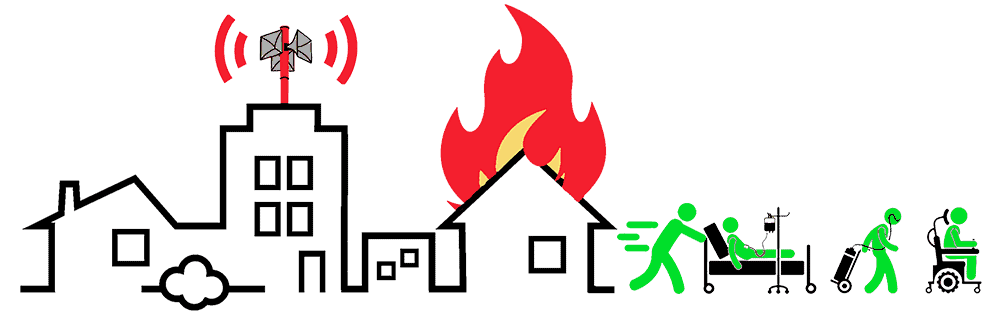 The register for people with health impairments, for needs-based support in emergencies and disasters.
The GfKV is a founding member of www.notfallregister.eu (German). Because of data protection concerns, it has so far not been possible to set up such a register publicly. We have therefore initiated one on an association basis and hope that sooner or later we can win over a state actor to operate this needs-based support in crises and disasters.
The aim is to give people with special needs better help when the occasion arises and to give the emergency services a better picture of the situation of where additional challenges will await them in their area of responsibility in special situations. As of 1 January 2023, 1,332 individuals and 5,081 registered care places/places in shared living arrangements have already been recorded in all federal states in Germany, and more than 70 retrieving bodies are connected to the system. The roll-out has now also begun in Austria.
If you know someone for whom this information could be useful, please feel free to pass it on.
“Schritt für Schritt – Krisenfit!” (Step by step – crisis-fit!)
Sandra Kreitner (German) has now written numerous aids and put them online (German). Among others:
- Template for municipalities and towns – power cut preparedness
- Template for hospitals – power cut preparedness
- Template for fire brigades – power cut preparedness
- Template for care homes – power cut preparedness
- Template for outpatient care – power cut preparedness
- Basic check for critical infrastructure staff
- Basic check for key company staff – power cut preparedness
(All templates in German.)

Podcast for adults & for raising staff awareness
In the last newsletter we presented the podcast series for children (German). There is now a sequel and a podcast series for adults (German). It can also be used freely – for example to raise staff awareness in organisations, companies etc.
Our guidelines for schools (German) have since been adopted and extended by the Austrian Ministry of Education and distributed to all schools in mid-December. The schools were asked to carry out concrete planning and communicate it to parents. This is a big and important step, because it creates the certainty many parents need to remain able to act if the worst happens. If you know that your children are safe, there is hardly any danger of acting “headlessly”.
Blackout – Das Notfallvorsorgebuch für Österreich (the emergency preparedness book for Austria)
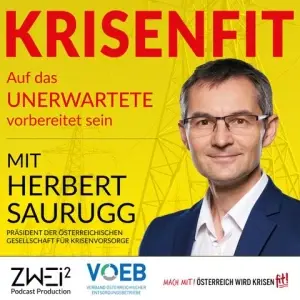
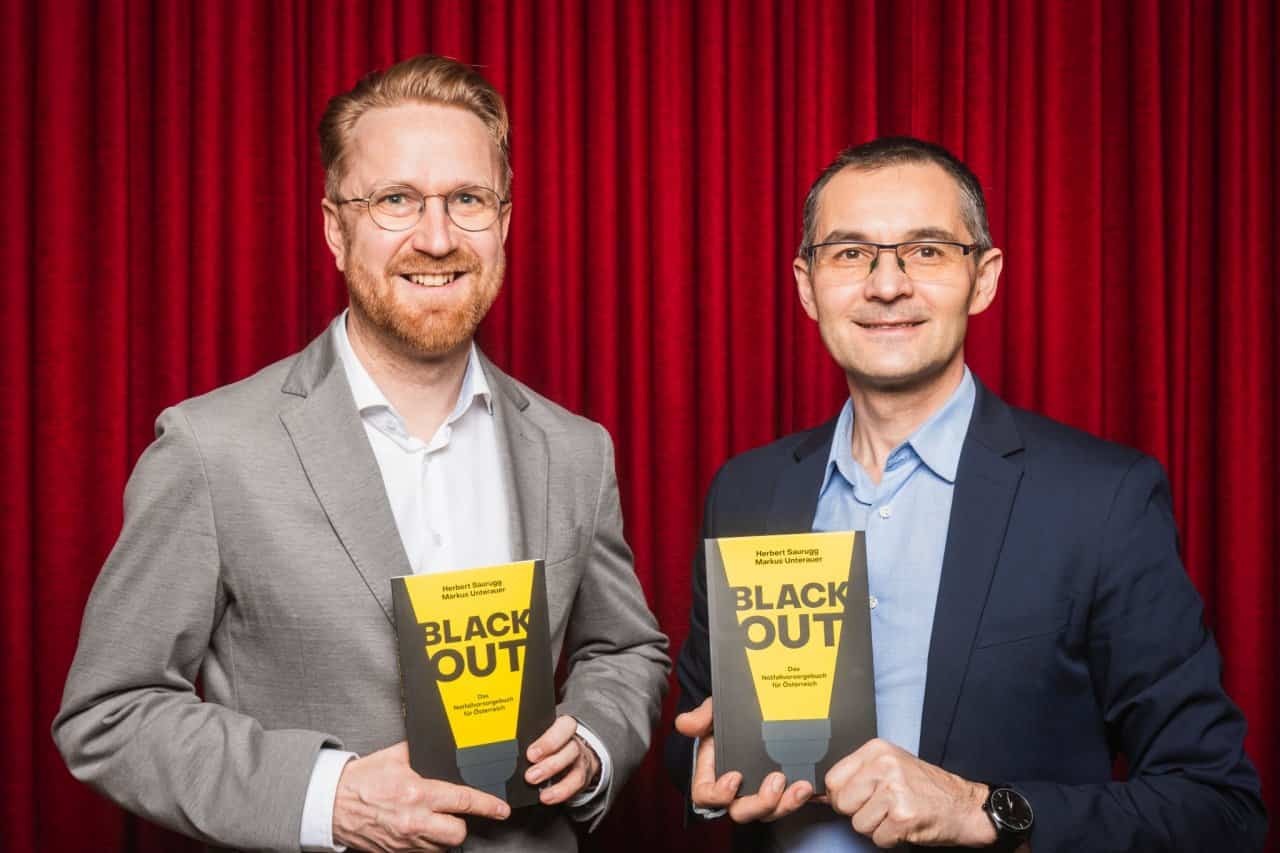
Blackout – and then? How can you prepare for an event that has never happened before? Why is it necessary at all? Which experiences can you spare yourself? How can it be done on a small budget? Or what do you do in a small flat with little space? These and many other questions are answered by two GfKV members, Herbert Saurugg, international blackout and crisis preparedness expert, and Markus Unterauer, preparedness expert, in their book “Blackout – Das Notfallvorsorgebuch für Österreich” (German). A basic equipment list especially for small budgets, precise checklists and plenty of practical tips, largely tested through personal experience, make this book an invaluable guide for your individual preparedness.
Call to action: personal preparedness!
Herbert Saurugg is currently working with food retailers and the food industry to get the supply of essential goods to the population up and running again as quickly as possible after a possible blackout or electricity shortage. The “aha effect” for everyone so far has been that the restart could take considerably longer than previously expected. Our just-in-time production and logistics contain many dependencies and pitfalls that jeopardise a rapid restart. The issue of the “cold chain” was already addressed above under electricity shortages.
Another issue that must not be forgotten is waste disposal as a whole. Austrian supermarkets hold about 200,000 tonnes of perishable goods. Households could add another 40,000 tonnes or so. These are dimensions that are hard to imagine. Depending on the time of year, further crises could quickly arise.
All the more important was the joint step taken by food retailers to define a common procedure (German) under which, hopefully, as many perishable goods as possible can be handed out in good time and in an orderly manner. Despite some communication to the contrary, this does not secure the food supply during a blackout. It is an emergency procedure. Personal preparedness remains the be-all and end-all. Fresh goods may then be a supplement, but they will be nowhere near enough for everyone.
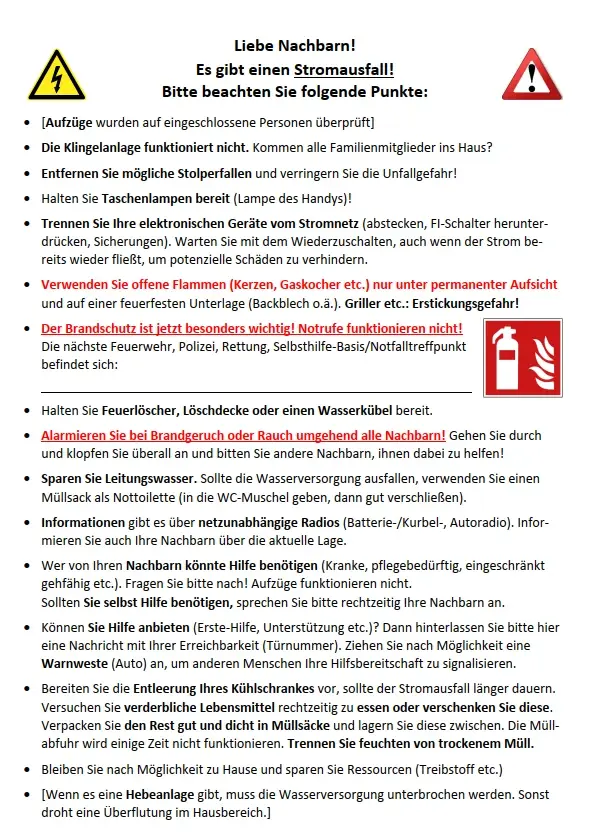
For preparedness in apartment buildings, we have created a notice (German) that can be put up on the entrance doors when needed and will hopefully provide initial orientation.
For anyone not so familiar with correlation and causality, we recommend this video (German).
Further articles and information
Blackout preparedness (German)
- Blackout danger very real – Austrian Armed Forces call for preparedness
- Recommendations for preparing a pharmacy for a power cut
- How does the pharmacy emergency service work in a blackout?
- Blackout notice for apartment buildings
- Preparedness: getting through power cuts, brownouts & blackouts safely with animals
- Ambivalence in crisis preparedness, or the reality of preparedness in Austria
- Vorarlberg population to be prepared in the event of a blackout
- How food supply works in a blackout
- Concept for food supply in the event of a blackout
- #SuccessStory: blackout preparedness for care homes & co.
- Secure electricity supply and blackout preparedness in Austria – symposium with experts from the energy industry and crisis preparedness in Parliament
Electricity supply system
- A Warm Winter Threatens Inland Shipping In Europe
- “Drawer regulation” drawn up: Styria prepared for the worst (German)
- Everyone wants to import, but no one says where the electricity is actually supposed to come from … (German)
- U.S. Risks National Blackout From Small-Scale Attack
- Risks in the European Transmission System and a Novel Restoration Strategy for a Power System after a Major Blackout
- Preparing for energy shortages and blackouts (German)
- Perfect storm brewing in European power supply system on 12.12.22
- Electricity market (German)
- The countries most at risk from Europe’s energy crunch
- Listening to European Electricity Traders Is Very, Very Scary
Crises/preparedness
- No crisis management without the population (German)
- Cyber attacks on critical infrastructures (German)
- Supply chain problems and failures (German)
- Social vulnerability to long-duration power outages
- Gas crisis in Europe (German)
- Swiss risk reports (German)
- Bottom-up Resilience
- Food Supply Shock Explorer
- Hope alone is poor preparedness (German)
- Major fire brigade operation after power cut in glass factory (German)
- Are we prepared for the coming disaster? (German)
- Far-reaching infrastructure failures and disruptions (German)
Miscellaneous
- Getting Nothing Done – podcast
- ENISA: Annual Incident Reports Telecom Sector
- Die Meinung der anderen (other people’s opinions) – book review (German)
- Shorting the Grid: The Hidden Fragility of Our Electric Grid – book review
Kind regards Herbert Saurugg, Gottfried Pausch and Franz Hein

For years I have been publishing extensive analyses of what happens in the event of a blackout on my website.
Since 2019 also in cooperation with GAIA: my newsletters are also published here for interested readers as they appear.

Notes on content provided by authors
Comments
Loading comments …
Become a member to comment publicly. GAIA members write comments in the members' portal — under their nickname, visible to everyone.