IBM, NVIDIA and Fermilab: Thank you for the groundwork!


Sometimes the biggest names in science and technology develop exactly the tools needed to realise your own vision of the future without even knowing it: IBM, NVIDIA and Fermilab have announced a new research initiative intended to bring together quantum computing, artificial intelligence and high-performance computing. And right at its heart: the simulation of fundamental physical interactions, explicitly including neutrinos. At the Neutrino Energy Group, we cannot help smiling.
For while some of the world’s most powerful scientific institutions are working to calculate the invisible processes of our universe with ever greater precision, we have long pursued a question that takes fundamental research one decisive step further: How can we not only understand physical interactions, but make them usable for technological applications today? That is exactly what we are working on. Not at some point. Not in the distant future. Here and now. With mathematical models, advanced materials research, graphene-silicon multilayer systems, sophisticated simulations, experimental investigations and the development of completely new architectures for decentralised energy conversion.
And while ever more powerful tools are emerging worldwide to explore the complexity of physical reality, we are already advancing our own technological approaches. One could say with a knowing smile: IBM builds the computing architecture. NVIDIA brings the AI computing power. Fermilab contributes its knowledge of particle physics. And we are already working on how advanced materials can convert physical interactions into usable electrical energy.
Of course, these institutions are not working directly for us. They are pursuing their own scientific tasks. But science has a wonderful property: its discoveries and tools rarely remain limited to the purposes for which they were originally developed. What is being created today to simulate fundamental particle interactions is also relevant to the research we are currently carrying out: understanding complex material interfaces, modelling energy transfer processes and experimentally investigating novel material systems.
That is precisely why we are developing our Neutrino Engineering District.
A research architecture in which mathematical models, materials science, artificial intelligence, advanced simulations and experimental results are brought together. Not as an abstract vision of tomorrow. But as an integral part of the research and development we are carrying out today. Our goal is to develop scalable systems that can convert available ambient energy into usable electric power. We are working on the materials, the system architectures, the simulations and the experimental verification. But here is the crucial point:
We are not waiting for others to finish drawing the entire scientific map. We are already exploring its technological possibilities while that map becomes more precise every day. The world’s leading scientific institutions are investing extraordinary resources to understand the invisible processes that govern our universe.
We have set ourselves an additional task.
Not only to ask what happens within these processes. But to investigate how we can put physical interactions to work in new technologies, starting today. Perhaps that is the fascinating difference between scientific curiosity and entrepreneurial vision.
The one asks: How does the universe work? The other adds: And what can we already begin to do with this knowledge?
Both belong together.
And that is why we welcome every new scientific discovery, every more powerful supercomputer and every advance in particle physics. For sometimes you do not have to develop every tool yourself. You just have to recognise what these tools are needed for, and already work on the applications while others are still perfecting them.
In that spirit: Thank you, IBM. Thank you, NVIDIA. Thank you, Fermilab.
We are following your work with the greatest interest. And perhaps that is the loveliest irony of scientific progress: all over the world, discoveries and technologies are emerging that complement one another, even when their creators pursue entirely different goals. The scientists, the mathematicians, the engineers, the innovators: each is advancing a different part of a much larger picture. And sometimes, without ever having sat at the same table, they are co-writing different chapters of the same extraordinary story.
SCIENCE EXPANDS THE BOUNDARIES OF THE POSSIBLE. WE ARE ALREADY WORKING TO TURN THESE POSSIBILITIES INTO TECHNOLOGICAL REALITY.
Neutrino® Energy Group - Clearly ahead of its time.
Read the full announcement in the IBM Newsroom →
Translated from English into German by GAIA, and now back into English. Original: IBM, NVIDIA AND FERMILAB – THANK YOU FOR THE GROUNDWORK!, Newsroom of the Neutrino Energy Group – with kind permission.
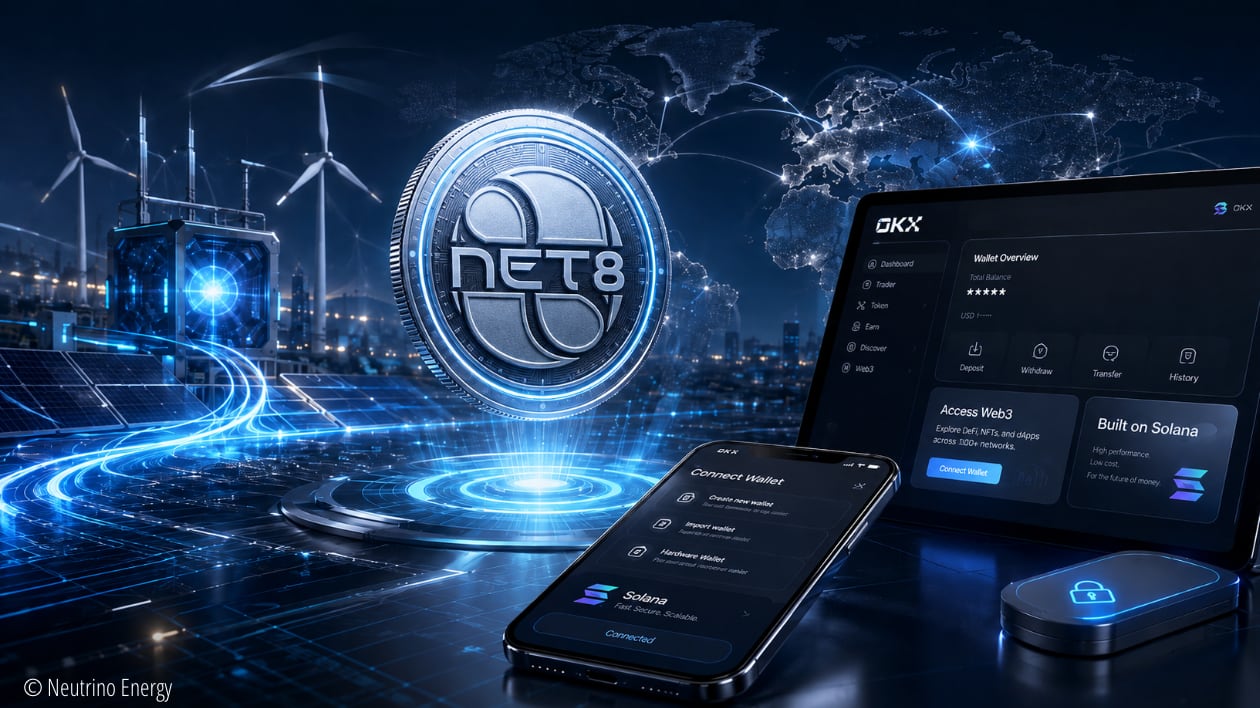
Cover image: Neutrino Energy Group
Notes on content provided by authors
Comments
Loading comments …
Become a member to read and write comments. GAIA members read and write comments in the members' portal.
Become a member Already a member? Read the comments in the portal →