Neutrinovoltaics: why clear words matter

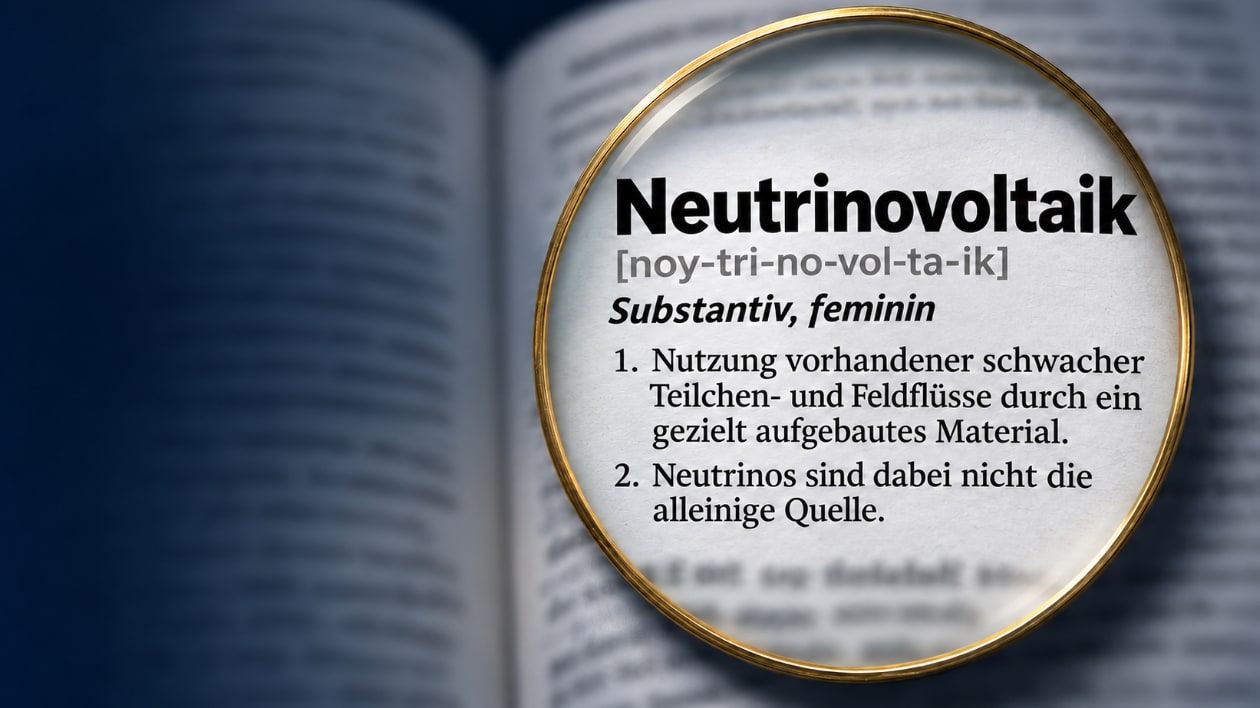
A name evokes images. When they hear “Neutrino Energy”, some people think of a technology that captures invisible particles and consumes them like fuel. Yet that picture does not describe our research approach. In a recent interview, CEO Holger-Thorsten Schubart explains why we need to explain more precisely what neutrinovoltaics means – and which claims do not follow from it.
With our Neutrinovoltaic Terminology Framework v2.0, we are creating a shared conceptual basis for this. It is intended to make research, development and public discussion easier to understand. After all, people who use the same words do not necessarily mean the same thing.
What we mean by neutrinovoltaics
We investigate how various physical influences from the environment interact with specially structured materials and how they can be converted into usable electrical energy. The influences we consider include electromagnetic, thermal and mechanical excitations as well as possible contributions from particle radiation. Neutrinos are part of this research context. However, our name does not mean that they are the sole or dominant energy source of our material systems. Which influence makes which contribution has to be clarified experimentally. An observed electrical effect alone does not answer this question.
The focus is, among other things, on thin graphene and silicon structures. What matters is how their layers, interfaces and contacts work together. Movement within the material is not enough: a technical application requires a directed, usable flow of electrical energy.
Why we also think in terms of volume
In photovoltaics, the illuminated area is a key variable. Our approach additionally examines how active material layers can be arranged in space when direct sunlight is not a prerequisite of the process under consideration. In the interview, Schubart illustrates this idea with a multi-storey building: its usable floor space cannot be read off from the size of the plot alone. Similarly, we are interested in how much effective material structure can be accommodated in a compact set-up. This is a design question, not yet proof of performance. Additional layers do not automatically deliver additional usable power. Energy input, shielding, interconnection and losses must be taken into account. Whether such an architecture works on a larger scale will be decided by measurements under clearly described conditions.
Four words that make a difference
Our framework consistently distinguishes between calculated, simulated, measured and open. This classification makes visible what state of knowledge a statement actually has. A calculation describes relationships under certain assumptions. A simulation examines a model. A measurement records an experimental finding. An open question states what has not yet been clarified.
Details matter for measurements, too: a voltage at the terminals is not yet evidence of permanently available power at a connected load. Likewise, a measured power output does not automatically explain its energy source. That is why experimental conditions, measurement uncertainties, controls and traceable energy balances form part of the documentation.
Precision starts with ourselves
In the interview, Schubart concedes that catchy short formulas in our own communication have encouraged misunderstandings. From this we draw a clear task: to describe more understandably which mechanisms we are investigating, which results are available and where further evidence is needed. Our approach concerns the conversion of energy supplied to an open system. The term “open” does not replace proof of the actual energy inflow. Conservation of energy and the requirements for a complete balance also apply to our development.
Among the open tasks are, in particular, separating the individual energy contributions, understanding the material processes and achieving reliable scaling. Controlled experiments and independent reproducibility are crucial for this. A laboratory prototype and an industrially qualified product mark different stages of development.
Conclusion: independence needs verifiable foundations
Our perspective remains a decentralised energy supply that could give people and businesses more independence and freedom. Whether and to what extent our development can contribute to this still has to prove itself on an industrial scale. Precise language helps us make this path transparent. It names goals, puts results into context and keeps open questions visible. We invite you to examine our research approach on the basis of its concrete statements. The interview and the three-language framework offer a starting point.
Sources
- Interview with Holger-Thorsten Schubart: What the word says and what it does not, 9 November 2026.
- Introduction to the interview in the Neutrino Energy newsroom, 9 November 2026.
Terminology framework v2.0: downloads
Our framework explains the terms we use and how scientific statements are classified. The three language versions are available here as PDFs:
Notes on content provided by authors
Comments
Loading comments …
Become a member to read and write comments. GAIA members read and write comments in the members' portal.
Become a member Already a member? Read the comments in the portal →