Scholé News – July 2025
Dear friends of Scholé
First of all, I would like to apologise for my hasty, overly optimistic assumptions about Musk and Trump in the February news! It was so nice to watch two strong men, attacked by overpowering opponents, suddenly seem to place themselves unanimously and harmoniously at the service of truthfulness and the common good – sadly too good to be true, as it turned out quite soon.
“Illusions leave the heart only slowly, drop by drop,” wrote Johann Nestroy almost 200 years ago. The illusion that the powerful of this world care about the well-being of the population has now, I hope, left my heart down to the last drop…
The two most powerful men in the USA still interest me, however, as instruments of fate. What Musk’s historical role is, I find hard to guess. Trump, on the other hand, obviously serves as the wrecking ball of the system. At the latest since his sudden change of heart in the Jeffrey Epstein matter, even his most loyal voters have had to recognise that Republican election promises can be trusted just as little as Democratic ones. More and more citizens have now finally had enough of the lies and covered-up crimes of the so-called elites. They will not forever accept that double standards are systematically applied, that corrupt rich and powerful people get away unpunished with misdeeds for which any ordinary citizen would have been sentenced to life imprisonment!
Here in Europe, too, the realisation is gaining ground that we do not have to choose between right and left, but between life-affirming and life-hostile. Those who have been able to escape the influence of the black-and-white ideological world view necessarily become seekers of truth. And no matter where their search began, sooner or later everyone arrives at the next fundamental insight: a party system geared to struggle and competition is by its very nature corrupt and hostile to life. Decency and idealism have no long-term chance of survival in it. Anyone who wants to bring something new and good into the world can only look for like-minded people outside the existing structures and learn to make skilful use of the remaining free spaces. Fortunately there are thousands upon thousands – worldwide surely already millions upon millions – of such pioneers who are courageously exploring new territory, and there are more every day. They preserve the fertility of the soil and the diversity of plant and animal species, deal with their fellow human beings on an equal footing, have the most varied spiritual experiences, explore alternative healing methods, try out free educational paths, make films, write, paint, compose, sing and dance for and with each other, found eco-villages or shared living communities, and use the new media to exchange ideas and to spread facts or opinions that cannot be found in the mainstream media.
In doing so, the pioneers discover, both in themselves and in others, how great and wide-ranging our human potential is. Every individual has individual talents from birth. If they trustingly follow the flow of life, they will notice that – depending on what they are enthusiastic about at the moment – they can keep developing new abilities and skills. Since I grew up between the narrow, high walls of the old world, I know its suffocating atmosphere very well and appreciate the fresh wind of the new time all the more. I would like to encourage at least one or two of my contemporaries who have remained there to dare a first step towards truth and freedom. The following letter to the editors of the ORF programme “Lebenskunst” (the art of living) is one such attempt. I am forwarding it to you because it contains some interesting information.
Dear editors,
“Lebenskunst” is one of the few ORF programmes I still listen to regularly. I look forward to receiving impulses there for love and peace between people and nations. Now, however, I increasingly have to note that even “Lebenskunst” has been infiltrated by a one-sided partisanship that I – and not only I – consider highly dangerous, especially when it comes across as sweet and harmless as in the piece about Christine Hubka’s book “Das Nachkriegshaus” (The post-war house).
Today I heard (for the 2nd time) Christine Hubka describe the Soviet occupiers from the perspective of the innocent post-war child. At first the author strives for balance. Mother and father react differently to the Russian soldiers – Dad calmly (we are not told why), Mum in panic because terrible things were done to members of her family by Russian troops – and Grandma weeps with joy over the State Treaty. So far, so good. But then an incident that only took place in 1958, i.e. 3 years later, is mixed in with the early childhood memories of 15.5.1955: the gruesome murder on Schwarzenbergplatz, right next to the Russian monument. Monuments, the little girl muses, are otherwise always built for the good, like the monument in the Stadtpark to Johann Strauss, to whom we owe such beautiful waltzes! But here stands a monument to the bad, which is why it has to be constantly guarded by a Russian soldier. And this sentry claims to have noticed nothing when a child (the murder victim was 21) was murdered right next to the monument?!
Were I not almost the same age as the author and, as the daughter of a resistance fighter against the Nazis, brought up to think critically, I might be tempted, in a rush of indignation and compassion, to conclude that even this murder is ultimately to be blamed on “the evil Russian”… How many younger listeners might react that way? Especially since they are told every day in numerous other ORF programmes that the good EU absolutely must rearm against the potential aggressor, evil Russia, so that we should all tighten our belts and prepare for the next big war…??
Unfortunately, I think it quite conceivable that even those responsible for the programme are not sufficiently aware of what a highly dangerous game with fire is being staged here, by letting the complexity of historical truth erode more and more in favour of a one-sided friend-or-foe scheme. Hence this letter.
In another very nice piece in today’s LEBENSKUNST about a 100-year-old priest (which I also heard for the 2nd time within a short period), the introduction does point out that 20 July has gone down in history as the day of the best-known assassination attempt on Adolf Hitler in 1944. However, not even this day of remembrance is taken as an occasion to report on men and women of the resistance, although there would be more than enough to tell within such a programme…
In this connection I would also like to tell you about a personal experience last week that fits in well. While visiting the exhibition KONTROLLIERTE FREIHEIT (controlled freedom) about the years of occupation at the Wien Museum, I caught, in a subordinate clause, a reference to a secret operation shortly before the end of the war that I had not known about. The name of this operation was not mentioned, so when I got home I entered “secret operation before Soviet invasion 1945 Vienna” as a search term. Here you can see the answer the computer spits out first:
*AI overview
Before the Soviet entry into Vienna in April 1945, there were no official secret negotiations concerning the entry itself. However, there were preparations and agreements between the Western Allies (USA, Great Britain, France) and the Soviet Union on the administration of Vienna after the expected conquest, as well as secret operations by the Western Allies to gather information about the Soviet occupation.*
Is this the official new wording to be passed on to the next generation: in 1945 it was not small, brave Austrians who negotiated with the evil Russian, but of course only the mighty Western Allies, our saviours and benefactors then as now, whose share of responsibility for the horrors of war is not up for debate? Astonished, I scrolled on and, fortunately, shortly afterwards found a very precise account of the last days of the war published only recently by Der Standard (German).
*Operation Radetzky is set in motion
The Austrian freedom fighters around Major Carl Szokoll, who have joined forces in Military District Command XVII (headquartered in what is now the government building on Stubenring) and had already been involved in the failed assassination attempt on Hitler in July 1944, decide to act.
On Szokoll’s orders, Sergeant Major Ferdinand Käs makes a perilous journey to the front south of Vienna in a Wehrmacht car driven by Corporal Johann Reif. He is to try to make contact with the Red Army and make proposals for capturing Vienna as gently as possible. Among other things, the vital Vienna mountain spring water pipeline is to be protected. They also propose that Vienna should be occupied not from the south but, after a detour, from the west and north.
The 9th Soviet Guards Army, or rather the High Command of the 3rd Ukrainian Front, has set up its headquarters for a few days in Hochwolkersdorf, around 75 kilometres south of Vienna. Today Käs and Reif succeed in making contact with the High Command. Here, in the coming days, the fate of Austria will be partly decided.*
The following chapters describe in detail how this story continued. Now that I knew the secret operation was called OPERATION RADETZKY, I found the following summary in the Wikipedia entry:
*Only since last summer has Szokoll’s resistance activity been commemorated with a plaque on today’s ministry building on Stubenring (see photo). The plan was uncovered and the officers Captain Alfred Huth and First Lieutenant Rudolf Raschke were arrested, sentenced by an SS court martial and, like Major Karl Biedermann, publicly hanged from street lamps in Floridsdorf on 8 April. Szokoll was warned, managed to escape arrest and fled to the command post of the 9th Guards Army in Purkersdorf, where he informed the Soviets of the failure of the operation.
Although it was partly possible to prevent the planned destruction in the city and the “western envelopment” succeeded, the fighting nevertheless lasted from 6 to 13 April. About 19,000 German and 18,000 Soviet soldiers lost their lives.*
The sentence I have highlighted in bold suggests that the heroic deed, for which several resistance fighters paid with their lives, was not in vain, even though the operation as such unfortunately failed. It probably nevertheless saved the lives of many people on both sides of the front and protected Vienna from destruction on a much larger scale! Above all, however, this operation, expressly denied by the AI, proves that even IN THE MIDDLE OF WAR – a German war of aggression to which 27 million inhabitants of the Soviet Union (among them many Ukrainians) fell victim – it was possible for individual brave people to come to an understanding with representatives of the other side in order to prevent further senseless destruction and casualties on both sides!
If ORF, and the programme “Lebenskunst” in particular, really want to contribute something to peace, as those responsible keep assuring us, then PLEASE report on historical and current examples of true art of living: on people who did not and do not let themselves be walled into the role of perpetrator or victim. On men and women who preserved their humanity, their freedom of thought and their drive even under the most difficult circumstances. Who fight FOR peace and freedom and not AGAINST an enemy nation. THEY, and with them those authors and media makers who consistently resist one-sided partisanship and stay on the trail of complex historical truth, were, are and remain the only guarantors of peace and freedom in the world.
In the hope of having given you food for thought.
Have a wonderful summer! Alexandra
More Scholé news
2nd edition of “Lernen ist wie Atmen” (Learning is like breathing)
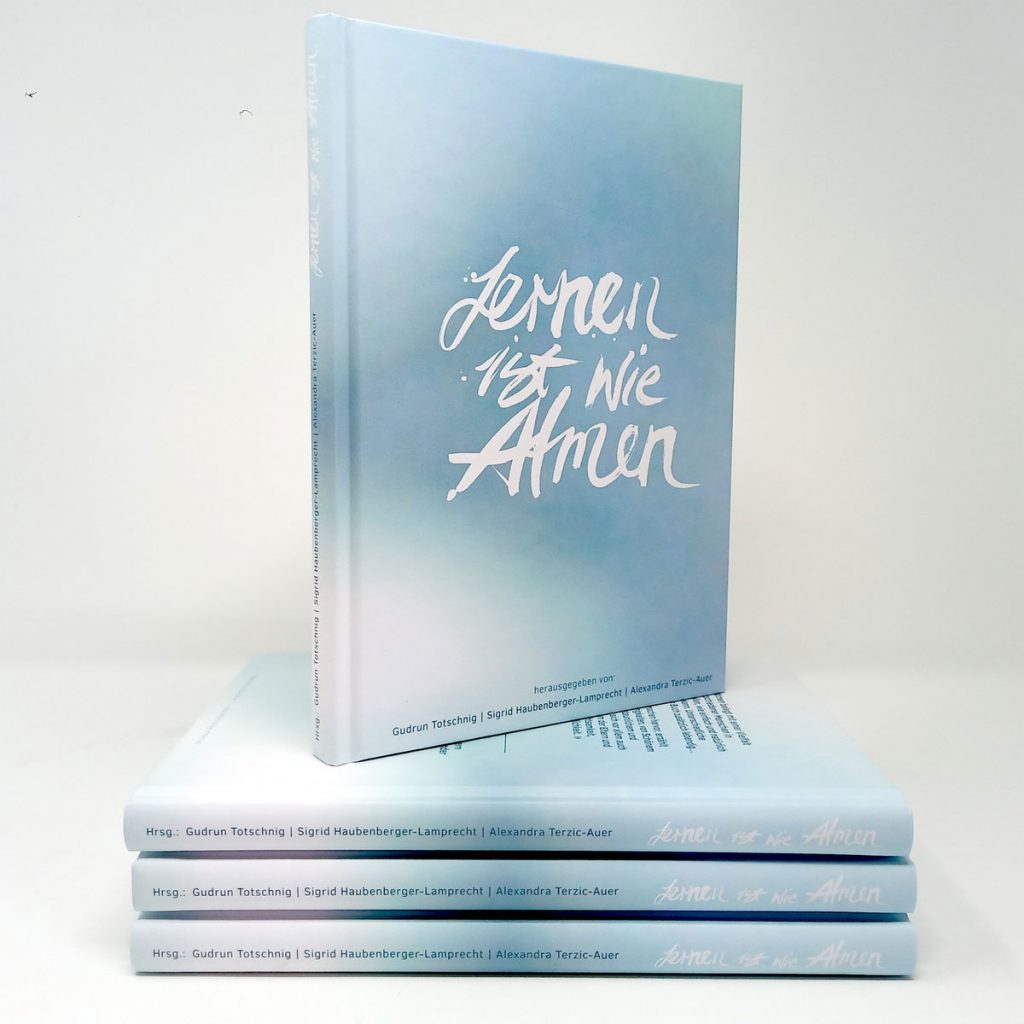
The 2nd edition of our book meets a completely changed readership.
In 2017, the idea that learning outside school was possible at all was considered the eccentric notion of a few outsiders. Since then, all parents, whether they wanted to or not, have had to deal with forms of learning outside school.
The number of children withdrawn from school has exploded since then, and alternative learning projects are springing up like mushrooms.
Buy the book (2nd ed., German)
Notes on content provided by authors
Comments
Loading comments …
Become a member to comment publicly. GAIA members write comments in the members' portal — under their nickname, visible to everyone.