Scholé News – October 2023
When I was a child there was a saying
that was quoted often and gladly: HOW? WHAT FOR? WHY? IF YOU DON’T ASK, YOU STAY STUPID! (In German it rhymes: “Wieso? Weshalb? Warum? Wer nicht fragt, bleibt dumm!”) I haven’t heard it for many, many years. What do children ask about who were put into a day-care centre long before the developmental phase in which they want to know at every opportunity WHY something is the way it is? With all the “stimulation” – group games, craft instructions, educationally valuable literature and so on – they hardly get round to dealing with the intuitive questions that rise from their own hearts …
So their questions mostly revolve around set topics, and the adults try hard to prepare the next generation for life in modern society by feeding children scientifically correct information as early as possible. Often parents or kindergarten teachers do not understand at all why the little ones turn away disappointed: what are two- or three-year-olds supposed to do with scientific facts, however “child-friendly” the packaging? They would have longed for an emotional reaction, a loving question in return, an appeal to their imagination …
Education for dependence
The consequence of such disappointing experiences with adults who cannot or will not respond personally to the questioning child is dramatic: warm personal trust in loving people, which would be essential for developing self-confidence and self-reliance, is replaced by a cool, impersonal trust in THE science, our universal religion, which supposedly serves only the well-being of people and nature and has a solution for every problem.
Children’s creativity withers amid an abundance of toys, consumer goods, teaching materials, children’s films and computer games. And with it, the joy of thinking independently shrivels. At the end of their eight or twelve years of school, many young people have learned one thing above all: asking questions is a matter for authority figures. My own questions don’t count; they are childish and stupid.
Very few see through why the authorities attach such importance – for example in the compulsory external exams for home-schooled children – to keeping sovereignty over which questions are the important ones and which answers are the right ones. If they did not prevent in good time inquisitive children from suddenly taking up other questions and looking for their own answers, the system would run out of supplies!
The power of the media
Even more lasting than the influence of home and school is the influence of the media, the secret teachers of entire generations. They demand neither effort nor achievement but score through distraction and entertainment. Most young people do not even notice that the mass media increasingly set themselves up as instructors or influencers. After all, they have been used since childhood to not being trusted to form their own opinion from many, partly contradictory facts. Besides, they hardly have access to facts any more; they move in an unmanageable flood of infotainment from which smaller and larger bubbles rise …
On top of that, independent thinking – also called “Querdenken” (lateral thinking) – has long ceased to be regarded as desirable and has instead mutated into the hallmark of cranks, esotericists, science deniers and other despised fringe groups. The pressure to conform socially has become so great that even – indeed often especially – very intelligent people instinctively shy away from independently questioning what the media serve them, probably out of panic that the ground of their scientific world view could be pulled from under their feet.
The paralysis of reason
11 September 2001 is a striking example of this: 22 years later it still takes courage, in the company of “normal” people who pride themselves so much on their rationality, to point out that the official narrative about this epochal event relies on phenomena that violate the laws of physics and have never been observed anywhere else:
None of the many high-rise buildings destroyed by fire before or since collapsed vertically into itself and crumbled to dust like the WTC towers. In all other burning high-rises, the steel frames at some point tipped over to the side or remained standing as charred skeletons among the fallen debris. The Pentagon, in turn, is the world’s only example of the miraculous disappearance of a large passenger aircraft. On entering the very wing where, purely by chance, the documents on billion-dollar losses of the US military that had become known only the day before were kept, the plane left only a hole a few metres wide and no other traces. An even more astonishing miracle was performed by the passport of the alleged hijacker Mohamed Atta: the little paper booklet not only survived the explosion of the aircraft and the fire in the building – no, it was also found intact on the glowing ash into which the steel, concrete, glass and all the other materials of the office towers had turned …
Panic-stricken fear of the truth
Since then, thousands upon thousands of critical scientists and experts have investigated what may really have happened in New York on that day, on which the worldwide war on terror was declared. The results of their work, however, interest only people who already think critically themselves. Everyone else avoids any confrontation with the overwhelming counter-evidence to the official account like the devil avoids holy water. This pattern of reaction has repeated itself in a very similar way in all the subsequent war scenarios around corona, the climate, Ukraine or Israel: the majority allows itself to be thrown into panic and then approves every ban on thinking and every measure, however absurd.
A small but steadily growing band of critical minds who have seen through the fact that these are staged events tries desperately to wake their fellow human beings from their trance by asking them simple questions: How do you explain that a third building, which was not hit by any plane, also collapsed at free-fall speed on the same day? And that this third building is not even mentioned in the official final report on the attacks? Would you like to know what ingredients the new vaccines contain? Are you interested in the results of the Pfizer study, which were kept secret for a long time but have now been made public after all? Do you know the background to the war in Ukraine? Do you really believe that it serves peace when terror is answered with terror?
I assume you have sometimes had such conversations too and had similar experiences to mine: anyone who asks FORBIDDEN QUESTIONS had better wrap up warm! They have to deal not only with the authorities but also with most good citizens. The reactions to my breaking of taboos ranged from bewildered silence and broken-off relationships to furious personal attacks. Enduring such failures, even taking insults or social exclusion, although you only meant well, takes quite a lot of inner strength!
The learning tasks of the resistance movement
But that is exactly what the task of the resistance was over the last 3 years, I believe! We had to learn to deal constructively with our annoyance at the “sleeping sheep” and our anger at the many followers and henchmen of a global attack on freedom and humanity. Painful experiences have helped us to an inner strength that immunises us against further attempts at division. In this way my annoyance with unteachable friends and relatives has gradually turned into compassionate patience, and my helpless anger at the warmongers is giving way step by step to an ever more unshakeable trust in God. The crimes that have been and are being committed against humanity are so enormous that we can only entrust their atonement to a higher justice!
Our next task, I believe, is that we, the many pioneers of a peaceful social order, no longer eye each other suspiciously and set ourselves apart from one another, but respect and support each other. In the different ways of thinking and approaches that at first still seemed to divide us, we may now more and more sense the richness and abundance of a world that is no longer steered by national, religious or transhumanist ideologies. The world of tomorrow will hopefully be neither unipolar nor multipolar. It will reflect the manifold wishes and hopes of billions of free, self-determined people who no longer let themselves be set against each other but ask their own questions and set their own goals.
What unites us and what divides us
The unifying bond between the very different, probably rapidly changing small communities that emerge in the process will no longer be ethnic or social but purely spiritual in nature. It is the consciousness of unity that is given to all people as soon as they break out of their ego prison. Then they experience that they are not helpless herd animals dependent on powerful guardians, but participants and co-creators of a many-layered reality that springs from the source of all life and, like the cells of our body, constantly renews itself from it.
One dividing line remains, however. It runs between the people who want to serve life in harmony with nature and those tech freaks who have decided to subjugate everything alive to their megalomaniac fantasies of omnipotence. Whether those who hatched the satanic plan of global domination are really human beings or entities of another kind, I cannot judge. I only know that most of the people who allowed themselves to be harnessed to carry out their globalist plans are not evil by nature. They would probably have developed more compassion and self-confidence if their childhood questions and needs had been taken seriously …
Real and false questions
All the more important, then, that children are encouraged to ask HOW? WHAT FOR? WHY? to their heart’s content, and that adults let themselves be inspired to do so again too. If we respond honestly and lovingly to children’s profound questions, we also become more clearly aware of the difference between facts and opinions. This distinction is essential to be armed against targeted disinformation, because the most important tool of all liars and swindlers is the mixing of facts and opinions. In dialogue with unspoilt children we also notice how often we fall for another devilish trick – idiotic pseudo-questions.
Whom do you like better, Mum or Dad? Do you feel like a girl or a boy? Do you want to go to school or stay stupid? Which culture is better, the Christian or the Muslim one? Who are the bad guys, the Ukrainians or the Russians? Is it morally justifiable to endanger the old and the sick instead of getting vaccinated? Each of these EITHER-OR questions is about as senseless as the question of whether we need air or food to live … Only we no longer even notice, because we are so used to being kept busy, worried and distracted by such pseudo-questions day after day.
The path to peace and spiritual freedom begins with the insight that there is an authority within ourselves that is always ready to answer us if only we ask it! Its answers are of a very special quality. Unlike those of the intellect, they do not follow the principle of expediency, in which advantages for one side all too often go hand in hand with disadvantages for the other. Rather, they obey the principle of meaningfulness, which is oriented towards connectedness, truth and love. Since my own Higher Self is in direct connection with the source, I can rely on everything it tells me serving not only my own good but always also the good of all other beings.
Cheerful autumn greetings,
Alexandra
2nd edition of “Lernen ist wie Atmen” (Learning is like breathing)
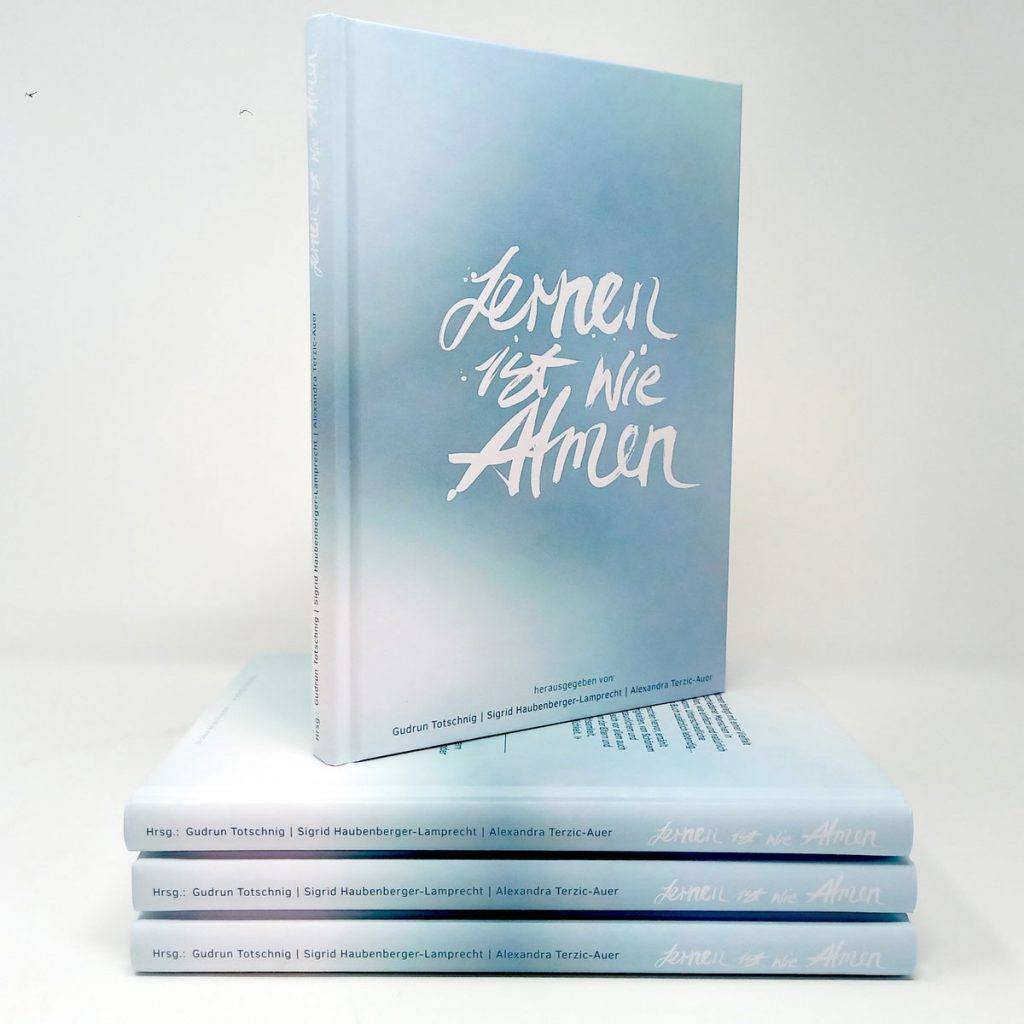
The 2nd edition of our book meets a completely changed readership.
In 2017, the idea that learning outside school was possible at all was considered the eccentric notion of a few outsiders. Since then, all parents, whether they wanted to or not, have had to deal with forms of learning outside school.
The number of children withdrawn from school has exploded since then, and alternative learning projects are springing up like mushrooms.
Buy the book (2nd ed., German)
Notes on content provided by authors
Comments
Loading comments …
Become a member to comment publicly. GAIA members write comments in the members' portal — under their nickname, visible to everyone.