Scholé News – August 2025
Dear friends of Scholé
“Love, and do what you will” (dilige, et quod vis fac) is the shortest and most concise summary of the Christian message. To understand it properly, you need to know that it is not about emotional, passionate love, which would be translated with the Latin verb amare. Diligere means to respect, to value, to hold in high esteem: we may feel deep love for only a few people, but all living things deserve respect. The sentence “Love, and do what you will” goes back to the great Doctor of the Church Augustine (354–430) and is ultimately the quintessence of all wisdom teachings. Is this love something supernatural, a superhuman achievement that only the greatest saints and sages can accomplish? No! LOVE in the sense of reverence for all living things is an inexhaustible potential with which we are all born! From the first breath, this potential begins to unfold, unless it is prevented from outside. So who or what keeps us from living this love that we could all still feel as small children? It is feelings of inferiority that were planted in us in our earliest youth. Painfully, we had to learn that it is not enough simply to BE and to do what our heart desired, namely to LOVE – to love life, to love ourselves, our neighbours, other living beings, nature and landscape, aromas, colours and sounds, things and activities that inspired us. Partly through temptations, partly through punishments and threats, we have been made to believe that we are not enough as God created us, but that we are deficient beings who must work very hard on ourselves in order to become capable of survival. Priests, teachers, doctors and politicians supply the OPTIMISATION PROGRAMMES needed for this, from which no one may escape. Very early on, most of us internalised that some authority or other always knows better than we do what is good for us.
The path of obedience
In this society, the first authority figure for a child is usually the mother.
“Mummy, I love you so much, I want to stay with you,” says the child, or expresses its affection with unmistakable gestures. “No, I’m afraid that’s not possible, Mummy has to go to work,” comes the answer.
“I want to help you…!” – “No, leave that. You can’t do that yet.” – “I want to tell you something…!” – “Not now, I’m in a hurry.” – “Please read to me…!” – “Another time, it’s already too late today. You know we have to get up early again tomorrow.”
In the crèche or nursery, the child thinks: do the other children long so much for people who aren’t there too? How are we supposed to love the carers when they aren’t even allowed to accept our love! Their job is to prepare us for life in the adult world without getting too close to any child. They aren’t even allowed to love us; they would be overstepping their competences and making themselves liable to prosecution. And what am I supposed to do with all the toys here? Funny, the most interesting thing is almost always the piece another child also wants to play with right now. Then we fight over it, even though there would be so much there… I want to go home! But I have to try to suppress this feeling as best I can, because that is what my dearest people expect of me. Only for their sake do I say YES although I feel NO, or NO although I feel YES. I don’t want Mummy to be hurt, so I try not to cry when I have to leave my bed and my home early in the morning. Sometimes I get terrible tummy aches from the tears I’ve swallowed, and then I’m allowed to stay home for a day. But to be honest, I don’t understand anything any more. I can’t feel at all any more what I really want. I don’t know who I am either. The carers say I should try out what I feel better as – a girl or a boy? Or perhaps a cat or a fox? Then I have to change my name too – Julia today, Jeremy or Kitty tomorrow… Will Mummy and Daddy call me something different then too? And what will Grandma and Grandpa say…?
At work the mother thinks: I can’t concentrate. How is my child doing? It was so tired and downcast this morning. Is something wrong with its tummy? We must have that checked by the doctor soon. At nursery my little one didn’t want to let me go at all. It hurt so much, but I had to tear myself away because I was already late. Always in a hurry, always stressed… And when I do have a holiday, I have to do everything that was left undone on working days. There is simply never enough time for my child! Sometimes I watch it while it sleeps and marvel at how big it has already grown…
The path of love
Where has this mother’s inexhaustible potential for love gone? It only flickers up now and then, dampened by suppressed longing, fear, a guilty conscience, regret and feelings of guilt. Like all members of the consumer society, she no longer lives where love dwells: in the now. Her consciousness is constantly manipulated and distracted from outside; it is occupied either with the past or with the future. It oscillates between memories and expectations, worries about the future and hopes for the future. But real LIFE takes place in the present, and love can only be experienced in the NOW! The NOW is, as it were, the point at which the horizontal x-axis, leading from the past into the future, intersects the vertical y-axis, which connects above and below, heaven and earth, nature and spirituality. It is no coincidence that NOW is the title of a famous book by Eckhart Tolle (published in English as The Power of Now), one of the greatest spiritual teachers of our time. Only in the NOW does a person have access to their instinctive intuition and at the same time remain open to inspiration from other dimensions of reality. The mind, which otherwise wanders restlessly back and forth on the x-axis, may take a break or concentrate on the now, the zero point between yesterday and tomorrow. A playing child lives entirely in the now. The inner child of adults would like to do so too. It longs to give free rein to its momentary impulses without pressure and stress and to be allowed to perceive the whole range of human feelings uncensored. But when adults stand up for children’s right to self-determination, they also rediscover their own inner child! For human rights are not worth much to children as long as they are tailored to fully conditioned adults: the right to vote or compulsory education are certainly not among children’s priority interests. On the one hand they want security in safe attachments, and on the other the freedom to develop their innate potential unhindered.
The task of the 21st century
We owe our current human rights to courageous pioneers who fought for the rights of men in the 19th century and the rights of women in the 20th century. What it would be like if women in this country were not allowed to study or to work outside the home without the permission of their fathers or husbands, we can hardly imagine any more! But what could the world look like if adults let the next generation grow up free and self-determined? Nobody can predict that, but anyone who seriously reflects on this question already senses that what is in my opinion the most urgent task of the 21st century – respect for children’s rights – will mean a quantum leap with unforeseeable consequences for the evolution of humanity. Renouncing the conditioning of children through the school’s “hidden curriculum” sets free their natural creativity, as can be observed in free learners. By devoting themselves undisturbed to activities they have chosen themselves, young people remain anchored in the now. They do not lose contact with their intuition and can perceive their connection with other people and the nature around them. If they are treated with respect from the very beginning, children quite naturally develop respect for other people. If they are helped, they want to help too. If they are listened to, they listen too. As you call into the forest, so it echoes back. Our current society, shattered and divided by fear propaganda, control mania and one-sided training of the intellect, cuts children off from their spiritual essence at a very early age. I got a foretaste of what a world could look like in which the natural spirituality of children, their innate talents and their inexhaustible potential for love are carefully nurtured on my visit to the Shchetinin school. It is hard to describe how gracefully these pupils moved, how lovingly they treated each other, with what enthusiasm they sang, danced, built, cooked, learned, cleaned or cared for animals and plants. Completely voluntarily, without a set plan and without any pressure or coercion.
What inspires young people
The young people I was able to talk to in Tekos were not preparing to make a career and earn a lot of money. What inspired these girls and boys was the prospect of putting their talents at the service of humanity – as inventors, educators, artists, social reformers, healers. And these were certainly not castles in the air! For apart from their incredible knowledge, all these children were already practised in a host of practical skills. They worked not only on the school grounds but also regularly helped the inhabitants of the nearby village with sowing and harvesting, with repairs or organising festivities, even with digging graves. I observe similar competence and helpfulness in the children who grew up without exams and who have since become young adults. And also in their parents, who through unconditional love for their daughters and sons regained access to their own inner child and learned to live trustingly in the now.
The Shchetinin school was closed by the district authorities after the death of its founder in 2019. German and Austrian school authorities and courts have conspired against free learning and continue to make life difficult for parents and children. Just like the globalists and their henchmen in politics, business and science, they sense the approaching end of their power and are trying with all their might to delay it. But their threats and punishments more and more often simply bounce off people who have left the path of obedience to return to the path of love. There they have rediscovered their inner child and since then can regard even very difficult experiences as challenges or even as gifts.
The poet Rainer Maria Rilke dedicated a wonderful poem to them as early as 1909 (original German):
*Du mußt das Leben nicht verstehen, dann wird es werden wie ein Fest. Und laß dir jeden Tag geschehen so wie ein Kind im Weitergehen von jedem Wehen sich viele Blüten schenken läßt.
Sie aufzusammeln und zu sparen, das kommt dem Kind nicht in den Sinn. Es löst sie leise aus den Haaren, drin sie so gern gefangen waren, und hält den lieben jungen Jahren nach neuen seine Hände hin.*
(In essence: you need not understand life – then it will become like a celebration. Let each day happen to you the way a child, walking on, lets every breeze give it many blossoms; it would never think of gathering and saving them, but gently loosens them from its hair and holds out its hands for new ones.)
With love Alexandra
More Scholé news
2nd edition of “Lernen ist wie Atmen” (Learning is like breathing)
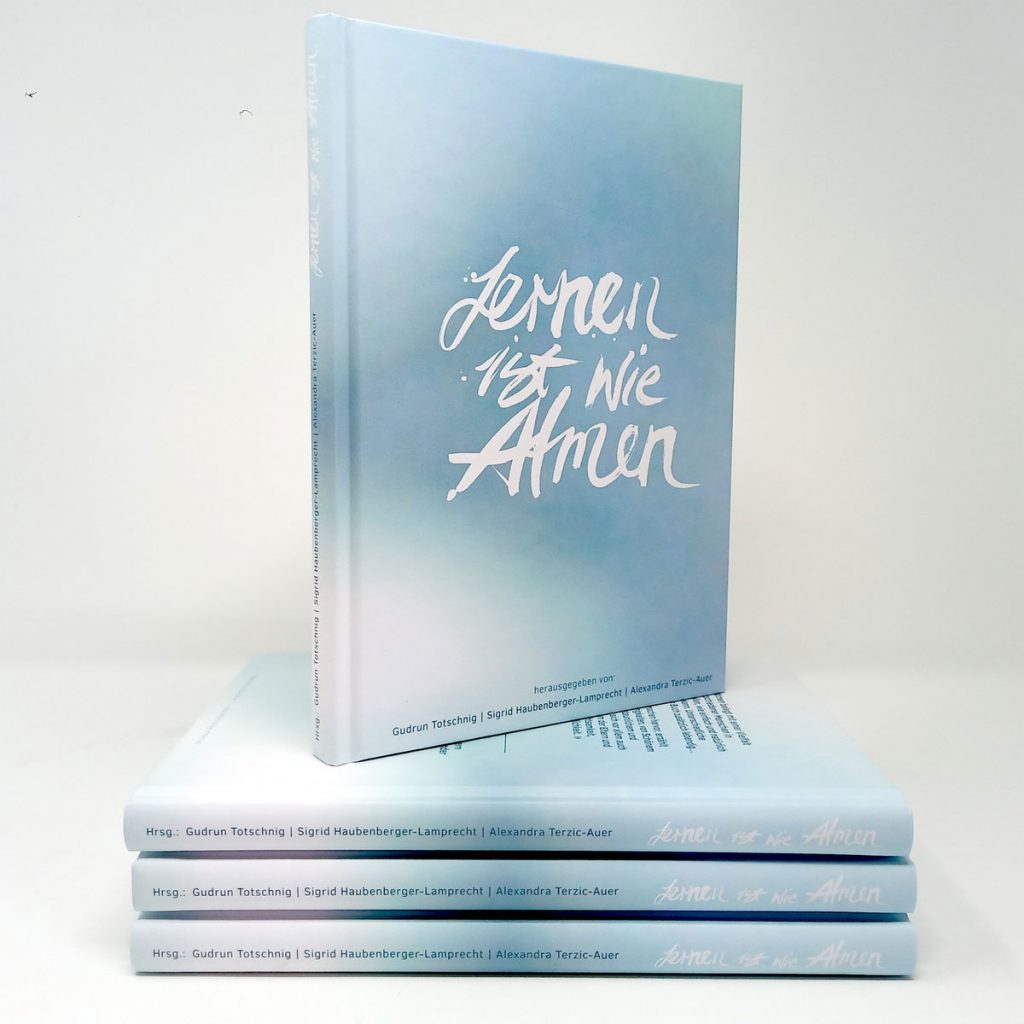
The 2nd edition of our book meets a completely changed readership.
In 2017, the idea that learning outside school was possible at all was considered the eccentric notion of a few outsiders. Since then, all parents, whether they wanted to or not, have had to deal with forms of learning outside school.
The number of children withdrawn from school has exploded since then, and alternative learning projects are springing up like mushrooms.
Buy the book (2nd ed., German)
Notes on content provided by authors
Comments
Loading comments …
Become a member to comment publicly. GAIA members write comments in the members' portal — under their nickname, visible to everyone.