The multi-paradigm shift becomes visible, part VII: Book money creation and its consequences

The multi-paradigm shift becomes visible – part VII: Book money creation and its consequences
In the last newsletter, after a short introduction to bookkeeping and the structure of a balance sheet, we looked at “credit money creation out of thin air” – the booking entry with which commercial banks create the borrower’s credit balance when granting a loan, and also the seller’s credit balance whenever a bank buys something.
In accounting terms this is a balance sheet extension against debt capital, i.e. a debtor’s entry, because a creditor must book an asset swap: after all, he hands over assets of monetary value and receives a receivable in return. We saw that this liability of the bank’s own (“sight deposit”), through which book money is shown in the bank’s balance sheet today, means that the granting of a loan can legally only be an exchange of IOUs, but by no means a loan. With a loan, the creditor must hand over “assets”, which in the balance sheet can only take the form of an asset swap. A balance sheet extension against debt capital is a debtor’s entry and means that, legally, two debtors face each other who exchange their IOUs (the borrower’s loan agreement against the commercial bank’s book money, which after all represents the bank customer’s claim to cash). Since, after the exchange of two assets of equal value, neither partner owes the other anything any more, neither “repayment” nor “interest” is conceivable! The legal assessment of the “bank loan” as an exchange of IOUs instead of a loan, which corresponds to the balance sheet of the “lending commercial bank”, is a challenge that the international judiciary will still have to face; in the end it could even prove to be the “democratic acid test of the entire legal system”.
The bankers’ favourite line (“We only lend out the savers’ money!”) is therefore finally exposed as a fairy tale and should no longer be used by them to describe their business model, since it has been empirically refuted and this is being reported more and more often in the media (see, for example, the information from the sovereign money initiative in Switzerland (German), from ARD (German) or even from the mainstream paper “Standard.at” (German)). Even eight-year-old children know about it today and can explain the process correctly (German). Unconventional thinkers among authors, too, such as Horst Seiffert, deal with the subject in great depth (German). In the places of higher education, on the other hand, much is “demanded”, but the concrete dialogue, or even just the correct information of students, continues to be refused (German). Cognitive dissonance there evidently prevails at every level.
Possible and actual consequences of debt money creation by private companies
But how is it possible that banks, on the one hand, can “create giro money” at will (within certain capital limits, which, however, they are often able to “shape” themselves (German)), but then, on the other hand, have to be “rescued” by the state (more precisely, by taxpayers) because of “over-indebtedness”? The reason is precisely that banks are probably the only companies that do not need any “money” (in the sense of legal tender, i.e. banknotes or coins) to “pay” an invoice, but simply issue IOUs themselves (by booking to their customers’ sight deposits, which for the bank are a liability). This can be seen nicely in this short excerpt from a business magazine programme.
Please pay attention here to what the journalist says at 2:25:
”… we too can book the increase in value as profit without having sold anything. And from the profit we can, of course, pay out dividends – to the owners!”
The analogy shown between a fashion boutique and a bank fails – as students of business administration can see clearly in their very first semester! – because of the following: a book profit from the revaluation of goods is, of course, non-cash, whereas the withdrawal or distribution of profit must be made in cash! But this applies only to the fashion boutique (and to all other companies in the real economy), not to the banks! Only a bank can “distribute profits” that were never realised as money but merely “booked” – because the bank creates “its money” for itself by booking it into sight deposits!

Does this fact (commercial banks are the only companies that can pay with their own IOUs; all other companies, in order to “pay”, have to “borrow” precisely these IOUs of the banks from those very banks) violate the constitutional principle of equality? Investigating this would probably be the next challenge for our democratic legal systems. In addition, the video above (German) shows how “accounting law for banks was changed in a cloak-and-dagger operation” (quote from Prof. Küting). What happened there in October 2008? In September 2008 the American investment bank Lehman Brothers collapsed and, unlike the insurance company AIG, which was supported with 40 billion dollars of taxpayers’ money, was not rescued. The result was a global shock wave. Politicians and regulators were led to believe that the global financial system was “in danger” (because of the collapse of the investment bank Lehman Brothers). With this line of argument, the IASB (International Accounting Standards Board) in London could also be influenced into issuing a special accounting rule for banks only.
The IASB in London is a private association that exclusively issues the accounting rules valid worldwide for listed companies (IFRS, International Financial Reporting Standards) on behalf of the international auditing firms, and is paid by them for doing so. These accounting rules are therefore a global monopoly of a private association, which, for example, sends its rules to the EU, which then prescribes them to the EU member states without their parliaments even having a right to object.
In the field of international reporting by listed companies there is therefore no competition, but a global monopoly, whereby the market for corporate information has been destroyed worldwide and replaced by a central power. The members of this body (the IASB) were now put under pressure by the appearance of an imminent collapse of the global financial system to issue an accounting rule exclusively for banks, according to which banks no longer had to write down their “distressed securities” in the balance sheet, but could carry them forward at their higher historical values (see also (German)). Through this (now applicable worldwide!) accounting trick, banks were once again able to report profits, through an accounting practice which, without this extortionate “pawn sacrifice” of an investment bank, would have had criminal consequences as balance sheet fraud (see also (German)).

But that was not all. In the individual countries, the bankers’ lawyers (in Germany, for example, Freshfields Bruckhaus Deringer) then wrote laws (in Germany the Financial Market Stabilisation Act, FMStG) which ensured that large parts of tax revenue (in Germany twice the annual federal budget!) were distributed to the “distressed banks” without parliamentary control and without transparency (see also (German)). Parliament (the Bundestag) was thereby robbed of its essential rights (German).
In the opinion of leading experts, this violated the Basic Law several times (see the following passages: passage 1, passage 2). What is also interesting about this excerpt from a German business magazine programme is that an FDP member of parliament describes how “a piece of his world view is collapsing” for him, since he “thought in good faith that laws are written in the ministries” (passage 3). Ministries, however, belong to the government, and the government is the executive, not the legislature. A form of state in which the executive writes the laws has a name: dictatorship.

How astonishing that not only money creation but also the basic principles of the separation of powers have not yet got around to members of parliament! At the end of this report we hear an exciting statement: “In the USA, at any rate, Congress demands an account of the billions of taxpayers’ money for the financial world. Why not in Germany?”
Thanks to the internet, we can watch this “accounting for the billions of taxpayers’ money in the USA” straight away. In this recording we see how Alan Grayson, a member of the House of Representatives, questions the Vice Chairman of the Board of Governors of the private FED, Donald Kohn.


Now that we have been schooled in the banks’ money creation practices, we should pay attention to the following details – which, incidentally, also greatly increase the entertainment value of this video: Donald Kohn (as a banker who creates debt money) regularly has trouble keeping “money lent” (money that is supposed to be paid back) and “money spent” (money that is “lost” as an expense) apart. This problem arises simply because both “money lent” (such as loans) and “money spent” (such as money “paid” by the bank for the purchase of property) are created by the same booking entry: asset (receivable or property) to sight deposit (liability). Kohn also does not name the specific banks that benefited from the taxpayers’ money (exactly as with SoFFin in Germany!). Instead, he points out that the FED publishes the “categories of recipient institutions”, but not the names of the recipients themselves. Evidently, then, accountability in the USA consists in holding a hearing in which, however, nothing is said!
Why this is so also becomes clear from the dialogue. Asked whether Congress or the House of Representatives, rather than the FED, should decide on the use of taxpayers’ money, Donald Kohn answers by referring to the Federal Reserve Act of 1913. This “political independence in monetary policy” of a private company, which can thus decide at its own discretion on the economic policy of an entire country, has been blamed by critics for both the economic crisis of 1929 and that of 2008. An interesting dialogue between Grayson and Kohn also develops over the question of how the securities bought by the FED with taxpayers’ money are valued in the balance sheet. Grayson asks how many of these securities are of value and how large the resulting write-downs on the others would be: “Were these assets marked to market?”. This questions their valuation (at “market values”, i.e. at current prices). Kohn answers evasively: “Some of them were, some not, some were loans.” In saying this he implies that the FED either cannot or will not value its credit risks (“loans”) – or he could also be referring to the accounting trick that the bankers extorted from the IASB regulators in October 2008 through the deliberate demise of the investment bank Lehman Brothers.
This exception rule, after all, allows – exclusively! – banks – worldwide! – to value their securities in their balance sheets at historical values without making mandatory write-downs. Incidentally, it is precisely this rule, valuation at market prices (known in the English-speaking world as the “fair value principle”), that banks constantly violate in their balance sheets when valuing the giro money they create themselves, as the international auditor (CPA, Certified Public Accountant) Michael Schemmann (president of the IICPA, the International Institute of CPAs) states in a circular to the international standard setters, in which he calls for changes (see his open letter of 1 May 2013). But auditing banks has not proved effective in the past. In many cases their annual accounts received an unqualified audit opinion (i.e. the auditor recognised them without reservation as “consistent with the underlying legal norms”), even though these very banks went bankrupt only a few weeks after this certification and had to be rescued with taxpayers’ money!

The accounting professor at the University of Sheffield, Prem Sikka, showed in a sensational article that the damage caused by the bank collapses is evidently related in size to the fees collected by the auditors for auditing and consultancy work for precisely these audited banks (see the article “Financial Crisis and the Silence of the Auditors”). We therefore see that the international monopoly on accounting regulation in truth encourages the proven misuse of debt money creation, and that it could therefore be remedied most easily and sustainably precisely at this point: the setting of standards for how companies (in this case banks) present information.

Congressman Alan Grayson also questioned the FED’s Inspector General (the US central bank’s internal oversight body), Elizabeth Coleman, about an “audit” of the FED that she had allegedly carried out (see). Right at the beginning he asks whether the FED’s activities that led to the decision not to rescue the investment bank Lehman Brothers but to let it go bankrupt had been investigated – for this crash was decisive for the “shock wave” that subsequently gripped the global financial system, and thus a major trigger of the “financial crisis” of 2008. The inspector answers that she had not carried out any investigation “in that particular area”. Grayson then asks her whether she has examined the FED’s “balance sheet extension” of more than 1 trillion dollars over the last 8 months. As we now know, such an entry “creates money”, i.e. the money supply was expanded. The inspector first answers very evasively, describing the audit process as a “review” and trying to argue that it was not really an “audit” at all. But after she admits that she has not examined this aspect either, she is asked whether she knows who received this money. She must answer no to this question too: she had not examined “that particular area”! Grayson now also wants to know whether she has examined the FED’s off-balance-sheet transactions, which according to a Bloomberg report reached a volume of 9 trillion dollars. Such transactions are used in particular to buy worthless securities from wealthy individuals or companies and replace them with (freshly created) dollars. The “inspector” must answer no to this question too, and she “justifies” herself by saying that she has no legal authority to do so. Grayson then asks the decisive final question: “If you are not responsible for these investigations, who is?” After he has repeated this question several times and the inspector has failed to give him an answer, Grayson closes the hearing with the words:
“I am shocked to learn that nobody at the FED, and not the Inspector General either, is monitoring these transactions!”
We therefore recognise that it is always an accounting monopoly that makes the misuse of these rules possible in the first place. When the “accounts” – which even listed corporations only prepare quarterly – are “audited” by someone who is in turn paid by the audited company, how serious can this “audit” be? What marks would pupils get from their teachers if they paid them themselves? In fact, the global misuse of these “standards” has long been known in academia, and there is a great deal of competent literature on it.
In the book “Called to Account” by Paul M. Clikeman, the entire history of the auditing profession in the USA (CPAs, Certified Public Accountants) since the founding of the SEC (Securities and Exchange Commission, the American stock market regulator) in the 1930s is meticulously described. We will turn to this development in detail in the next newsletter. Let us now return to the demonstrable misuse of (giro) money creation by private companies (commercial banks, in the course of so-called “lending”).

Since the sentence for credit fraud is based on the amount of damage (as the bank claims it purely by calculation), this means that “refinancing costs” and the like, which are merely charged but not actually paid by the bank, considerably increase the sentence of the “credit fraudsters” (no, under current case law these are still the customers, not the banksters!). And the judiciary still officially has no idea how bank loans actually come about (see the documentary “Justiz entlarvt – Geldschöpfung unbekannt” (Judiciary exposed – money creation unknown, German)). The emeritus professor of criminal law Michael Köhler has shown in his paper “Humes Dilemma – oder: was ist Geld?” (Hume’s dilemma – or: what is money?, German) that even in Roman law (according to “Ulpian’s rule”) mixing a trust agreement (with the saver) and a loan agreement (with the borrower) was inadmissible and would therefore be an offence against property! It is astonishing that serving judges apparently have large gaps in their knowledge in this respect!
DOCUMENTARY: JUSTIZ ENTLARVT (German)
Norbert Häring describes in one of his blog articles (German) the case, which occurred in Austria, of a defaulting borrower who suddenly found a positive balance in his loan account. After he had asked his bank adviser where this “money” had come from and whether he was really entitled to the amount, the bank employee confirmed this, and so the borrower immediately transferred the amount to his lawyer to pay his fee. After a long time, however, the bank contacted him, claiming that he had to pay the “money” back, because it had merely been a “value adjustment” on a “sub-account of his loan account”. Several details of this story give pause for thought:
- Why is a loan “value-adjusted” on a personal account instead of a general (collective) account?
- Why does a “value adjustment account” have an IBAN, so that the amount (of the “value adjustment”!!) can be used and transferred as “giro money”?
Since the bookkeeping system used here (which evidently allows such misuse!) is also used in many other bank branches in Austria, a comprehensive IT audit would have to take place immediately. Instead of ordering one, however, these questions were not addressed at all at the trial, which was instead “protected” by an anti-terror unit. Norbert Häring’s conclusion is a simple, logical thought:
“Could it have been the uncomfortable proximity to the legal creation of money by banks that kept well-meaning judicial officials from looking into such questions more closely in this trial?”
The former bank regulator William K. Black, who was in office at the end of the 1980s during the so-called “savings and loan crisis”, describes in one of his publications what happened in the USA at that time: 3,300 savings banks had collapsed financially and had to be “rescued” with 125 billion dollars of public money. Under the Reagan administration of the day, however, the doctrine of “free competition” was regarded as an economic cure-all. So the following solution was implemented: “brave investors” were sought to buy a bankrupt savings bank, and in return these institutions were then hardly regulated any more, so that “free competition” would make them “healthy”. Black explains the further development by saying that practically all of the “brave investors” were in fact front men for mafia bosses (banksters), who lent them the money to buy a savings bank “at a bargain price”. After the purchase, the savings bank that had been bought granted the bankster a loan that was many times higher than the (investment) money he had provided. This loan was, of course, never repaid; the savings bank went bankrupt once again and was once again “rescued” with taxpayers’ money.

The book in which William K. Black describes these connections crystal-clearly bears the resounding title “The Best Way to Rob a Bank is to Own One”, a title reminiscent of Brecht’s line “What is robbing a bank compared with founding a bank?”. William K. Black has repeatedly denounced these historical events and the inability of the “supervisory authorities” to learn from them in public (e.g. in lectures such as this one and in interviews such as this one), but there has been no reaction from politicians. If we have now recognised that the public purse can be defrauded at any time through the misuse of private (debt) money creation in the “lending” of commercial banks, and has demonstrably been defrauded on an enormous scale, then we should also consider how money creation by the national banks affects the common good.

For the national bank, too, the creation of (giro) money is in accounting terms a balance sheet extension, i.e. a liability of its own. Here too, however, as with the commercial banks, the question arises of what the national bank is then supposed to owe to whom, and why. In the article “Die verhinderten Möglichkeiten der Geldpolitik” (The thwarted possibilities of monetary policy, German), the former Austrian bank executive Wolfgang Edelmüller explains this “debt of the national bank” as a historical relic from the days of the gold standard, when currencies really did have to be backed by gold and claims for gold could therefore be made against the national bank at any time. Today, however, in the age of unbacked “fiat currencies”, this liability lacks any meaningful interpretation, so that the only other possibility for an entry on the liabilities side that remains is income (the income from money creation, so-called seigniorage).

A national bank would, of course, have to distribute this profit from money creation to the state; governments would then suddenly have no reason to “get into debt” any more, as they do in today’s system, in which giro money arises exclusively through a liability entry. With this knowledge, the (debt) monetary system (money creation in lending) could also be seen as an instrument for concealing precisely this profit from money creation, or for preventing it from arising in the books, in order to put pressure on politicians through this “indebtedness” where necessary (as Norbert Häring openly suspects (German)).
Conclusion
Debt money creation by booking entry (as a liability of the commercial bank or national bank itself) has demonstrably been and is being misused, and leads to losses running into many billions for bank customers and taxpayers. The judiciary still turns a blind eye to these frauds, probably also out of fear of the political consequences that this centuries-old misuse could entail. At the latest since the abandonment of the gold standard in 1973, however, the national bank’s own liabilities in money creation can no longer be interpreted meaningfully in economic terms and should therefore be replaced by openly reporting the income from money creation (seigniorage). This income should then be distributed to the state (in the interest of the population), whereby national debt could initially be greatly reduced and in the medium term could even become entirely superfluous. At the level of the commercial banks (“credit money creation”), too, receivables and liabilities make no sense whatsoever, since here two IOUs of equal value face each other. Here too, other entries should be used, and banks should no longer receive support from the judiciary in “enforcing loan claims”, because these representations and claims lack any legal basis.
What alternatives to bank rescues (without taxpayers’ money!) and to money creation (without debt!) have already been proposed is something we will examine in the next newsletter in November 2018. Since all these proposals are merely different booking techniques within the logic of double-entry bookkeeping, all they need is a legal basis – and that only requires the political (majority) will – to become reality today.
To everyone affected by these confused and harmful booking practices (in whatever role, whether as borrower, banker, judge, lawyer or politician) I wish strength and confidence on the way to a debt-free, cooperative future!
With warm regards, Franz Hörmann
WHO I AM
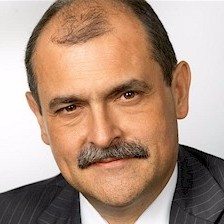 Franz Hörmann, born 1960, Univ.-Prof. Mag. Dr.
Employed since 1983 at the Institute for Auditing, Trust and Accounting of the Vienna University of Economics and Business, and a licensed management consultant since 1997.
- 1995–2015: corresponding member of the Data Processing Senate of the Austrian Chamber of Chartered Accountants
- 2001–2010: visiting professor at the Institute of Business Informatics (Communications Engineering) at the University of Linz
- 2001–2010: lecturer at the FHW (University of Applied Sciences of the Vienna Chamber of Commerce)
- 2001–2015: examiner in the training of chartered accountants at the Austrian Chamber of Chartered Accountants
First came to public attention in 2011 as a critic of interest-bearing debt money with his work “Das Ende des Geldes” (The end of money, German); he developed the new form of money “Informationsgeld” (information money, German) and is bringing it to market as OSBEEE:Money with the OSBEEE cooperative. Co-founder of the “Interdisciplinary Research Institute for Systemic Sciences” (IRISS). Franz Hörmann is married and the father of two children (daughter Sophie, born 1996; son Leonhard, born 1999).
CONTACT BY EMAIL MY WEBSITE (German) SUBSCRIBE TO MY NEWSLETTER (German)
Next constellation dates on the paradigm shift
- Wed, 5 December 2018: “Freie Energie” (Free energy, German)
- Wed, 27 February 2019: “Bedingungsloses Grundeinkommen” (Unconditional basic income)
- 2nd quarter of 2019: “Energiewende” (Energy transition)
In many areas, GAIA pursues the same goal as I do. So in December 2017 we decided to use GAIA as an information platform and to contribute a series of articles. I look forward to interacting actively with readers and interested people through GAIA and its network.
Notes on content provided by authors
Comments
Loading comments …
Become a member to comment publicly. GAIA members write comments in the members' portal — under their nickname, visible to everyone.