Anticipation is the magic word

Herbert Saurugg is a recognised expert on blackout scenarios.
To support and show our appreciation for his work, we help to spread his information.
After four years, we are pleased to present the “Vernetzung und Komplexität” (Networking and complexity) website in a new design. We have tried to present the content in a more appealing and concise way. Some content is still waiting to be revised. If you find any mistakes or have any other suggestions, we look forward to your feedback (German)!
Three new practical guides
In recent months, three new practical guides (German) on blackout preparedness have been produced, designed to support the following areas of organised assistance:
- Guide “Die Gesundheits(not)versorgung nach einem Blackout” (Emergency healthcare after a blackout, German)
- Guide “Mein Krankenhaus auf einen weitreichenden Strom- und Infrastrukturausfall vorbereiten” (Preparing my hospital for a widespread power and infrastructure failure, German) (a further development of the previous guide “Der Krankenhausbetrieb im Fall eines weitreichenden Strom- und Infrastrukturausfalls” – Hospital operations in the event of a widespread power and infrastructure failure)
- Guide “Meine Feuerwehr auf einen weitreichenden Infrastrukturausfall („Blackout“) vorbereiten” (Preparing my fire brigade for a widespread infrastructure failure, German)
Here, too, we welcome feedback and experiences (German). For guides like these are never finished and can only offer suggestions.
“Emergency healthcare after a blackout”
As the workshop “Die Gesundheits(not)versorgung nach einem Blackout” (German) with around 100 participants from the Austrian healthcare sector unfortunately confirmed once again at the beginning of September, there is still a great deal of unfinished work in blackout preparedness. Alongside personal preparedness and self-efficacy, local self-organisation and help between neighbours, decentralised emergency healthcare after a blackout plays a fundamental role. For healthcare will in no case be able to continue at the usual and expected level, nor at the quality that is actually always necessary. Quite the opposite. Because people have not engaged with such a rare event and preparations are still inadequate, an unimaginable disaster and human suffering are looming here. An existing emergency power supply is only a small part of the measures required. If we are to prevent an early collapse of medical care, or of hospital operations as a whole, we must succeed in organising decentralised emergency care for at least two weeks! Because that is at least how long it will take for supplies that are vital for hospitals too (including medicines and medical goods) to get going again on a broad scale. Here, the district administrative authorities in particular are called upon to coordinate. Not only once the crisis hits, but NOW.
Three phases instead of two
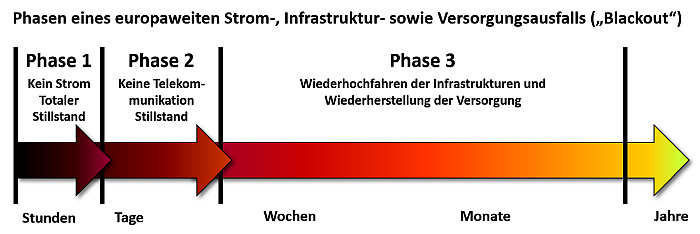
Many preparations focus on the time during which the power may be out. That is why the previous two-phase model has been extended by a third phase (German). Phase 2 in particular – when the power is already flowing again but telecommunications are not yet working, or only to a limited extent – is completely underestimated. Without telecommunications, neither production, logistics nor the fuel supply (German) will work! And it is precisely in the telecommunications sector that there are considerable uncertainties (German) about how long restoration will take. Of course this is directly related to how long the power was out – for example, whether the emergency power supply for critical areas was sufficient. On the other hand, we should assume that we are completely underestimating the transnational dependencies throughout logistics. In a widespread blackout, no deliveries come in from outside and none go out. All supply chains come to an abrupt standstill. For even if shorter outages are to be expected in Austria, we will feel the longer-lasting problems to be expected in other countries directly in our own supply!
Hence the words of warning from Karl-Dieter Brückner, Austrian Red Cross regional rescue commander for Vienna, at the healthcare workshop: “Question your expectations of third parties and don’t let yourself be fobbed off with ‘everything is covered’. You – all of us – could be in for a very nasty surprise. What was still normal a few years ago is often no longer there today. There are no warehouses, etc.”
Personal preparedness is the fundamental basis!
We have repeatedly raised the indispensable role of personal preparedness here as an essential precondition for technical and organisational preparations to work. Unfortunately, in-depth surveys show again and again in practice that there are considerable shortcomings everywhere. Even among those who claim to have looked into the scenario more closely. For with this subject in particular, it is a vicious circle! If, as we recently saw once again, not even the members of emergency services and their families can look after themselves for at least a week, how is a real deployment supposed to work? This of course also applies to all the other organisations that will then have to get the systems running again. But which staff will turn up for a deployment (or for work) if a personal crisis has already broken out at home after just a few days? Are we really so naive and starry-eyed as to believe that it will all somehow work out? Apparently so.
For all those who would like to do something for themselves and their own family after all, the guides offer suggestions (German). For those who would rather rely on a ready-made product, our partner Krisenvorsorge.at offers a suitable range. As a special offer, when you buy a blackout box >>here<< (German) with the voucher code “Blackout-Vorsorge2018”, you get a crank and dynamo lamp (link (German)) worth 19.99 euros free of charge. (Offer from October 2018.)
Anticipation is the magic word
This important statement was made recently by the well-known Austrian criminal psychologist Thomas Müller: “The best preparation for unexpected events is to engage mentally with the fact that such events can happen at all. This creates important alternative courses of action that can be called up more easily when needed.” Thinking ahead to events in this way is called anticipation.
Another noteworthy statement came from the head of the Disaster Research Unit in Berlin, Martin Voss: “Politicians and the authorities avoid the debate for fear that it would cause panic among the population. An unfounded worry: people are perfectly able to engage with the danger of an emergency without panicking.”
Safety communication
It is therefore encouraging that there will be several in-depth media reports on blackout preparedness in Austria in October 2018. The Upper Austrian Civil Protection Association (German), for example, is currently running a broad campaign on the radio, in cinemas and on posters.
Background research on addendum.org
From Monday, 8 October 2018, the research platform addendum.org (German) will run a multi-part series on blackout preparedness in Austria.
TV 1: ServusTV – Is Austria prepared for a blackout?
On Thursday, 11 October 2018, at 9:15 pm, ServusTV will broadcast the Im Kontext report “Ist Österreich für ein Blackout gerüstet? (Is Austria prepared for a blackout?, German)”.
TV 2: 3sat – Power off – How safe are our grids?
On Tuesday, 16 October 2018, at 11:15 pm, 3sat (German) will show a repeat of the documentary Strom aus – Wie sicher sind unsere Netze? (Power off – How safe are our grids?, German).
TV 3: Am Schauplatz
On Thursday, 25 October 2018, at 9:05 pm, ORF 2 will broadcast an edition of Am Schauplatz (German) on blackout preparedness. This programme reaches around 600,000 people on average.
Blackout flyer
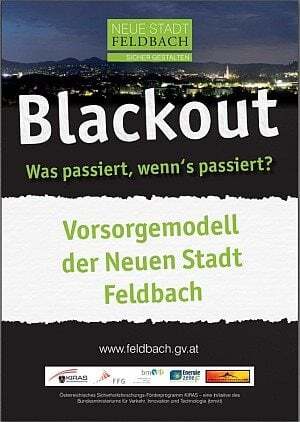
In the south-east Styrian municipality of Feldbach (German), every household received a blackout flyer (part 1, German) at the beginning of September 2018. In winter there will be a broad campaign and a further flyer (part 2 – What can I do?) to keep informing the people of Feldbach and encourage them to prepare for a blackout. The flyer was produced as part of the security research project Energiezelle F (Energy cell F, German) and other municipalities are welcome to adopt it. Simply get in touch with us (German).
Five years at most
Perhaps these reports will at last spark a broad public debate. We still have a little time. Unfortunately, nobody knows how much time is really left for preparations. Given the way developments have gone in recent months, and how they continue to look for the next five years, we do not expect to get through this period unscathed. Things are likely to become particularly critical again for Belgium (German) from November 2018. Six of its seven nuclear reactors have to be taken off the grid for repairs. It is not yet clear how the missing capacity can be replaced by imports from the European grid. People are counting on European solidarity. Only this is not about virtual values, as with money. The infrastructure also has to be able to cope with the loads required. Normally this will succeed. As long as no further event comes on top. That could then end badly for the whole of Europe.
A planned but rushed coal phase-out in Germany is also making the situation worse. Less because of the missing capacity than because of the associated loss of instantaneous reserve (German). As we unfortunately see again and again, this is hardly known and not taken into account. The European grid is still assumed to have unlimited capacity and to be stable at all times. In addition, more and more countries want to meet their electricity needs through imports in future (German). Only nobody says where that electricity is then supposed to come from.
As if all this were not enough, this summer a warning from the German Cyber Defence Centre (German) became public, according to which a Europe-wide blackout caused by a cyber attack is considered possible.
The technologically high-powered society is more vulnerable than ever
This fits the article in the Neue Zürcher Zeitung (German) on the bridge collapse in Genoa, which states:
As long as bridges hold, nobody talks about them. When they collapse, they instantly become symptoms of crisis. An enormous carelessness characterises our relationship with infrastructure. The more invisible infrastructures become in their routine functioning, the greater the risk of accidents and disasters.
It is precisely this taking-for-granted that lulls us and makes us extremely careless. Sadly, this is all the more true of our (vitally) important power supply. Wisdom about how the disaster came about, as is usual after cyber attacks, could come too late here:
Audio: Schattenseiten der Vernetzung (The dark side of networking, German)
All in all, unfortunately, no good news again. But the future does not just happen – WE shape it. How it develops is in all our hands. Each individual naturally feels powerless here. But things can only change if many people get moving. Let us start with ourselves, in our family, in our neighbourhood or municipality.
Have you ever talked to your boss or your mayor about this? Or to your doctor, if you or members of your family perhaps need medical services more often? Why might this be important for you and your family? Why might you now want to tackle it? By the way, the supply of medicines is no longer guaranteed in a blackout, not even for hospitals. For their stocks, too, soon run out. Nonsense? Then see Viele Impfstoffe sind knapp, weil es zu wenige Anbieter gibt (Many vaccines are scarce because there are too few suppliers, German) or, more starkly still:
Audio: Medikamentenversorgung in einem Krankenhaus (The supply of medicines in a hospital, German)
Various reports
A collection of various media reports (German) without further comment. All links lead to German-language pages unless marked otherwise.
Crisis management and preparedness
- Katastrophenschutz: Was man zuhause haben muss, wenn der Notfall eintritt (Disaster protection: what you need at home when an emergency strikes)
- Viele Impfstoffe sind knapp, weil es zu wenige Anbieter gibt (Many vaccines are scarce because there are too few suppliers)
- Alles ist relativ … 400.000 Tode pro Jahr (Everything is relative … 400,000 deaths a year) in the EU from air pollution
- Stadtgemeinde Feldbach sensibilisiert die Bevölkerung und bindet diese in die Blackout-Vorsorge ein (Feldbach raises awareness among its population and involves it in blackout preparedness)
- Workshop „Die Gesundheits(not)versorgung nach einem Blackout“ (Workshop: emergency healthcare after a blackout)
- Die technisch hochgerüstete Gesellschaft ist verletzlicher denn je (The technologically high-powered society is more vulnerable than ever)
- Parlamentarische Anfrage: Vorbeugende Maßnahmen und Informationspolitik des Verteidigungsministers bezüglich eines potenziellen Blackouts (Parliamentary question: the defence minister’s preventive measures and information policy regarding a potential blackout)
- Bevölkerung unterschätzt Gefahr von Blackout – Es wird kaum Vorsorge für einen Notfall getroffen (Population underestimates the danger of a blackout – hardly any provision made for an emergency)
- Keine Veränderung ist auch keine Option (No change is not an option either)
- So bereiten sich Salzburgs Feuerwehren auf ein Blackout vor (How Salzburg’s fire brigades are preparing for a blackout)
- Eine Pandemie hätte ähnlich verheerende Auswirkungen wie ein Blackout (A pandemic would have similarly devastating effects to a blackout)
- Novelle Telekommunikationsgesetz / Streichung Amateurfunkgesetz (Amendment to the Telecommunications Act / repeal of the Amateur Radio Act)
- Vorsorgen für den Blackout (Preparing for the blackout)
- Krisenszenarien werden zu wenig geprobt (Crisis scenarios are not rehearsed enough)
- Was tun wir, wenn das Licht ausgeht? (What do we do when the lights go out?)
- Commenda: “Die Österreicher sind auf Krisen überhaupt nicht vorbereitet” (Commenda: “Austrians are not prepared for crises at all”)
- Wenn nichts mehr geht (When nothing works any more)
- Großkrankenhaus überprüft Notfallsysteme (Large hospital checks its emergency systems)
- Funkmarathon ALLS OE3 2018 Abschlussbericht (ALLS OE3 radio marathon 2018: final report)
Power supply
- Die Energiewende – Fiktion und Wirklichkeit (The energy transition – fiction and reality)
- Wie bleibt unser Stromnetz stabil? (How does our power grid stay stable?)
- Weckruf: Orchestrieren statt Steuern (Wake-up call: orchestrate rather than control)
- Die Abwendung von der physikalischen Wirklichkeit ist die Schwachstelle der Energiewende (Turning away from physical reality is the weak point of the energy transition)
- Extremwetterlagen verursachten 2017 fast ein Fünftel der (Telekom)Netzausfälle in Europa (Extreme weather caused almost a fifth of (telecom) network outages in Europe in 2017)
- „Wer ein Land lahmlegen will, versucht, bei Kraftwerken und Netzen anzusetzen“ (“Anyone who wants to paralyse a country tries to start with power stations and grids”)
- Die Gefahr lauert im Stromnetz (The danger lurks in the power grid)
- Strompreis an Leipziger Börse klettert auf Rekordhoch (Electricity price on the Leipzig exchange climbs to a record high)
- Hitzewelle zwingt Kraftwerke in die Knie (Heatwave brings power stations to their knees)
- How hacked water heaters could trigger mass blackouts (English)
- Software sorgt für Stromausfälle (Software causes power cuts)
- Hochleistungsserver soll Netzstabilität sichern (High-performance server to safeguard grid stability)
- Massiver Stromausfall in Schleswig-Holstein (Massive power cut in Schleswig-Holstein)
- Folgenschwerer Stromausfall – ein Beispiel von vielen! (A power cut with serious consequences – one example of many!)
- Netzbetreiber richten Plattform für Netzstabilität ein (Grid operators set up a platform for grid stability)
- Neuer Kostenrekord für die Stromnetz-Stabilisierung (New cost record for stabilising the power grid)
- SBB blockt Heizungen im Zug – um Blackouts zu verhindern (Swiss Federal Railways blocks train heating – to prevent blackouts)
- Stromausfall am fünftgrößten Flughafen Deutschlands – Flughafen Hamburg (Power cut at Germany’s fifth-largest airport – Hamburg Airport)
Cyber security
- Cyberangriffe auf Kliniken: Wie sicher ist die moderne Medizin? (Cyber attacks on hospitals: how safe is modern medicine?)
- Die Big-Data-Lüge (The big data lie)
- Wenn die Welt plötzlich offline ist (When the world suddenly goes offline)
- Cyber-Angriffe auf Kritische Infrastrukturen (Cyber attacks on critical infrastructure)
- Lücken bei der Cybersicherheit im Bereich kritische Infrastruktur (Gaps in cyber security for critical infrastructure)
- BSI warnt vor Angriffen auf Stromnetze (German Federal Office for Information Security warns of attacks on power grids)
A look at the situation in the European power supply system
The examples given come solely from publicly available sources. They show the current challenges and should remind us of the turkey illusion (German).
- Current situation (German) – a summary of the current challenges in the European power supply system;
- Analysis of redispatching & intraday stops (German) – an analysis of interventions to stabilise the grid; the cost of congestion management in Austria rose again in the first quarter.
- Droht in Belgien der Blackout? (Is Belgium facing a blackout?, German)
- Damit der Schweiz der Strom nicht ausgeht (So that Switzerland does not run out of electricity, German)
- Alle wollen importieren, nur niemand sagt, woher der Strom dann wirklich kommen soll (Everyone wants to import, but nobody says where the electricity is really supposed to come from, German)
- In August 2018 the cost of congestion management (German) in Austria again reached a peak and, at around 22.6 million euros, was almost as high as in the whole of 2015!
- Since 22 September there have again been negative electricity prices (German) for the first time since May. Only a few days earlier, a MWh had even cost over 90 euros. The extremes are clearly increasing. The electricity price has also risen markedly: whereas in August 2016 a MWh cost around 25–30 euros on average, in 2018 it was already 55–60 euros. See, for example, the following chart of electricity prices in August 2018 and August 2016 (click to enlarge):


Notes on content provided by authors
Comments
Loading comments …
Become a member to comment publicly. GAIA members write comments in the members' portal — under their nickname, visible to everyone.