Global trend towards solar and wind power analysed

Herbert Saurugg, saurugg.net
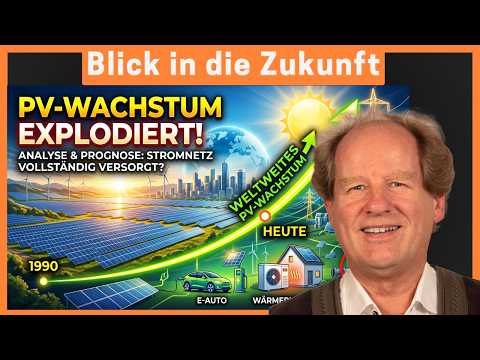
An article based on Eduard Heindl’s analysis “Weltweiter Trend zu Solar- und Windenergie analysiert” (Energievortrag #029, 1 August 2026, in German).
In a nutshell
The last 30 years show an extremely stable upward trend in solar and wind power. If this trend is projected forward, global electricity demand could, on paper, be covered entirely by solar and wind energy around 2050. Decarbonising the entire energy demand (not just electricity), however, will take considerably longer.
Why this analysis is different
Many forecasts on the energy transition rest on detailed technical assumptions, political targets or short-term market developments. Eduard Heindl takes a different approach: he looks at the electrical energy actually generated (in terawatt hours, TWh) over the past three decades and identifies long-term trends from it.
The result: solar and wind energy follow a remarkably stable, almost linear growth path – a pattern that, over 30 years, has hardly been “bent” by individual policy measures or economic fluctuations.
The status quo: where do solar and wind stand today?
- Leading producers in 2025: China, Germany, India, the USA and, surprisingly, Brazil each generate more than 100 TWh of solar and wind power per year.
- Africa is lagging behind: the continent as a whole is still weak, with exceptions such as Egypt and South Africa.
- In the global mix: together, solar and wind have already overtaken hydropower and nuclear energy (measured in the CO₂ equivalent of “coal saved”). Fossil fuels, however, still dominate global primary energy demand.
The decisive finding: a stable trend over 30 years
If the annual solar and wind power generation of the last ~30 years is plotted, the result is exponential growth. On a logarithmic scale this becomes an almost straight line – a clear indication of a very stable, long-term trend.
Heindl stresses: “Experience shows that such long-standing trends often continue; they are more robust than short-term forecasts that rely heavily on detailed technical assumptions.”
The forecast model: damped but continuing growth
Instead of unlimited exponential growth (“trees don’t grow to the sky”), Heindl models a declining growth rate:
- Annual growth tends to fall (from around 40 % in earlier years to around 18 % today).
- But it remains positive (e.g. 5–10 %).
This damped growth model matches the historical data points over 30 years much more closely than a simple exponential extrapolation.
Result of the projection:
- By 2030: about 10,000 TWh of solar and wind power
- By 2040: considerably more, with the curve still rising
The intersection: 2050 as a milestone for the power sector
Global electricity consumption, for its part, grows very steadily at about 3 % per year. If both curves are laid on top of each other (solar/wind generation vs. electricity consumption), they intersect around 2050:
By then, as much solar and wind power could be generated globally as electricity is consumed worldwide.
That means a 100 % renewable electricity supply in the power sector – not automatically a 100 % renewable total energy supply.
The big hurdle: electricity vs. total energy demand
At around 186,000 TWh, global primary energy demand (converted into electricity equivalents) is far higher than electricity consumption (in the range of ~20,000–30,000 TWh).
Even if electricity came 100 % from solar and wind, large sectors would remain a challenge:
- Industry: e.g. chemical plants, high-temperature processes
- Heating: parts of building and process heat
- Transport: despite electrification, residual shares remain (aviation, heavy goods, shipping)
Heindl is also sceptical as to whether Germany can realistically reach its goal of a 100 % renewable energy supply by 2045 – the electricity transition, he says, is easier than the complete energy transition.
What this means for crisis preparedness and resilience
The analysis underlines that the expansion of solar and wind is not a short-term hype but a long-term, structural trend. At the same time, it implicitly warns against overly simple “100 % promises”:
- Integrating large shares of volatile generation remains a systemic challenge.
- Storage needs, grid stability and the decarbonisation of sectors that are hard to electrify are unresolved questions.
- The transition phase with high shares of volatile renewables requires robust, decentralised structures with storage capacity.
This is exactly where the work of the Gesellschaft für Krisenvorsorge (GfKV, Society for Crisis Preparedness) comes in: energy cell systems, microgrids and emergency concepts are not alternatives to the energy transition – they are necessary building blocks for making it crisis-proof.
Conclusion: 2050 is not an end point but a turning point
The message is clear: the energy transition is progressing, but the path is complex. 2050 marks a possible turning point for the electricity supply – not the end of the challenges.
For municipalities, businesses and private households this means:
- Planning certainty: solar and wind will keep growing – investments in these technologies are viable in the long term.
- Think resilience: decentralised structures, storage capacity and emergency concepts are not “insurance against the worst case” but essential elements of a robust energy system.
- Stay realistic: decarbonising the entire energy demand will take longer than the electricity transition – that requires patience, but also clear priorities.
This article first appeared in German on saurugg.net – with kind permission of Herbert Saurugg. Licence: CC BY-NC-SA 4.0, Herbert Saurugg. Translated from German by GAIA.
Cover image: seagul / Pixabay
Notes on content provided by authors
Comments
Loading comments …
Become a member to comment publicly. GAIA members write comments in the members' portal — under their nickname, visible to everyone.