Grid integration challenges
Herbert Saurugg, saurugg.net
In this post I want to collect and link the EIT lecture series with Hanane Oudli, founder and CEO of Hanane Global. She sheds light on very important and often still overlooked aspects of the energy transition and shows how they can be dealt with.
Key messages
- The energy transition is changing not only the power plant fleet but also the physical foundations of the power grid.
- Modernising the grid therefore concerns not only individual components but the interplay of generators, storage, loads, protection systems and controls.
- The grid is changing – and engineering must change with it.
Part 1: Grid integration challenges: renewable penetration, inertia, and the rise of AI data centre load
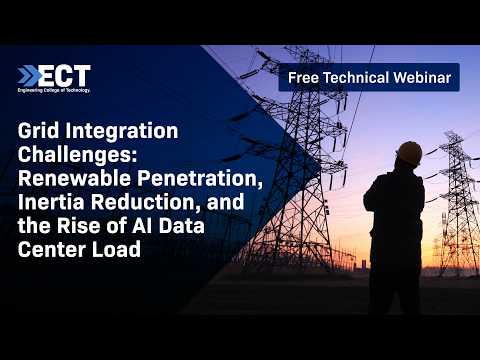
When the power grid becomes faster, more variable and more demanding
The energy transition is changing not only the power plant fleet but also the physical foundations of the power grid. Solar and wind energy are growing worldwide into central components of electricity generation. At the same time, electricity demand is rising sharply due to AI applications and large data centres.
Core message: Two developments are colliding: generation is becoming more variable, while demand is becoming larger, more dynamic and less tolerant of supply interruptions. It is precisely this combination that poses new tasks for grid planning, grid operation and system stability.
Renewables change the logic of the grid
Solar and wind power are indispensable for a low-emission energy supply. Unlike conventional power stations, however, they do not deliver output that can be controlled at any time.
The output of photovoltaic installations can change within minutes when clouds pass over. With wind turbines, output depends on the weather and can change significantly over hours. Coal, gas or hydro power stations, by contrast, offer plannable and controllable generation.
A high share of renewables creates four challenges in particular:
- Low visibility: many rooftop and small installations are not fully known to the grid operator.
- Limited central controllability: the feed-in of numerous decentralised installations cannot be dispatched like the output of a large power station.
- Forecast uncertainty: weather-dependent generation is harder to predict both the day before and within the current day.
- Voltage and power quality problems: high photovoltaic feed-in can cause challenges, especially at the edges of the distribution grid.
Integrating renewables into the grid is therefore not merely a question of additional generating capacity. Better measurability, communication, forecasts and control options are needed just as much.
Less rotating mass, faster frequency problems
A second focus of the talk is declining grid inertia (German).
Conventional generators have large rotating masses. These store kinetic energy and act like a shock absorber when there is a sudden imbalance between generation and consumption: if a power station fails or demand rises unexpectedly, rotational energy is released immediately. As a result, the grid frequency initially changes comparatively slowly.
Photovoltaic installations and many modern wind turbines, by contrast, are connected to the grid via power electronics. They therefore do not automatically have the same physical rotating mass as a synchronous generator.
If system inertia falls, an identical disturbance has greater consequences:
- The frequency falls faster.
- The frequency gradient, the so-called rate of change of frequency (RoCoF), increases.
- Protection relays and generating installations can disconnect if the values are too high.
- As a result, a disturbance can under certain circumstances spread like a cascade. [This is what happened in the 2025 blackout on the Iberian Peninsula (German)!]
Grid operators are responding, among other things, with RoCoF limits and new requirements for the system inertia to be provided. Battery storage and grid-forming inverters may play an important role in providing so-called synthetic inertia in future. See the next talk.
AI data centres become large consumers relevant to the grid
On the consumption side, artificial intelligence is creating a new class of large loads. Training and running large AI models requires considerable and continuous computing power. In many regions, AI data centres are already among the largest new loads seeking connection to the grid.
These loads differ in several respects from conventional industrial or commercial consumers:
| Property | Significance for the power grid |
|---|---|
| **High output** | A single facility can reach the electricity demand of a small town. |
| **Continuous operation** | Data centres need an almost uninterrupted supply. |
| **High sensitivity** | Voltage dips or frequency deviations can impair sensitive IT systems. |
| **Rapid load changes** | AI training loads can change their power consumption quickly and strongly. |
For grid operators, this raises not only questions of connection capacity. The effects on voltage quality, frequency behaviour and the planning of reserve capacity are just as important.
Supply and demand are developing in opposite directions
The central tension of the talk lies in the combination of both developments:
- On the generation side, variability is increasing.
- On the consumption side, large, sensitive and fast-reacting loads are growing.
- At the same time, classic rotating system inertia is declining.
The power grid must therefore cope with fluctuations on the generation side while at the same time supplying consumers who place very high demands on availability and power quality. Modernising the grid therefore concerns not only individual components but the interplay of generators, storage, loads, protection systems and controls.
Simulation becomes an indispensable planning tool
An important practical point of the talk is the role of grid simulations. Critical faults cannot simply be tried out in the real power grid. Engineers therefore model generators, renewable installations, consumers and control systems in digital grid models.
Two modelling approaches are distinguished:
RMS simulation
RMS or phasor-domain simulations are suitable for slower, large-scale stability studies. They look at processes in the range of seconds to minutes, for example:
- Frequency and angle stability.
- Reactions of large grid areas.
- Behaviour after the failure of a power station.
- Effects of different generation and load scenarios.
EMT simulation
EMT simulations, i.e. electromagnetic transient simulations, model fast processes in much greater detail. They work in the range of microseconds to milliseconds and are particularly relevant for:
- Inverter dynamics.
- Fault and short-circuit behaviour.
- Fast frequency and voltage processes.
- Investigating inertia and protection responses.
Real disturbances can be reproduced in the models, such as the sudden failure of a generator. It is then possible to examine how the grid behaves with different levels of renewable penetration or with different load profiles of AI data centres.
The results can support decisions on grid connection rules, storage sizes and the use of grid-forming technologies. Simulation thus serves not only for subsequent fault analysis but for proactive risk reduction.
Conclusion
The talk paints a picture of a power grid undergoing structural change. Renewables make feed-in more variable and in part harder to see, while the decline of conventional generators reduces natural grid inertia. At the same time, AI data centres are creating large, permanent and highly sensitive electrical loads.
The central message is therefore: the energy transition cannot be managed by adding generating installations alone. Grid operators and planners need better visibility, new stability mechanisms, adapted grid rules and powerful simulation models.
Or, in the concise wording of the slides: the grid is changing – and engineering must change with it.
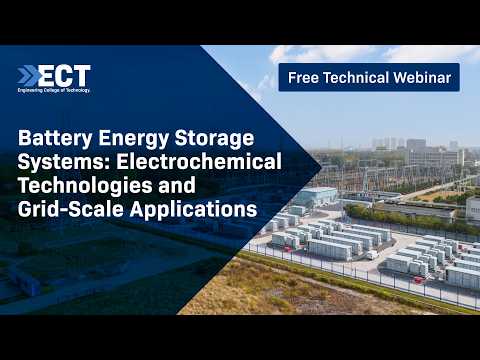
Part 2: Battery energy storage systems: electrochemical technologies and grid-scale applications
This is the second webinar in a five-part webinar series on “The evolution of modern power systems – grid integration, battery storage (BESS) and the modern power grid in practice”. Battery storage is one of the most discussed solutions in the energy industry today – and is quickly becoming indispensable infrastructure for supplying electricity in all areas, from private households to AI data centres.
This session gives a clear, easy-to-understand overview of the most important battery technologies used for grid storage, explained using everyday comparisons, and shows why lithium-ion batteries have become the industry’s favourite.
This article first appeared in German on saurugg.net – with kind permission of Herbert Saurugg. Licence: CC BY-NC-SA 4.0, Herbert Saurugg. Translated from German by GAIA.
Cover image: analogicus / Pixabay
Notes on content provided by authors
Comments
Loading comments …
Become a member to comment publicly. GAIA members write comments in the members' portal — under their nickname, visible to everyone.