What matters in an uncertain future?

Herbert Saurugg, saurugg.net
What matters in an uncertain future?
In the sixth episode of the series “How to Think About the Future”, Nate Hagens (The Great Simplification) examines how people can act sensibly under conditions of great uncertainty. His central message: we do not need a precise prediction of the future, but a decision logic that holds up in as many conceivable future scenarios as possible.
It is particularly important, he says, to avoid irreversible losses, to build local capacity to act and not to follow the growth paradigm blindly.
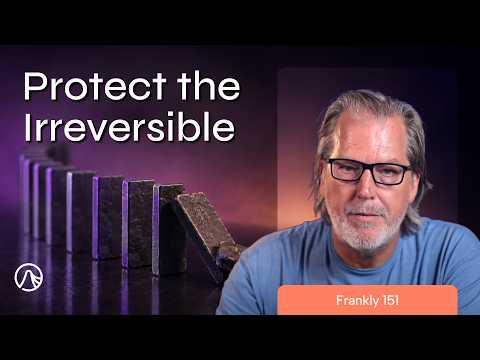
Here is a summary.
The future as a space of possibilities
Hagens does not see the future as a straight line but as a landscape with different paths, bottlenecks, forks and tipping points. The economy, energy supply, geopolitical order, social cohesion and the stability of ecosystems influence one another.
This has an important consequence: nobody can say with certainty which specific future will occur. Scenarios of long-term stabilisation are possible, as are authoritarian, fragmented or increasingly disintegrating forms of society.
Planning should therefore not be geared exclusively to a single picture of the future. Measures that remain useful under different conditions make more sense.
Two kinds of failure
When acting under uncertainty, Hagens distinguishes two fundamental errors:
- Errors of omission: a real danger is underestimated or ignored. Examples are inadequate protection of soils and biodiversity, a lack of municipal resilience or too slow a transformation of the energy system.
- Errors of commission: people do react, but base their response on an incomplete model and thereby make other problems worse. A measure can seem sensible in one area but trigger cascade effects elsewhere.
The challenge is neither to wait passively for complete certainty nor to push through a single, possibly wrong solution with excessive confidence.
Growth as a false positive signal
One of the sharpest theses of the episode concerns the assumption that the economy will grow permanently. According to Hagens, governments, companies, financial systems and institutions treat growth not as one possible scenario but as a stable foundation for all their planning.
Should this assumption no longer hold, many projects that make sense today could become problematic:
- Infrastructure designed for expansion becomes a permanent maintenance burden when the economy shrinks.
- Financial instruments that depend on steady appreciation and compound interest lose their basis.
- Institutions meant to distribute growing surpluses are poorly prepared to deal with shrinking resources.
- Large projects can create new dependencies and burdens if they are wrongly sized.
Hagens is not criticising every form of investment or technological progress. Rather, he warns against automatically gearing measures to a future in which more energy, more raw materials, more capital and more economic activity are available.
Reversible and irreversible losses
The most important yardstick of the episode is the distinction between reversible and irreversible losses.
Money, jobs, market share or certain material goods can in principle be regained. Other losses, by contrast, can only be reversed over very long periods or not at all:
- fertile soils
- groundwater reserves
- extinct species
- pollinator populations
- social trust
- institutional experience
- democratic norms
- physical and mental health
The current economic and political system often optimises for short-term measurable quantities such as gross domestic product, efficiency and quarterly profits. As a result, reversible values are protected while irreversible foundations can gradually erode.
The priority derived from this is: it can be reasonable to sacrifice money, efficiency or comfort in order to preserve soils, ecosystems, social relationships and human development.
For energy and infrastructure projects, for example, this means looking not only at costs and performance. Maintainability, local security of supply, ecological follow-up costs, knowledge transfer and the question of whether damage can actually be repaired later are just as relevant.
Robust measures instead of bets on the future
Hagens recommends measures that remain useful in many different future scenarios. These include in particular:
- Strengthening soil fertility and local ecosystems.
- Building neighbourhood and community relationships.
- Learning practical skills such as repair, food production, first aid and water management.
- Reducing dependence on fragile global supply chains.
- Making local energy, food and water systems more resilient.
- Passing on knowledge within organisations and communities.
- Cultivating trust and the ability to cooperate.
Such measures make sense both in a relatively stable future and in a phase of economic or social disruption. A local energy cell, a functioning neighbourhood network or well-documented technical knowledge are not just crisis preparedness. They also improve a community’s autonomy and adaptability under normal conditions.
The basic idea is: under real uncertainty, robustness is more important than maximum optimisation. A system that is particularly efficient under only one ideal condition can be more vulnerable than a somewhat less optimised system that can cope with several disruptions.
General and personal commitments
Not every sensible strategy has to be geared to all conceivable futures. Hagens leaves room for personal priorities. People can devote themselves with great passion to a particular task – such as protecting marine ecosystems, nuclear disarmament, preserving a language or restoring a river.
These focused commitments arise from a special personal attachment. It is precisely this passion that can enable long-term work that cannot be justified by general resilience arguments alone.
For most people, a combination of two elements is advisable:
- A foundation of robust measures that help one’s own household and local community in many scenarios.
- One or two personal focus projects that match one’s own values and interests.
Capacity to act at the local level
In the face of global crises, it is easy to feel powerless. Individuals cannot change the global energy system or planetary development on their own.
Hagens therefore suggests looking for capacity to act where results become visible:
- in one’s own household
- in the garden or living environment
- in personal relationships
- in the neighbourhood
- in local associations and institutions
- in one’s own company
- in a region or catchment area
At these levels, the connection between action and effect is immediately recognisable. Anyone who takes part in a local initiative, passes on knowledge, builds a community garden or improves a municipal emergency structure creates concrete change.
Many such local contributions can later enable larger social changes, even if the individual contribution is barely visible at the global level.
“Constrained” does not mean predetermined
Hagens stresses that physical and ecological limits constrain the future but do not determine it completely. Humanity cannot consume any amount of energy and material it likes or permanently overload ecological systems.
Within these limits, however, there are great differences between possible developments. The range extends, for example, between:
- communities that cooperate in difficult times and those that fall apart;
- regions with functioning local supply systems and regions with high dependence;
- a future of gradual repair and a future of increasing loss of control;
- a world in which coming generations still find viable living conditions and a world with significantly restricted options.
The future is therefore not completely open, but not fixed either. Decisions at household level, in organisations, municipalities and regions influence which of the possible developments become more likely.
Conclusion
The episode does not provide a concrete to-do list or a forecast for a particular future scenario. Instead, it develops a method for decisions under uncertainty:
- Do not bet on a single future.
- Take omitted measures as seriously as wrong measures.
- Assess reversible and irreversible losses differently.
- Prioritise natural foundations of life and social cohesion.
- Build robust structures rather than maximum short-term efficiency.
- Act where your own impact becomes visible.
- Additionally pursue personal topics for which you feel a special responsibility or passion.
Perhaps the most important question from the episode is therefore:
What can I protect, build or pass on today that will remain valuable even under very different future conditions?
In this way, preparing for the future changes from an attempt to eliminate uncertainty into a practice of orientation, resilience and the conscious protection of what cannot easily be restored.
Nate Hagens, “What Matters Most in an Uncertain Future? | How to Think About the Future Pt 6”, Frankly 151, published on 17 July 2026.
This article first appeared in German on saurugg.net – with kind permission of Herbert Saurugg. Licence: CC BY-NC-SA 4.0, Herbert Saurugg. Translated from German by GAIA.
Cover image: Babel_hospitality / Pixabay
Notes on content provided by authors
Comments
Loading comments …
Become a member to comment publicly. GAIA members write comments in the members' portal — under their nickname, visible to everyone.