Ricardo Leppe & Richard Kandlin: learning to read

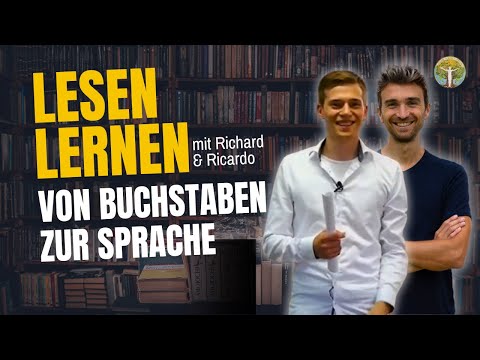
From letters to language | New perspectives
Why do many children struggle to learn to read even though they actually have what it takes? Richard Kandlin and Ricardo Leppe question traditional reading methods.
🔍 Key problem areas:
We have tried to summarise the most important information from the video here for you, as at around 45 minutes the video takes up quite a lot of time – but its content is absolutely valuable.
- The standard focus on letters is not enough. Starting with sound-letter correspondence (phonics) often falls short.
- Missing connection between letters and meaning. Reading is more than mere decoding – real reading competence only arises through making sense.
💡 Approach: building a bridge to language:
- Examples from teaching illustrate: Children who work on reading aloud with motivation develop their own reading strategy more quickly.
- Success factors are: trust in the child’s experience, less frontal teaching, more learning support.
✨ Richard Kandlin shares insights from practice:
- Promote a holistic understanding of language: work with stories, conversations and understanding even before reading.
- Awaken motivation and curiosity: when children feel “reading power”, they learn faster and more easily.
- Individualised learning paths: everyone learns differently – flexible methods instead of a rigid curriculum.
Conclusion
Learning to read only succeeds in the long term when the meaning of words and sentences is at the centre – instead of teaching isolated letters. A linguistically rich, motivating and individual approach is the key to success.
Interview, approx. 45 min (German): Learning to read – from letters to language | New perspectives
Who is Ricardo Leppe?
Ricardo Leppe was originally an Austrian magician and memory trainer. As a child he was taught by his parents on long journeys. Through his work as a memory trainer he came into many schools and subsequently gave talks on alternative learning techniques. In April 2020 Ricardo Leppe founded the association “Wissen schafft Freiheit” and has since been helping a growing number of like-minded parents and teachers to found free schools. And this on the basis of up-to-date findings, with heart and with the child’s needs in absolute focus!
Who is Richard Kandlin?
Richard Kandlin was born in Pforzheim (Germany). He is an initiator who is mainly concerned with the so-called Shchetinin pedagogy – an alternative learning model based on the Russian boarding school Tekos. He is a graduate of the Shchetinin school in Tekos (Russia). He spent several years at this forest boarding school, where children learn in a self-organised way in mixed-age learning groups.
Since then he has been spreading and representing this method in the German-speaking world and giving talks and seminars on it. He founded KiEP – Kinder Entwickelte Pädagogik (child-developed pedagogy), a platform for the systematic implementation of his own ideas from the Shchetinin model.
As an author and speaker, in 2023 he published the book “11 Schritte die Schule zu verbessern” (11 steps to improve school), aimed at teachers, parents and pupils.
[Note from the GAIA editorial team: his work is sometimes viewed critically – particularly because of possible ideological and esoteric aspects in the environment of the Anastasia movement and völkisch-nationalist tendencies.]
More about our work (German)
Regional groups for free exchange
Would you like to support our VISION? See here what you can do.
Of course we are also happy about your COMMENT, your SUBSCRIPTION and your THUMBS UP.
Wissen schafft Freiheit – association for strengthening, educating about and spreading knowledge and education, Gloggnitz, Austria
Notes on content provided by authors
Comments
Loading comments …
Become a member to comment publicly. GAIA members write comments in the members' portal — under their nickname, visible to everyone.