The path of education: choice or hurdle?

Why free educational paths hardly stand a chance in the existing system
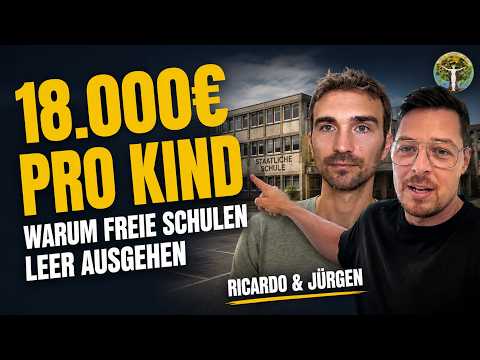
“Why is there an education budget for every child – but free schools, learning groups or homeschooling initiatives get nothing from it?” This is exactly the question Ricardo Leppe and Jürgen Bruckner ask in their latest conversation about the Austrian education system. It is not only about a lack of equal treatment, but about a structural problem that has hardly been discussed publicly for decades.
At the centre is the question of why alternative educational paths are permitted but almost completely disadvantaged financially – even though, according to Ricardo Leppe, between 15,000 and 18,000 euros of public funds are earmarked per schoolchild every year.
Educational freedom without equal rights?
Ricardo Leppe has been working for years on alternative education models, free learning spaces and self-directed learning. Together with Jürgen Bruckner and other campaigners, the idea of an umbrella association for free educational paths emerged. The aim is to make it easier to found schools, build networks and, in the long term, achieve more equal treatment in the education system.
The central criticism: parents who take their children out of the state system, found free schools or organise learning groups effectively lose access to the public funds originally intended for their children’s education.
According to Leppe, there is still hardly any transparent answer to the question of where this money actually goes when children choose alternative educational paths. This very lack of transparency was one of the triggers for looking more closely at the legal basis.
“They always talk about equal rights and freedom – but most people don’t even know that this unequal treatment exists.”
The legal background
In the conversation, Jürgen Bruckner describes how a team of lawyers examined the legal situation more closely. The starting point was decisions of the Austrian Constitutional Court on the financing of private schools and alternative forms of education.
The findings were sobering. According to the Constitutional Court decisions quoted in the video, the different treatment of state schools, denominational private schools and free educational initiatives is “objectively justified”. The state argues that comprehensive funding of alternative forms of education could lead to a “two-class society”.
Leppe and Bruckner are particularly critical of the structural preference given to denominational private schools, which enjoy a special historical and legal status. The video points out that parts of these regulations are historically closely linked to Austria’s relationship with the Vatican.
The core message of the court rulings is, in essence: state funding should primarily benefit those schools that are as similar as possible to the public school system.
From the point of view of the two speakers, this creates a fundamental contradiction: alternative educational paths are legally possible but systematically disadvantaged financially.
Why many parents are increasingly questioning the system
The conversation becomes particularly clear where Ricardo Leppe and Jürgen Bruckner talk about their personal motivation. Both are parents themselves – and both openly question whether the existing school system still meets the demands of our time.
The criticism is not directed solely at individual schools or teachers, but at the structure of a system that, in their view, has hardly changed for decades.
Digital transformation, new learning methods, individual talents, personal responsibility, practical skills or emotional development often fall short in the existing model. At the same time, enormous administrative costs arise, while small free educational projects often have to fight for their existence.
“Once I know how the system works, I can no longer send my child there.”
Both repeatedly stress that they are not seeking to destroy the existing system, but want more diversity, openness and real freedom of choice.
The umbrella association as a counter-model
This situation gave rise to the idea of an umbrella association for free educational paths. It is intended not only to provide legal orientation, but above all to connect people who want to build new forms of education.
Jürgen Bruckner describes the basic idea with a simple image:
“Breaking a single match is easy. Breaking ten million is difficult.”
In the long term, the association is to create a common voice for free educational initiatives – regardless of whether they are free schools, homeschooling networks, learning groups or other alternative learning models.
At the same time, both openly admit that fundamental change would only be possible in two ways:
- Through new political decisions and changes in the law.
- Through renewed legal proceedings with corresponding financial and social backing.
A fundamental question for society
The conversation makes it clear that this is about much more than school policy. At its core is the question of who education actually belongs to:
The state? The institutions? Or the families and children themselves?
While many countries are already relying more on flexible education models, project-based learning and individual support, alternative educational initiatives in the German-speaking world often face bureaucratic and financial hurdles.
For Ricardo Leppe, it is therefore clear: the future of education will not be decided by political programmes alone, but by people who put new paths into practice.
Despite all resistance, Leppe and Bruckner announce that they will continue their work – step by step, with concrete projects, networks and support for free educational paths.
Rethinking funding
One of the most frequent questions is about funding. Many assume that alternative education must inevitably be expensive. But that is not necessarily the case.
Many countries already have a budget per child that flows into the education system. This money exists – it is just currently allocated exclusively to certain structures. If this principle can be changed so that the budget follows the child, a completely new dynamic arises. Then alternative models can also become accessible without additional financial burden for families.
The goal is clear: education must be accessible to everyone.
Online conversation, approx. 12 min (in German) The biggest education problem nobody talks about
I don’t believe in perfect visions that don’t work in reality. What we are building here is not a finished system. It is a beginning. A counter-impulse. We don’t have to create the perfect school right away. We have to start heading in a better direction. Perhaps at first it is only a small model. Perhaps it seems incomplete. But it moves. And that is exactly what matters.
More on our work
Regional groups for free exchange
Want to support our VISION? See here what you can do.
Of course we are also happy about your COMMENT, your SUBSCRIPTION and your THUMBS UP.
Wissen Schafft Freiheit – association for strengthening, educating about and spreading knowledge and education, Gloggnitz, Austria
Source
Notes on content provided by authors
Comments
Loading comments …
Become a member to comment publicly. GAIA members write comments in the members' portal — under their nickname, visible to everyone.