The school we really need

Why education needs to be rethought
When I look back at the beginning of this journey, there was no master plan. It was more a feeling – a clear, almost inescapable feeling that something is not right. Jürgen contacted me, we met, talked and spun ideas. And it very quickly became clear: we see the same problem, and we bear the same responsibility.
A personal starting point
In recent years I have visited countless schools, spoken with teachers, discussed with parents and above all spent time with children. And no matter where I was – state school, private school or alternative institution – I kept running into the same structural limits. The system no longer works as it should. And that is not a provocative thesis, but a sober observation. If we look at how school has developed over the last hundred years, we see hardly any progress.
While almost every other area of life has developed rapidly, education has in many respects stood still.
That alone would be problematic. But we are also seeing children suffer more and more under this system.
A system that no longer holds
When a system no longer works, this does not show up first in concept papers or political discussions. It shows up in the people who live in it. Today, children often experience school not as a place of development but as a space of pressure, fear and conformity. Many lose their natural curiosity early on. They do not learn because they want to, but because they have to. And this is where the real break begins: I have never met a child who does not want to learn. What I do see very often are children who have been trained out of learning. Children who have learned that mistakes are bad. That performance is graded but not understood. That they have to conform instead of develop.
The figures we see on this are alarming: emotional overload, anxiety, loss of joy in life. These are no longer isolated cases – this is a structural problem. And that is exactly why it is not enough to optimise the existing system slightly. We have to rethink fundamentally.
Why school does not develop
One of the central questions is: why has school changed so little? The answer lies in a mechanism that seems stable at first glance but prevents innovation in the long term: the lack of competition. In almost every other area of our lives there is competition. Companies have to get better because there are alternatives. Technologies develop because someone tries something new.
School, on the other hand, is a state-dominated area in many countries. That does not mean everything is bad – but it does mean that the natural pressure to develop is missing. If there is no real alternative, there is no need for change either.
And that is exactly why we put forward a radical but logical idea: what happens if school suddenly becomes part of an open system?
Thinking of school in a free market
When we speak of a “free market”, it is not about commercialisation in the classic sense. It is about freedom of choice and development.
Imagine parents and children could actually choose which school they want to attend – and these schools competed with each other on an equal footing. Not through marketing, but through quality. Then movement arises automatically.
- How well do children really learn here?
- Do they feel comfortable?
- Do they develop skills they need in life?
In such a system there are only two options: adaptation or standstill. And in the long run, standstill will disappear. That is the core of our idea.
What education really has to achieve
If we rethink school, we must first let go of the question of what children should learn – and instead understand why they learn. For me, five basic areas crystallise that every form of education must cover:
First there are the classic basics: reading, writing and arithmetic. Without these skills, the foundation is missing. But what matters is not only that they are learned, but how.
Beyond that, something is needed that is becoming ever more important in today’s world: adaptability. We do not know what the future will look like. We do not know which professions will emerge or disappear. What we do know is that change is the only constant. Preparing children for this does not mean giving them fixed answers, but giving them the ability to master new situations.
Another central point is understanding one’s own body. Health, exercise and nutrition are not side issues. They are the basis of a functioning life. Children should learn early on to understand their body and take responsibility for it.
Emotional and mental development is just as important. How do I deal with stress? How do I communicate? How do I build relationships? These questions often decide more about a person’s path in life than any grade. And finally comes perhaps the most important point: learning itself.
Those who understand how learning works become independent. They can acquire new knowledge at any time – in any field.
… away from the one-size-fits-all model
A fundamental mistake in the current system is the idea that there is one “right” kind of school. Reality is much more complex. Families have different life situations. Children have different needs. And that is exactly why diversity is needed.
Some parents want maximum freedom and individual learning paths. Others value structured qualifications and security. Both are legitimate. That is why we do not think of school as a rigid model but as a flexible system with different points of access. Free schools, private models, learning groups or hybrid forms – what matters is that choices arise.
Learning in relationship
Another central aspect is the structure of learning itself. Large classes prevent individuality. They make real relationship almost impossible. Yet this very relationship is decisive for learning processes. That is why we deliberately rely on small groups. Not as an ideal, but as a functional necessity. Children need space to be seen. They need accompaniment, not just instruction.
In such an environment, the role of the teacher also changes. They are no longer a mere transmitter of knowledge, but a learning companion. That changes everything.
Learning in real life
One point that is particularly important to me personally is the connection back to real life. Many children today grow up in a world in which they consume things without understanding them. Food comes from the supermarket, knowledge from the internet, solutions from outside.
But real education means recognising connections. It means understanding where things come from, how processes work and how to become effective oneself.
This can come about through practical experience: through cooking, working in nature, through projects that have a real connection to the world.
Real education means recognising and understanding connections.
The role of parents
An often underestimated factor is the environment outside school. Education does not end at the school gate. On the contrary: the greatest influence lies in the everyday life of the family. If parents see education as an outsourced process, a gap arises. Children perceive contradictions. They do not take their cue from words but from behaviour. That is why it is clear to us: parents must be part of this system. Not as controllers, but as active co-creators.
Rethinking funding
One of the most frequent questions is about funding. Many assume that alternative education must inevitably be expensive. But that is not necessarily the case.
Many countries already have a budget per child that flows into the education system. This money exists – it is just currently allocated exclusively to certain structures. If this principle can be changed so that the budget follows the child, a completely new dynamic arises. Then alternative models can also become accessible without additional financial burden for families.
The goal is clear: education must be accessible to everyone.
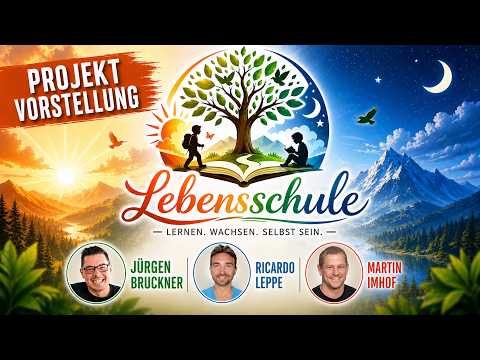
Kick-off conversation, approx. 120 min (in German) Lebensschule kick-off | How we throw the school system onto the free market
I don’t believe in perfect visions that don’t work in reality. What we are building here is not a finished system. It is a beginning. A counter-impulse. We don’t have to create the perfect school right away. We have to start heading in a better direction. Perhaps at first it is only a small model. Perhaps it seems incomplete. But it moves. And that is exactly what matters.
Conclusion Education and freedom

In the end it is not about school in the classic sense. It is about something more fundamental. It is about whether we press people into a system – or enable them to develop.
For me, education is inseparable from freedom. Freedom to think. Freedom to learn. Freedom to develop. If we manage to give children back this freedom, something emerges that goes far beyond school.
Then a generation emerges that is not conformist – but conscious. Not dependent – but self-reliant. Not disoriented – but clear. And that is exactly the basis for real independence.
More on our work
Regional groups for free exchange
Want to support our VISION? See here what you can do.
Of course we are also happy about your COMMENT, your SUBSCRIPTION and your THUMBS UP.
Wissen Schafft Freiheit – association for strengthening, educating about and spreading knowledge and education, Gloggnitz, Austria
Notes on content provided by authors
Comments
Loading comments …
Become a member to comment publicly. GAIA members write comments in the members' portal — under their nickname, visible to everyone.