Scholé news April 2019
Dear friends of Scholé, this time I would like to begin with a warm invitation to the unschoolers’ second information evening:
WHEN? Mon, 20 May 2019, from 7 pm WHERE? Markhofgasse 19, 1030 Vienna
BILDUNG NEU DENKEN (RETHINKING EDUCATION): Unschooling as an opportunity for the education landscape
All people are free learners from birth. Our brain is made to process and store experiences when they are judged to be meaningful subjectively. INTEREST, CURIOSITY and ENTHUSIASM are therefore indispensable. Anyone who has to perform under pressure can no longer be creative. We can only develop our potential if we are allowed to learn in a SELF-DIRECTED way. Science has confirmed this for decades.
What could our education system look like if these findings were finally put into practice?
What is still regarded as utopian in today’s school system, some pioneers of self-directed learning are already making possible for their sons and daughters. What insights set them on this path, what experiences they are having and what obstacles they face – you will hear all this first-hand on this evening!
Chair: Michael Karjalainen-Dräger
DI Sigrid Haubenberger-Lamprecht and Dr Gudrun Totschnig will introduce the topic.
Talks
- Marie Sophie Frei, lawyer, linguist and cognitive scientist: “Learning from the perspective of cognitive science”
- Mag. Heidrun Krisa, behavioural biologist: “Unschooling and socialisation”
- Prof. Dr Ulrich Remus, head of the interdisciplinary research centre “Information Systems for Networked Work and Life”, University of Innsbruck: “Studies and career prospects”
- Mag. Jan Engelberger, lawyer and taiji teacher: “The legal view of self-directed paths of education”
All speakers are parents of unschooled children and will be happy to answer questions from the audience!
Contribution: 10–15 euros, as you see fit To make organisation easier, please register at veranstaltung@freilerner.at
Let us stand up together for new paths in education!
The situation of Austria’s unschoolers is currently on a knife-edge: From the left come fears that society’s social cohesion is at risk if not every child is taught according to the same school curricula. From the right, performance checks, standardisation and adaptation to the needs of the economy are being pushed further. What has been decided, then, is an increase in the fines for anyone who dares to take an individual path. In practice, as so often, freedom depends on one’s bank balance: how many parents can afford to pay a fine of 800 euros per child – 400 euros for the mother and 400 euros for the father – several times a year, at the discretion of the authority in charge?!
The Declaration of Human Rights rests on the idea that in a democratic community the freedom of each individual must count as the highest value and therefore must not be subordinated to the wishes of the state and society. In this spirit, I have written a letter to the judges who have to decide on these fines:
As a citizen of a democratic state, I object to the imposition of administrative fines for unschooling, invoking HUMAN RIGHTS, which rest on unconditional respect for the freedom of the individual:
Every human being comes into the world with individual dispositions and needs. Given the diversity of human dispositions and needs, there cannot be one universally valid concept of education that would allow every child to develop its innate potential as fully as possible. All representatives of developmental psychology therefore argue for maximum individualisation.
Different paths of education cannot be judged good or bad, right or wrong in principle, but only as more or less suitable at the moment for a particular child – depending on its dispositions and its personal, family and social situation. In addition, due regard must be paid to the individual learning strategies of children and young people.
The CHILD’S BEST INTERESTS therefore depend on how well a form of education, under the given circumstances, meets
- the individual needs of the child concerned,
- the human and social possibilities of the family.
It goes without saying that everything should be done to prevent obvious violations of the child’s best interests, which occur within the school system just as they do outside it. No form of education can claim to GUARANTEE the child’s best interests, let alone later professional success – not even school!
In recent decades, the diversity of our world has grown exponentially in every field – a growing number of problems is therefore matched by a growing number of possible solutions:
- The world’s knowledge doubles every few years.
- Potentially, anyone who can use a smartphone now has access to the world’s knowledge.
- Most countries in the world are dealing with a growing diversity of languages and ever greater cultural differences among their inhabitants.
- At the same time, there have never been so many different paths of education, professions, opportunities for travel and work as today.
- Social development is so rapid that nobody can say exactly which skills will be in demand in 10 or 20 years.
- From this point of view, a binding curriculum for all is completely unrealistic and has thus become obsolete in practice; instead, there is already an almost unmanageable range of educational opportunities outside school.
- Never before have the differences in development between children and young people of the same age been as great as today. Among 13-year-old pupils, differences in development of +/- 7.5 years have been measured between the most mature girls (who at this age are on average 1.5 years ahead in development) and the least mature boys! No wonder that the teaching of same-age classes still customary in our schools is so often felt to be an imposition by teachers AND pupils.
- Diversity is also increasing noticeably in the school sector: although state schools are striving to diversify through mixed-age classes and numerous other measures, one child in ten in both Germany and Austria already attends a private or free school. Home education is also growing strongly: in the USA, the number rose from 2 to 3 million, of whom an estimated 300,000 to 400,000 are unschoolers who do without external exams (which is perfectly legal in English-speaking countries).
I find the current legal situation in Austria extremely unjust, because both attending private schools and unschooling depend solely on the financial situation of the families concerned: those who have enough money can send their children to a private school, pay tutors to prepare them for exams, or pay the regular fines for unschooling out of petty cash.
Children from poorer families are in practice disadvantaged several times over by fines that are supposedly imposed for their own good:
- As long as there is no education voucher for every child, their parents have to pay all educational expenses out of their own pockets.
- Fines strain the already tight family budget, leaving even less for learning materials, courses, excursions, meetings with other children, travel and so on.
- The adults caring for them have to spend a great deal of time they could spend with the children on dealing with authorities, submissions and disputes.
- If the fines cannot be collected, the parents go to prison like criminals.
- The atmosphere in the neighbourhood and among the wider family and friends is often severely strained by court proceedings or even a prison sentence. Those who suffer most are the children, who experience this as extremely shameful without being able to do anything about it!
In Canada and the United Kingdom, studies on the social and professional development of young people who were allowed to educate themselves informally have produced such favourable results that unschoolers there increasingly receive state SUPPORT. Would it not serve the child’s best interests far more if officials acted not as punishing controllers but as cooperative SUPPORTERS of unschooling families?
In the name of the young people entrusted to them, Austria’s unschooling families demand the legalisation of free or informal learning, as long as the children themselves want it. (Schoolchildren should have the opportunity to become unschoolers, and unschoolers the opportunity to go to school.) They naturally welcome measures that genuinely serve to protect the child’s best interests and apply equally to everyone entrusted with bringing up children. If existing studies from abroad continue not to be recognised in Austria, they call for scientific research into self-directed paths of education, which elsewhere have always been valued as the original form of learning and as an enrichment of modern education systems.
Please spread these thoughts, or get back to me if you have objections – or if you would like to actively support unschoolers!
Storm-tossed spring greetings, Alexandra
P.S.: As newsletters are not easy to forward, here is a link where the Scholé News have been published as posts for some time now: https://gaia-energy.org/tag/schole/
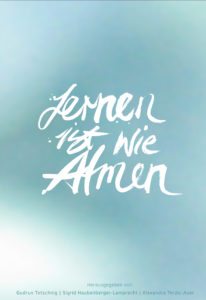
Book tip – “Lernen ist wie Atmen” (Learning is like breathing)
Together with two unschooling mothers, Gudrun Totschnig and Sigrid Haubenberger, we published it ourselves.
We all feel that the time is ripe for this many-voiced account of how unschooling can be lived in practice. Order your own copy on the GAIA marketplace, with a 10 % discount for members. The book is in German.
Notes on content provided by authors
Comments
Loading comments …
Become a member to comment publicly. GAIA members write comments in the members' portal — under their nickname, visible to everyone.