Scholé news March 2019
Dear friends of Scholé, at our last educational freedom meeting on 25 March we once again did a hidden constellation.
At the beginning of our constellation, EDUCATIONAL FREEDOM had her eyes closed and was at first entirely occupied with grounding herself and sensing her body. Then she invited the NEEDS to do the same and to seek contact with nature as well. Both lay down on the floor and enjoyed the blissful feeling of deep connection with the earth. Filled by this experience, EDUCATIONAL FREEDOM and the NEEDS then stood up, smiled at each other and began to dance exuberantly in a circle. The little CHILD, who had been watching them attentively, visibly enjoyed it enormously – it was beaming all over its face!
From this constellation I concluded that we must concentrate first and foremost on existential basic human needs. So it is not about lofty ideas of the undiscovered genius in every child, but rather – quite concretely and down to earth – about simple things such as healthy food, enough sleep, respect for biorhythms and the urge to move, emotional security, secure attachments and other vital needs, depending on age, sex, innate disposition and current physical, emotional and mental condition.
I know nobody who would deny that all this is important for everyone and vital for young people in particular. But who would answer with a clear YES if asked whether the institutions to which we entrust the next generation meet these vital basic requirements even remotely?! For decades, countless fruitless discussions have been held about how pupils’ results in maths, German or science could be improved. People look to the international PISA tests and debate all-day schools, better teacher training, greater use of computers or even robots, the introduction of yet more performance tests and a hundred other side issues. In the process, the really decisive questions have been lost from sight:
Which of us would be able to learn maths, German or science successfully while we are hungry or thirsty, or unhealthy food lies heavy in our stomachs; while we have slept badly or not long enough; while we feel lonely and abandoned, suffer from fears, are bullied or overlooked, are not allowed to move, and have to suppress our sorrow, our curiosity and our imagination for many hours a day?? Which of us would come through unscathed being constantly monitored, assessed and judged without being able to defend ourselves? Which of us could cope with the stress young people are under when they have to prepare for dozens of tests, written exams and examinations from morning to night? Which of us would be strong enough to get through it without switching off our natural feelings? And which of us would NOT give in to the temptation to escape into virtual worlds at every free moment, where we can freely connect with friends, survive heroic adventures, defeat evil enemies or build new worlds? Where else would we finally have the chance to decide for ourselves what we want to do…?
A system of instruction that ignores people’s basic needs drives them into addiction to substitute needs such as consumption, entertainment, drugs, fame and money. Because we have all been through this experience in one form or another, most of us still consider it “normal” and believe it is reasonable to expect the next generation to go through it too. Who would think of questioning the system itself? Just as we learnt at school, we continue to let others set the questions and topics we are supposed to deal with – now the media, our new schoolmasters. We argue eagerly about artificially inflated problems, such as the right way to teach German to children from immigrant families, and as usual suppress our natural feeling, our inner voice, which would tell us clearly: “Children with traumatic experiences of flight need attention, peace, healing and security. Let us take care of their existential basic needs, and they will learn the language of their rescuers joyfully and as if by themselves!”
I am convinced that we lack neither the money nor people who sense exactly what is needed and would gladly do it. What paralyses us as a society, however, is the same panic fear of change and loss of control that each of us goes through when deciding to break away from outlived old patterns in order to find our way back to ourselves and our true needs. Anyone who has gone through this healing path knows only too well how hard it is to give up old habits, even when one has long since realised that they only do harm. Again and again one puts off the decision and eagerly seizes on any excuse, however silly, to delay the leap into the unknown a little longer. Often the crisis has to come to such a head that there is no choice left but to dare to leap or go under…
A very similar process is now taking place across society as a whole. In fact, everyone now knows that our school system – like the economic system it serves – has no future. But since nobody knows what comes next, people cling to the old system against their better judgement and like to invoke unalterable “practical constraints”. On the surface, the oversized administrative apparatus in charge of Austrian schools even benefits from the growing problems: the state’s monopoly on education guarantees – with or without proof of results – an inexorably rising flow of tax money. No wonder its beneficiaries want to preserve it at all costs, for it feeds an ever-growing army of education officials, head teachers, subject teachers, support teachers, school psychologists, course leaders, private tutors, private institutes, youth welfare staff and so on. And the harder it becomes to bring today’s children, who come from different cultures and develop in ever more different ways, up to the standardised state learning targets, the more new posts have to be created for the purpose!
Fortunately, the system is not a machine but consists entirely of living people who need not submit to the so-called practical constraints. Every single one of them has the chance to contribute to change, ideally by connecting with as many others as possible who are also prepared to follow their hearts against outside resistance. Only in this way can the longed-for change gradually take shape from below in a truly democratic way: through teachers who risk going it alone because they have built warm relationships with their pupils. Through parents who take their children’s right to self-determination so seriously that they are prepared to swim against the tide. Through officials who see themselves not as controllers but as supporters of the people they deal with. And through the children and young people themselves, who – hopefully not only on FRIDAYS FOR FUTURE – actively stand up for a future worth living. That future begins with unconditional respect for the basic needs of all living beings on this earth…
Finally, an advance notice and invitation to the MARKHOF: the WHITSUN SYMPOSIUM “Die Kultur des Gemeinsamen” (The culture of the common) begins there on Friday, 7 June, at 6 pm and ends on Sunday, 9 June, at 1 pm. It is organised by Colearning Wien and the Freie Bildungsstiftung Berlin. You can find more details at www.markhof.wien/pfingstsymposium (German)
With greetings full of hope for the future,
Alexandra
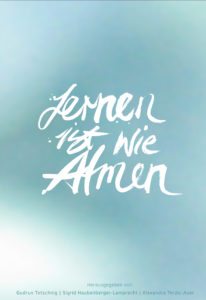
Book tip – “Lernen ist wie Atmen” (Learning is like breathing)
Together with two unschooling mothers, Gudrun Totschnig and Sigrid Haubenberger, we published it ourselves.
We all feel that the time is ripe for this many-voiced account of how unschooling can be lived in practice. Order your own copy on the GAIA marketplace, with a 10 % discount for members. The book is in German.
Notes on content provided by authors
Comments
Loading comments …
Become a member to comment publicly. GAIA members write comments in the members' portal — under their nickname, visible to everyone.