Scholé news December 2018
Dear friends of Scholé, looking back on 2018, I have the impression that many new ideas and initiatives were put to the test this year.
Remnants of old thinking and habitual reflexes evidently had to be overcome – and still do – to pave the way for profound social change. No easy task!
In January I tried to persuade the Vienna Education Board (SSR) to set up an appreciation commission for unschoolers, school dropouts and school refusers. To show how serious our proposal was, I was accompanied by Prof. Karl Garnitschnig, a highly respected emeritus professor of education. Only a few weeks earlier, SSR president Himmer had seemed very friendly and open-minded in a personal conversation. But our negotiations with a representative of the legal department and the head of the Institute for the Promotion of Giftedness failed because of the complete lack of understanding of these two officials. After almost two hours we gave up, realising that neither of them was prepared to move even a millimetre from their usual rules.
How wonderful it would have been to find a solution for unschoolers and school dropouts together with the authorities – one that spared the children all exam anxiety and showed the commission what a colourful variety of fruits informal learning without pressure or coercion can bear! But the authorities wanted nothing to do with our lovely idea of having these fruits presented to them and granting them official recognition in an appreciative way… What did we do wrong? What did we fail to consider? How could we do better? These questions occupied me for months.
In the meantime I have realised that it makes no sense to expect a solution “from above”. The education authorities are so busy with school problems that they cannot even imagine education outside school – nor do they want to. They react to it just as defensively as orthodox representatives of conventional medicine react to the successes of naturopathy, which in their view cannot be proven. It always depends on what you accept as proof: the patients’ subjective feeling of having been healed, or objective statistics on measurable parameters! In fact, the successes of homeopaths or naturopaths cannot be compared one-to-one with “evidence-based” success statistics of conventional medicine, because naturopathy does not fight objectively defined symptoms but tries, in many different and individual ways, to strengthen the self-healing powers of each sick person. Moreover, it starts from a completely different image of the human being: besides the physical symptoms, mental and spiritual aspects are always included, and these cannot be captured statistically at all.
By analogy, one could say that school fights “ignorance” by means of sophisticated curricula and teaching methods, while supporters of self-directed learning trust in each child’s innate individual potential and only gently support its natural process of unfolding. Marks and school reports assess nothing other than a child’s ability to adapt to set requirements. The free unfolding of hidden talents, on the other hand, fundamentally eludes “objective” assessment, because every unschooled child finds its very own access to the world’s knowledge at its own pace. Anyone who observes the human, social and intellectual development of freely learning children can marvel at it, delight in it and be inspired by it – but it cannot be compared or objectively assessed, precisely because it cannot be objectified! The gentle brain researcher Gerald Hüther, who inspires hundreds of thousands with his books and lectures, arrives at a very radical diagnosis: a person who is made into an OBJECT (of education, of care, of economic and other constraints) loses their human dignity and is broken by it!
In medicine, there are growing signs of a gradual rapprochement between the two worlds; “gentle medicine” is finding more and more supporters among doctors. Perhaps we can also build a bridge in education? Recently, some unschooling parents decided to record exactly, day by day, what their children are occupied with. They want to pass this documentation on to a committed teacher, who will try to “translate” it into the language of the framework curriculum. We will see whether we can make progress this way, from below…
My dear colleagues from the association “jedes Kind” (every child) are building this bridge from the other side: this year’s annual theme was the “Stärkenschatzsuche” (treasure hunt for strengths), developed by Ingrid Teufel during her time as a primary school teacher. You can find it on the association’s website (www.jedeskind.org, German). One of Ingrid’s former pupils has even developed an app so that teachers can access it even more easily on their smartphones. Just a few days ago, the Salzburg Education Board decided to introduce the treasure hunt for strengths in all Salzburg schools: instead of focusing mainly on their pupils’ mistakes, teachers are encouraged to discover their hidden strengths – and to become aware of their own strengths in the process.
Of course, there are opposing forces trying to prevent the bridge from being built. At the medical faculty of the University of Vienna, the only lecture on homeopathy was discontinued this year in the middle of the winter semester, and of all people the Green patients’ ombudswoman Sigrid Pilz campaigned to demand a ban on selling homeopathic remedies in pharmacies as well! The Salzburg children’s and youth ombudswoman provided a perfect parallel in education by demanding that Austria, following Germany’s example, abolish home education altogether or restrict it to a few medically justified cases. What she did not say: we already had this rule once – between 1938 and 1945, when Austria was called Ostmark and was part of the Third Reich…
Seen constructively, such setbacks might perhaps also have positive effects, who knows? Issues such as the motions just mentioned, or the reintroduction of repeating a year and of marks (euphemistically called “Noten” in Austria :-)) for seven-year-olds, will hopefully intensify and deepen the public debate on education. Then perhaps more people will learn to distinguish between the welfare state and paternalism from above, and will claim their right to self-determination.
I think what is currently paralysing our democracy are adults who were made to feel so small during their school years that they can no longer feel themselves and no longer trust themselves to do anything. Having been used from an early age to depending on experts in every situation in life, once they become parents they can no longer imagine taking responsibility for their children themselves! Gratefully, they hand over one- or two-year-olds to early-years educators, speech therapists, occupational therapists and so on for expert care and “optimisation”. They demand ever more early support from politicians and let experts convince them that all this is in the best interests of their children and also serves the self-fulfilment of modern mothers and fathers… That in truth they are running in the hamster wheel and willingly ensuring that the next generation will one day behave just as conformingly as they do themselves – most parents unfortunately only notice this, at the earliest, when a child who is still aware of its greatness and dignity jumps out of the hamster wheel and resolutely claims its human right to self-determination…!
That is why I consider the legalisation of unschooling the decisive first step towards bringing about a turn towards EDUCATIONAL FREEDOM, and thus making the democratisation of our society possible from its base. The few adults who are already prepared today to set an example of self-responsibility for their children are the pioneers of a generation that will be ready and able to take responsibility for preserving our planet into its own hands! The protest of a fifteen-year-old Swedish climate activist, heard all over the world, began with a call for a school strike :-)) Watch the three-minute video of her speech at the UN climate conference if you have not seen it yet: https://www.youtube.com/watch?v=VFkQSGyeCWg
In this spirit, I wish you all with all my heart a joyful celebration of the return of the light! Alexandra
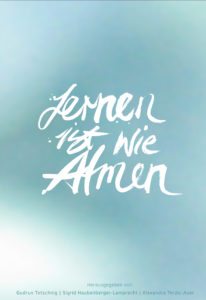
Book tip – “Lernen ist wie Atmen” (Learning is like breathing)
Together with two unschooling mothers, Gudrun Totschnig and Sigrid Haubenberger, we published it ourselves.
We all feel that the time is ripe for this many-voiced account of how unschooling can be lived in practice. Order your own copy on the GAIA marketplace, with a 10 % discount for members. The book is in German.
Notes on content provided by authors
Comments
Loading comments …
Become a member to comment publicly. GAIA members write comments in the members' portal — under their nickname, visible to everyone.