Scholé news November 2018

Dear friends of Scholé, the issue of educational freedom seems to be becoming ever more urgent.
As we can see from the media every day, the problems in the education system are getting worse. As a result, there are more and more school dropouts and school leavers, and the number of unschoolers is rising too. The authorities are responding with even more coercion – marks from year 2 of primary school, stricter penalties for truancy, more checks.
As is well known, Germany has had a rigorous compulsory school attendance requirement – since 1938! After 1945, Austria returned to the more liberal rules of the pre-war period. But now, of all bodies, the Children’s and Youth Ombudsman’s Office is pushing for the German rules to be reintroduced in Austria too, which would mean that home education would only be permitted in medically justified exceptional cases!
That is why, in recent weeks, I have written both to Federal President Van der Bellen and to Education Minister Faßmann, asking them to work towards informal forms of education finally being researched rather than banned. (You will find the letters below.) Yesterday a friendly reply came from the Federal President: he had read my letter carefully and sent a note to Minister Faßmann, since he himself has no influence on legislation. What that really means, of course, nobody knows, but I was still pleased that our concern had at least been noticed. Although – or precisely because – the situation is coming to a head, I have the impression that something might finally start to move.
THE HIDDEN CONSTELLATION AT THE 2ND MEETING ON EDUCATIONAL FREEDOM suggests that developments that are still unimaginable are already brewing: they concern things that lie outside our current frame of thinking and that felt positive – we only have to ALLOW them. The central message of this constellation was that CHILDREN have a primary need to fulfil a meaningful task. For this they need the support of their PARENTS. If they get this support, the CHILDREN can joyfully devote themselves to free, INFORMAL PLAY and in a short time develop so much strength and self-confidence that even the LAWYERS, on whose goodwill educational freedom depends, suddenly have to take them seriously.
But the constellation also showed that TEENAGERS remain dependent on the attention of their PARENTS! Although they want to gain experience outside the family on their own and sometimes put their PARENTS to a hard test, being close to them is still extremely important to them. The OCCUPATIONAL THERAPISTS felt strongly drawn to the TEENAGERS. They recognised the COERCION exerted by the compulsory school system as the precondition of their work: they act as a bridge to educational freedom and can make TEENAGERS aware that they are not ill, but are showing healthy reactions to a sick system!
The most trustworthy diagnostician of this sick system is a teacher who won many awards: John Taylor Gatto (1935 – 2018). After getting to know life in many different jobs (including paramedic, university employee, taxi driver, jewellery designer and copywriter), he became a teacher and for 30 years taught children from all walks of life in the city and state of New York. At the urging of one of his pupils, on the evening in 1991 when he was named “New York State Teacher of the Year” – after having been New York City Teacher of the Year three times – he did not keep quiet but spoke plainly for the first time. The speech he gave that evening opens his book “Dumbing Us Down” (German title “Verdummt nochmal”), first published in 1992, which has since become part of the history of education. In the English-speaking world, where informal learning outside school is permitted, it gave a boost to the unschooling movement. Here are a few excerpts in Gatto’s own words (translated back from the German edition):
“Over the years, while struggling with the obstacles that stand between the child and their education, I have come to believe that the state’s monopoly schools are structurally unreformable. If their central myths are exposed and abolished, they cannot function. I have since understood that, regardless of my own view of my task as a teacher, I am in reality following a largely invisible curriculum that reinforces the myths of the institution of school and of our economic system, which is based on a caste system. When I thought about what I could tell you to make my experience fruitful, it became clear to me that the best thing would be to tell you what is wrong with what I do. Because what is right is easy to understand: I do not stand in the children’s way; I give them time and space and respect. What is wrong with what I do, however, is strangely complex and frightening. I want to show it to you.”
“The first lesson I teach is confusion. Everything I teach is out of context. I teach the un-relating of everything. I teach too much… What I do is more like the making of a television programme than the making of an orderly structure…”
“The second subject I teach is inescapable membership of a particular class. … My job is to make the children like being locked in together with children of the same level, or at least to endure it without protest. If I do my job well, the children cannot even imagine being anywhere else, because I have taught them to envy and fear the higher levels and to look down with contempt on the levels below… That is the real lesson of any artificially imposed competition, and of school too: you learn your place…”
“The third subject I teach is indifference. I teach children not to care too much about anything, even though they should seem to. I do this in a very clever way, by demanding that they engage unconditionally in my lessons, jump up and down in their seats with enthusiasm and compete eagerly with one another for my favour… But when the bell rings, I insist that they drop whatever we have been doing at once and move quickly on to the next workstation. They must be turned on and off like a light switch… The real lesson of the bell is that no work is worth finishing. …”
“The fourth subject I teach is emotional dependency. With gold stars and smiley faces, with smiles and frowns, prizes, honours and punishments, I teach the children to surrender their will to the predestined chain of command… Rights do not exist in a school… Individuality is a threat to all systems of classification.”
“The fifth subject I teach is intellectual dependency. Good students wait for a teacher to tell them what to do. This is the most important lesson of all: we must wait for other people, better trained than ourselves, to make the meanings of our lives. All important decisions are made by experts… Successful students take on the thinking I give them with a minimum of resistance and decent signs of enthusiasm. I decide which of the millions of things worth studying we have time for. In reality, though, this is decided by my invisible employers. …”
“The sixth subject I teach is provisional self-esteem. If you have ever tried to get children into line whose parents have convinced them that they are loved unconditionally, you know that it is impossible to make self-confident spirits conform. Our world as it is would not survive a flood of confident young people for long, so I teach that a child’s self-respect should depend on an expert’s opinion. My children are constantly evaluated and judged. … People need to be told what they are worth.”
“The seventh lesson is that one can’t hide. I teach students that they are always being watched and constantly monitored… I develop a kind of extended schooling, the so-called homework, so that the effect of surveillance, if not the surveillance itself, reaches into the private household, where students might otherwise use their free time to learn something unauthorised… Children must be closely watched if you want to keep a society under tight central control…”
There is nothing to add. Warm regards, Alexandra
OPEN LETTER TO FEDERAL PRESIDENT VAN DER BELLEN (German, PDF) OPEN LETTER TO EDUCATION MINISTER FASSMANN (German, PDF)
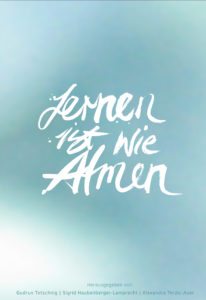
Book tip – “Lernen ist wie Atmen” (Learning is like breathing)
Together with two unschooling mothers, Gudrun Totschnig and Sigrid Haubenberger, we published it ourselves.
We all feel that the time is ripe for this many-voiced account of how unschooling can be lived in practice. Order your own copy on the GAIA marketplace, with a 10 % discount for members. The book is in German.
Notes on content provided by authors
Comments
Loading comments …
Become a member to comment publicly. GAIA members write comments in the members' portal — under their nickname, visible to everyone.