Scholé News – February 2024
Learning to be free
2024 is a special year in many respects – for me also because the association “Scholé – Muße für Herz und Geist” (Scholé – leisure for heart and mind) turns 10 this year. So it’s time for a short look back and ahead! When Sibylle Eisenburger and I went to the registry of associations in Klosterneuburg in spring 2014, we were terribly excited. We had received a generous donation from a patron who was, and still is, my closest confidante. All kinds of ideas were buzzing around in our heads about how best to use the funds in line with the association’s purpose – “to promote free and self-determined education”.
I had carried the Scholé project in my heart for some time – more precisely, ever since the shock triggered in me by the book “…und ich war nie in der Schule” (“…and I never went to school”) and, a little later, by meeting its author André Stern in person. Why had it never occurred to me until then – despite my dramatic experiences in 7 different schools and boarding schools and despite the many school problems I had gone through with other people’s children and my own – that it might be possible simply to let young people grow up free?!
We cannot improve on nature, at most disturb it
The answer, of course, was to be found with André’s parents: what had enabled them to make this decision, still “unthinkable” for most of our contemporaries? They started from a completely different image of the human being, which they had arrived at through their personal experiences in the Malort (painting place): the human being is perfect as they are. Each individual carries the universal knowledge of humanity in their cells and comes into the world with an individual learning plan that corresponds to their particular life task. A child therefore needs only loving accompaniment and support to unfold their talents from within, step by step. From this perspective, general curricula drawn up by civil servants and imposed on all children, whether they want them or not, are an absurdity…
For my sons this epochal insight unfortunately came too late, but I decided from then on to make as many other parents, teachers and officials as possible aware that our education crisis is not insoluble, because there are alternatives to attending school! One of them is free learning at home with open-minded parents. The next alternative I “happened” to come across was Sugata Mitra’s “school in the cloud” experiment: the Indian IT specialist built a computer into a wall in a slum in Kolkata and was thus able to observe, unnoticed, how even the most underprivileged children – purely out of curiosity and enthusiasm – playfully managed to teach themselves, without any instruction, first how to use the computer and then English, reading, writing and many other things.
An education project that has inspired many
Even more astonishing were the impressions Sibylle and I gained when, after a year of preparation, in November 2013 we finally reached the legendary Shchetinin School, a Russian boarding school in the Caucasus. There we were able to experience at first hand what a world of difference it makes whether children are taught or trained according to plan as rational mammals, or whether they are respected as high spiritual beings and systematically supported in acquiring the world independently in their own way.
The Shchetinin School, which unfortunately closed after its founder’s death in 2019, became world-famous for the “inexplicable” intellectual achievements its graduates regularly produced. But what fascinated us personally even more was the calm friendliness of the young people in dealing with us and with each other, their radiant health and the enthusiasm with which, as disciplined as they were joyful, they did sport, sang, danced, made music, painted, built, cooked, cleaned and learned. I had never before met young people who radiated such dignity, alertness and vitality!
A young German who graduated from the Shchetinin School later introduced us in more detail to the diagram work that had been developed further there over the years. It enables holistic learning in cross-curricular contexts of meaning. A diagram might begin, for example, with the question of what mathematics actually is, how it came about, what it is for, how varied its applications are and what it has to do with the other fields of knowledge – physics, chemistry, biology and the humanities.
These profound questions, however, are not answered by teachers! Instead, 4 to 8 interested pupils of different ages – the youngest 9, the oldest 17 – sit down together and begin to research independently in books and on the internet. They discuss what they have found out in lively conversations with each other and with adult learning companions, who may only answer questions without interfering. Each group organises the material in its own way and finally presents it to their schoolmates in the form of a diagram. Besides writing and drawing, songs or short sketches are also used, because the pupils know from their own experience: only if they reach the hearts and minds of their listeners can the handing over of a diagram succeed. Only then does the mysterious learning effect occur that one researcher once called “knowledge osmosis”.
A footnote: the Shchetinin pupil whom we later invited to give a talk in Vienna then spent quite some time at the Weinbergschule on the Wallersee, passing on his knowledge and experience to teachers and pupils. Although the Weinberg pupils had always performed above average in external examinations for many years, the Salzburg education directorate had the school closed on flimsy pretexts and, as if that were not enough, expressly banned diagram work as such from teaching!
A secure existence or a free life?
When people have not only grown up without freedom themselves but later profit professionally from the next generation also growing up without freedom – as is the case, for example, with representatives of education authorities – they are understandably terrified of a spiritual freedom that would indeed bring down their entire system of power, which gives them security. In the many conversations and information events of the last 10 years, the issue was again and again the incompatibility between a “secure”, planned existence and an independent, self-determined life. Freedom is not for scaredy-cats! Nor can it be planned; it falls as a gift into the laps of those who entrust themselves to the flow of life – we have experienced that many times ourselves!
When it came to new projects, for example, we always did constellations to clarify in advance whether our ideas would lead anywhere or not. What came out often did not match our hopes or expectations at all, but I believe it saved us many detours and wrong turns! When we really didn’t know how to go on, we often encountered the strangest coincidences and synchronicities instead, which showed us unexpected new paths.
The inner senses of the human being
When, for example, we were thinking about how we could make parents understand everything that lies within their children, I stumbled on the internet across so-called seeing without eyes. This ability is one of the inner senses and a preliminary stage of clairvoyance. It is present in all people but withers away at the latest at the onset of puberty if it is not used. At seminars with Irina Lang, many parents were amazed to see that their children needed only a little encouragement to recognise, blindfolded and in no time, first colours, then pictures and objects, to play games of skill or to read texts.
We made some wonderful and some sad observations. One girl discovered that she could orient herself much better with her eyes closed, so that travelling by train on her own was no longer a problem for her. A school beginner who could not yet read managed it effortlessly when blindfolded. But sometimes a parent – as far as I remember, it was always fathers – considered the whole thing humbug and voiced the suspicion that the blindfolds had not been tight. That hit the children so hard that they immediately buried their newly discovered abilities deep inside themselves again and could no longer find access to them afterwards…
Interested adults then learned more about the inner senses from the quantum physicist Alexander Schatanov, who held seminars under the title “Education from the future”. Our next step was to set up a meeting place for free-learning families in Sonnenuhrgasse, where the Colearning Space experiment later began. The attempt to let up to 45 children between zero and sixteen educate themselves freely together was a daring adventure! The project soon moved to a former printing works in Vienna’s 3rd district, which, with almost superhuman organisational and financial effort, was converted into a combination of colearning and coworking space.
Self-determined learning in community
In the 5 years in which I was involved on the sidelines, I was able to learn a great deal from this project. It showed me everything that big and small children learn playfully with and from each other, which social rules they develop independently, and how precisely their behaviour mirrors what moves the adults. When there were difficulties, they mostly had to do with the fears, weaknesses, false expectations and personal prejudices of the adults. As in almost all private learning groups, there were also pressing financial problems, disagreements among the founders and, of course, increasing pressure from the authorities. When a break finally came, some of the team formed a new small learning group in another place, which still exists. The Markhof is now a popular seminar centre. In the afternoons it offers space and leisure activities for a social project for children.
At the end of 2017, two free-learning mothers and I published the book LERNEN IST WIE ATMEN (Learning is like breathing; a 2nd edition appeared in 2023). Since then, the work of the Scholé association has focused more and more on supporting free-learning families who are brave enough to choose the exam-free path. Because this is unfortunately still illegal in Austria, most of these families have to grapple with lengthy court proceedings and are regularly ordered to pay administrative fines. One mother, only one of whose 4 children was learning freely, even served her sentence in prison twice! The initiative “Freie Bildungswege” (Free paths of education) aims to change that.
Learning to be free
Personally, I regard free learners as harbingers of a new era. For me there is no doubt that our materialistic age, marked by a spirit-hostile obsession with performance, growth and control, will soon reach its expiry date. With the self-determined children growing up today, an era begins in which what is still a rare exception today will be the rule: peaceful coexistence of self-determined people of different ages, different origins and different talents, who are as clearly aware of their uniqueness as of their spiritual connectedness. Such people no longer long for leaders, nor do they dream of global domination. They find their greatest joy and fulfilment in serving life in all its forms.
What we need to reach this state is summed up by the title of a recently published special issue of TAU magazine on education: FREI SEIN LERNEN (Learning to be free). Two colleagues from TAU magazine, a free-learning mother and I are currently preparing an event that will also be held under the motto FREI SEIN LERNEN. In doing so we realise how much we ourselves still have to learn! The event is to take place at the beginning of spring, on 22.3.2024, in the roof hall of the Urania observatory and to bring together people who, as participants and contributors, want to bring in their material and immaterial resources and thereby give to and inspire one another. If you feel called to this celebration, please get in touch with me at aterzicauer@gmail.com!
I wish us all leisure for heart and mind! Alexandra
2nd edition of “Lernen ist wie Atmen” (Learning is like breathing)
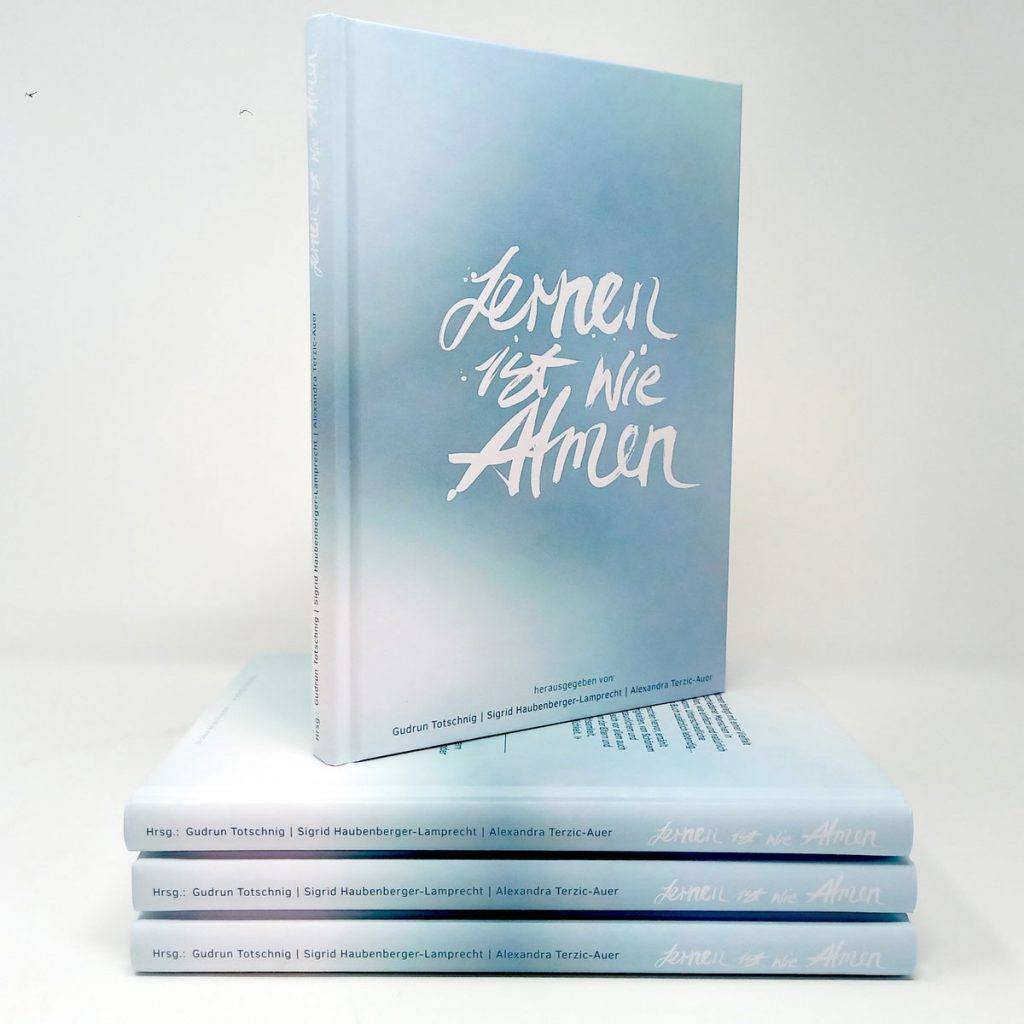
The 2nd edition of our book meets a completely changed readership.
In 2017, the idea that learning outside school was possible at all was considered the eccentric notion of a few outsiders. Since then, all parents, whether they wanted to or not, have had to deal with forms of learning outside school.
The number of children withdrawn from school has exploded since then, and alternative learning projects are springing up like mushrooms.
Buy the book (2nd ed., German)
Notes on content provided by authors
Comments
Loading comments …
Become a member to comment publicly. GAIA members write comments in the members' portal — under their nickname, visible to everyone.