Scholé News – October 2024
Dear friends of Scholé,
In September, the platform Freie Bildungswege (Free Educational Paths) once again sent an open letter to all officials dealing with education and child welfare. This time it was about the unfair, often downright harassing conditions of the notorious external examinations – a kind of annual school-leaving exam that children in home education have to take at the end of every school year. On freie-bildungswege.at (German) you can read the letter and the responses to it.
Communication with those responsible is so difficult because they speak a completely different language: we talk about the very concrete rights and needs of individual children, the other side replies in generalising legal gibberish that ultimately serves only to secure the state institutions’ claim to power. Courts and youth welfare offices like to invoke the abstract legal concept of the best interests of the child, but how the individual child is really doing inside or outside the school system has so far not interested them at all.
But this wall is beginning to crumble. There are already individual rulings that reject equating school attendance with the child’s welfare. This is mainly thanks to the few pioneers who, regardless of all threats and penalties, allowed their children to grow up in freedom, i.e. without exams on the school curriculum. These children have since become very independent young men and women, and even the courts have to acknowledge that their parents’ hopes have, against expectations, really been fulfilled: young people who were never torn out of real life are indeed more contented and more capable in life than many school leavers who had to spend most of their childhood in closed educational institutions.
Learning freely, living freely
Because they were seen and accepted as they are from the very beginning, these young people never had to compete for attention or flee into virtual worlds. Because they were neither compared nor graded, they now find it easy to communicate with other people – whether the same age, younger or older – as equals. They know who they are and know their strengths and their limits. They are interested in many things and are used to continuing their education independently. Thanks to these qualities they are extremely sought-after as employees and find suitable jobs very quickly even without certificates. But the best thing is that they will never stop learning with unbroken joy, because the joy of learning is one of the natural traits of every person whose learning has not been spoiled by pressure, coercion and prescribed content.
Actually, one should not even use the same word for school learning and free learning, so different are they. We adults have all “enjoyed” countless hours of lessons. On average, however, we have remembered only a few percent of the curriculum that was hammered into our heads with so much effort. What is stored in us and can never be lost, on the other hand, is the experiential knowledge we were allowed to acquire, mostly outside the classroom. Things we did voluntarily, with love and enthusiasm. And for which we always had too little time, because we had to go to school, do homework, prepare for tests and class exams…
I don’t think we school leavers can really imagine what it is like to have holidays all year round and be guided every day by one’s personal interests. Even early childhood memories of exciting discoveries are buried deep in most of us, under a thick layer of learned stuff. In this context I remember an experience at an autumn meeting of free learners that touched me particularly, probably because it reawakened vague memories of my own early experiences.
What little Hans learned early
It was a cold morning; hoarfrost was already glittering on the blades of grass. In the yard of the former farmhouse that served as our lodging stood a water trough, a hollowed-out tree trunk, into which a thin stream of water ran from an iron pipe. I was just crossing the yard and saw from a distance how the front door opened. Out toddled a very small girl, the daughter of a now grown-up free learner, who, as I knew, was celebrating her 1st birthday that day. The mother watched her go, nodded to me, left the front door open and withdrew.
The little girl headed straight for the water trough, which reached up to her chest. She dipped her little hands in, stood quite still and felt the cool water. Then she slapped the surface so that it splashed, let the water run through her fingers with squeals of delight, fished out a floating leaf, tried in vain to reach the stream of water with her short little arms, and then discovered a rag lying on the edge of the trough. Carefully she let it slide into the water and watched how it became heavier and heavier as it sank. With holy seriousness she pulled the soaked rag slowly and deliberately through the trough, lifted it, let it sink again, revelled in the gurgling sounds it made, the furrows and lines on the water… and God alone knows what else she may have perceived.
I stood some distance away and watched the child, completely absorbed in what she was doing, with growing fascination. It seemed to me that in the timeless 10 minutes her wondrous experiment lasted, the little one learned far more about the properties of water, gravity and other natural phenomena than could have been taught to her in many hours of physics lessons. Nobody called the child back, nobody said: “Be careful not to get wet, it’s cold! You’ll catch a chill!” The little one was allowed to keep playing until, completely sated with her experiences, she ran back into the house. Her mother took her in her arms with a smile, carried her up the steep stairs and put dry clothes on her without comment.
When she herself was still a child, her parents had shown her the same great trust. That is why it was easy for the young mother to let her daughter, only 12 months old, have exciting new experiences without worry. She could also rely on nobody calling the police because of an unsupervised toddler. The little girl was surrounded here by free-learning families – anyone would have helped her immediately if necessary, but no one would have disturbed her or interfered in her play unasked. And the little one didn’t catch a chill either; she felt exactly for herself when it was enough.
A question of mindset
This little everyday scene illustrates very well, I think, how today’s usual attitude to upbringing differs from the mindset needed for a self-determined life. If one regards a young person from the very beginning as a high spiritual being in a small body, reverence for their human dignity forbids disturbing or patronising them unnecessarily, on the pretext of having to protect and socialise them. The young people who are allowed to unfold according to their own inner learning plan therefore radiate calm and self-confidence. Their characters are as different as their abilities and skills, but there is no need to worry about any of them.
Of course, people living self-determined lives also face great challenges, and of course they too have interpersonal, financial or health problems. Unlike ordinary citizens who are not yet aware of their spiritual connectedness with everything, however, they do not constantly call for state or institutional support. They have given up trusting in Father State and have learned to trust themselves, each other and life. That is why they prefer to activate their own inner resources, choose alternative healing methods or ask personal friends for help. Pressure from outside does not break them but welds them together.
Paths to self-empowerment
Each of the free-learning families I have met showed me different paths to self-empowerment. I am infinitely grateful to them for this. They have encouraged me to find my way back to my own nature, to trust my intuition again and to be open to inspiration. Today I no longer let myself be confused by complicated intellectual arguments or diverted from my own truth. The kinesiological test I work with also confirms to me every day that almost all mental and physical problems can be traced back to early traumatisation in kindergarten, school and the parental home. Their common root is methods of upbringing aimed at making a person, from the very beginning, fulfil other people’s goals, expectations, wishes or orders.
Our own higher self is like a generous free-learning mother who always keeps an eye on us but intervenes only in emergencies. Lovingly it invites us to stand by ourselves unconditionally and to let ourselves be guided fearlessly by love and enthusiasm, even when things are topsy-turvy outside. If we are aware of its everlasting presence, we will not let ourselves be diverted from our individual path either by threats or by temptations. Rather, we will discover that in each of us there is a cheerful adventurer who enjoys taking on the challenges of life.
Cheerful autumn greetings Alexandra
More Scholé news
2nd edition of “Lernen ist wie Atmen” (Learning is like breathing)
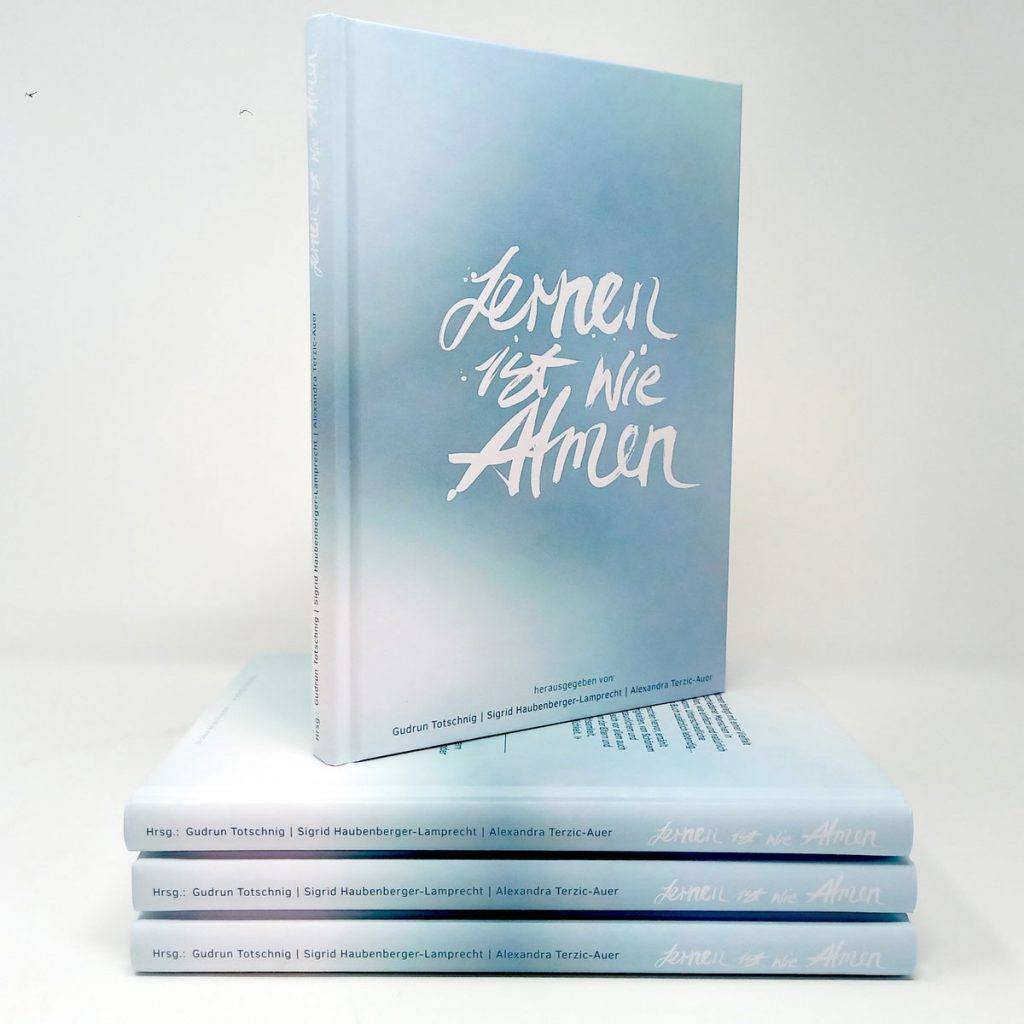
The 2nd edition of our book meets a completely changed readership.
In 2017, the idea that learning outside school was possible at all was considered the eccentric notion of a few outsiders. Since then, all parents, whether they wanted to or not, have had to deal with forms of learning outside school.
The number of children withdrawn from school has exploded since then, and alternative learning projects are springing up like mushrooms.
Buy the book (2nd ed., German)
Notes on content provided by authors
Comments
Loading comments …
Become a member to comment publicly. GAIA members write comments in the members' portal — under their nickname, visible to everyone.