Straw-man arguments against new energy technologies


When criticism starts in the wrong place
In the public debate on new energy technologies, besides a lack of openness to technology, a classic rhetorical error keeps cropping up: the so-called straw-man argument. Here a position is not discussed in its actual form but is first simplified, distorted or reduced to a single detail. This simplified version is then refuted – and the result presented as proof that the whole concept is wrong. This happens frequently with innovative technologies in particular.
Complex relationships are reduced to a single element, while the actual disruptive technological approach is ignored. Exactly this pattern can also be observed in the discussion about the work of the Neutrino Energy Group and Holger Thorsten Schubart.
The actual concept behind the technology
The central approach of so-called neutrinovoltaics is not to use neutrinos exclusively as an energy source. Rather, the technology is based on the idea that our environment is permanently permeated by a broad spectrum of invisible energetic fields. These include, among others:
- neutrinos
- electromagnetic radiation (e.g. radio waves or ambient RF)
- terahertz radiation
- thermal fluctuations of the environment
 The underlying physical logic of neutrinovoltaics does not consider these influences in isolation, but combined, as an energetic background field that is constantly present. The nanomaterials used act as highly sensitive receivers for this extensive permeation by certain parts of the spectra.
Graphene as a nanoscale resonance converter
Materials science is at the heart of the technology. Graphene, a two-dimensional carbon lattice of extraordinary stability and flexibility, reacts extremely sensitively at the atomic level to the smallest energetic impulses.
Because of these properties, graphene behaves like an ultra-thin membrane that responds to external influences with microscopic vibrations. These vibrations do not arise because particles are “stopped”, but already through their passage and the associated momentum transfers.
In combination with silicon doping, these microvibrations can be converted into a directed flow of electrons – that is, into electric current. The technology thus follows a resonance principle in which mechanical movements at the atomic level serve as the starting point for energy conversion.
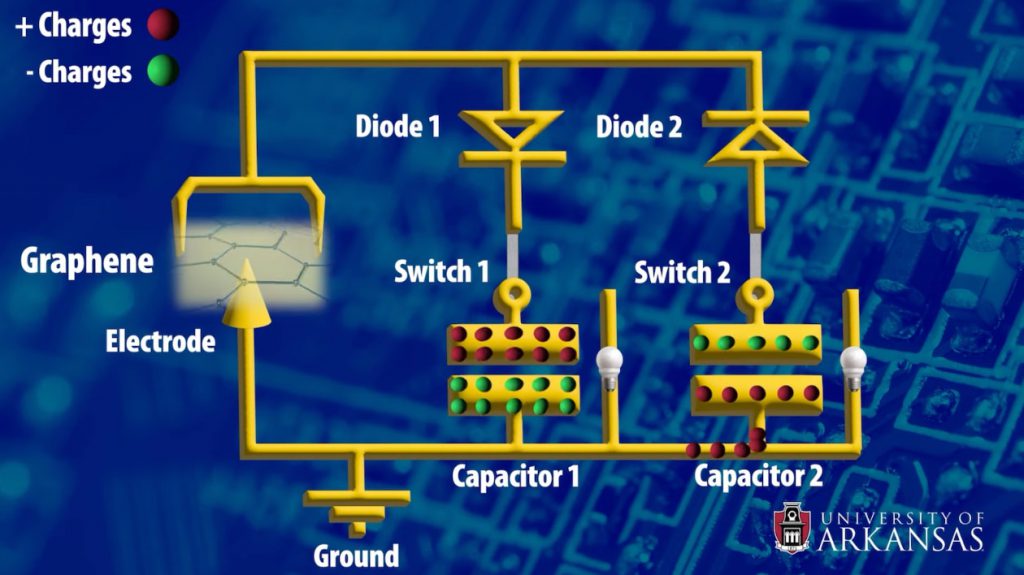
Schematic representation of “energy harvesting” • University of Arkansas, 2024
Initial experimental work – including at the University of Arkansas – shows that even thermal fluctuations in graphene structures can be converted into electrical voltage. Studies from 2020 to 2024 demonstrated that random atomic movements (Brownian motion) in graphene can indeed be converted into a directed current (“graphene energy harvesting from Brownian motion”). These results underline that graphene is among the most sensitive known materials for microscopic energetic excitations.
At the same time, experiments such as those of the COHERENT Collaboration prove that even weakly interacting particles can transfer momentum to matter. Even though these interactions are rare, they are physically detectable and provide important insights into energy transfer at the subatomic level.
Another central point is that hybrid energy harvesting systems, which combine several ambient energy sources, already represent an established line of research today. The approach of jointly using various weak but continuously available energy inputs – such as thermal fluctuations, electromagnetic radiation or particle interactions – thus corresponds to a recognised scientific paradigm.
Taken together, these research results show that both thermal fluctuations and weak particle interactions can produce real, measurable effects. Together with the hybrid approach, this creates a sound physical basis for modern energy harvesting concepts that aim to make the smallest, ubiquitous energy sources systematically usable.
The scaling effect through nanostructures
Another central component of the concept is geometric scaling through multilayer structures. Since most of the invisible radiation fields can pass through matter almost unhindered, numerous nanometre layers can be stacked on top of each other.
Each individual layer is still permeated by the full energetic flow. Unlike with classical solar cells, there is no shading effect between the layers. As a result, the low output of each individual layer adds up to a usable total output.
This stacking effect is a decisive difference from conventional energy converters and is one of the central mathematical and materials-science foundations of the technology.

Schematic representation of layered wafers
Why the straw man distorts the debate
Many critiques focus exclusively on a single element of the system: the physical interaction of neutrinos with matter. Since this interaction is indeed extremely weak, the conclusion seems obvious that no appreciable energy can be obtained from neutrinos alone.
But this is exactly where the straw-man argument arises. The criticism refutes a simplified version of the concept – namely the idea that neutrinos alone serve as the energy source. The actual technology, however, is based on the combined effect of various energetic fields and on materials-science resonance effects.
The real discussion should therefore be conducted less about particle physics and more about:
- nanomaterials and their resonance properties
- energy harvesting concepts
- scaling through nanostructures
- new approaches to decentralised energy generation
A particularly widespread straw-man argument is: “They capture neutrinos – that is physically impossible.”
However, this statement fundamentally distorts the actual approach. The technology is not based on deliberately capturing or stopping neutrinos, but on the fact that particles and fields continuously passing through matter – regardless of interaction probabilities – trigger microscopic impulses and vibrations in suitable materials. These are used within the framework of a resonance and energy harvesting principle. The criticism thus refutes a claim that is not made in this form and sidesteps the actual question: whether and how combined, continuous energy inputs at the nanoscale can be made technically usable.


Conclusion: Energy harvesting beyond classical paradigms
The idea behind Neutrino Energy technology can be understood as an extended concept of energy harvesting. The aim is to make the permanent energetic noise in the background of our environment usable – regardless of time of day, weather or geographical location.
Whether and to what extent this technology will prevail in the long term remains a matter of scientific and technical development. What is clear, however, is that a serious discussion should focus on the actual physical and materials-science foundations – and not on simplified straw-man arguments.
For especially at a time of growing energy uncertainty, the future of energy supply could lie in developing decentralised systems capable of providing baseload power that tap continuously available energy sources. Technologies pursuing such approaches therefore deserve a differentiated assessment – and an open scientific debate.
Notes on content provided by authors
Comments
Loading comments …
Become a member to comment publicly. GAIA members write comments in the members' portal — under their nickname, visible to everyone.