Climate Change Through Cyclical Changes


Climate change controlled by the sun and ocean currents
Dr. Peter F. Mayer, tkp.at (German)
The sun is evidently mainly responsible for warming our planet. Its considerable cyclical changes are therefore also mainly responsible for climatic fluctuations. This is easy to show.
Among other things, the sun goes through an 11-year cycle in which the poles reverse, the number of sunspots varies greatly between maximum and minimum, and the magnetic field changes considerably in intensity. The latter in particular has a strong influence on the radiant energy that can reach the Earth’s surface and warm it to a greater or lesser extent.
As can be seen in the title graphic, the magnetic field of the sun – and of course that of the Earth – deflects cosmic radiation, whose particles are ionised and therefore electrically charged. This cosmic radiation consists of ionised atomic nuclei such as beryllium-10, with 4 protons and 10 neutrons. When these particles hit the upper atmosphere, they serve as condensation nuclei for cloud formation. The weaker the magnetic field, the more gets through, the more high clouds there are and the less solar energy reaches the Earth’s surface.
The solar wind, by contrast, consists of protons, i.e. hydrogen nuclei, which cannot contribute to cloud formation even when they hit the Earth – that requires cosmic radiation with larger elements. These high clouds are largely responsible for the Earth’s albedo, i.e. the reflection of solar radiation. This graphic shows what they do:
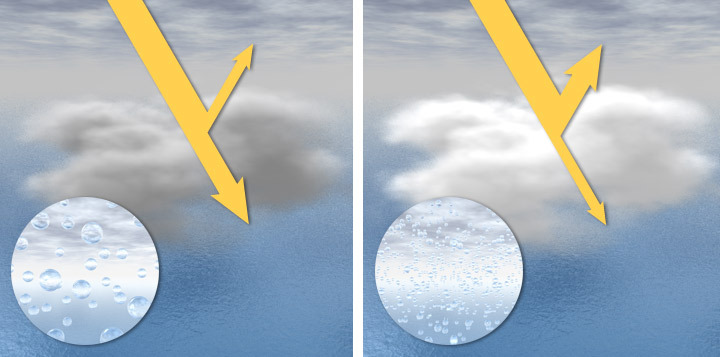
These relationships have been demonstrated precisely using satellite data on high clouds. As reported here (German), the evaluation of these data showed that the “albedo of the Earth’s entire sky has fallen by about 0.79% since 2000, leading to an increase in the absorption of planetary shortwave radiation of ≈2.7 W/m².” Solar radiation is shortwave, while the Earth’s heat radiation and the back-radiation from the greenhouse effect are longwave.
The largest heat store is the water of the oceans, which cover 71% of the Earth’s surface. The so-called Atlantic Multidecadal Oscillation (AMO) is crucial for transporting heat from low latitudes to the poles.
In his Substack, Dr Stephen Andrews shows a graphical presentation supporting these theories of climate change, in which CO2 could play no role.
Climate change: a tale of two theories
Andrews thus once again successfully challenges the “established scientific” narrative that climate change is driven by man-made carbon emissions. He presents data from reputable sources suggesting that the current rise in global temperature (from 1850 to the present) can be explained by a combination of two alternative theories:
- Cosmic ray hypothesis: This theory, put forward by Professor Nir Shaviv and Professor Henrik Svensmark, states that cosmic rays, whose intensity varies with altitude, interact with the atmosphere and form nuclei that form clouds. Clouds have a net cooling effect that has a considerable impact on our climate. Consequently, periods of high cosmic radiation have a cooling effect and periods of low radiation a warming effect.
- Winter gatekeeper hypothesis: This theory, put forward by Dr Javier Vinós, states that climate change is caused by changes in the transport of energy towards the poles, with solar variability a key factor in this process.
The following graphs show a strong correlation between solar cycles, cosmic radiation, heat transport in the ocean/atmosphere and temperature.
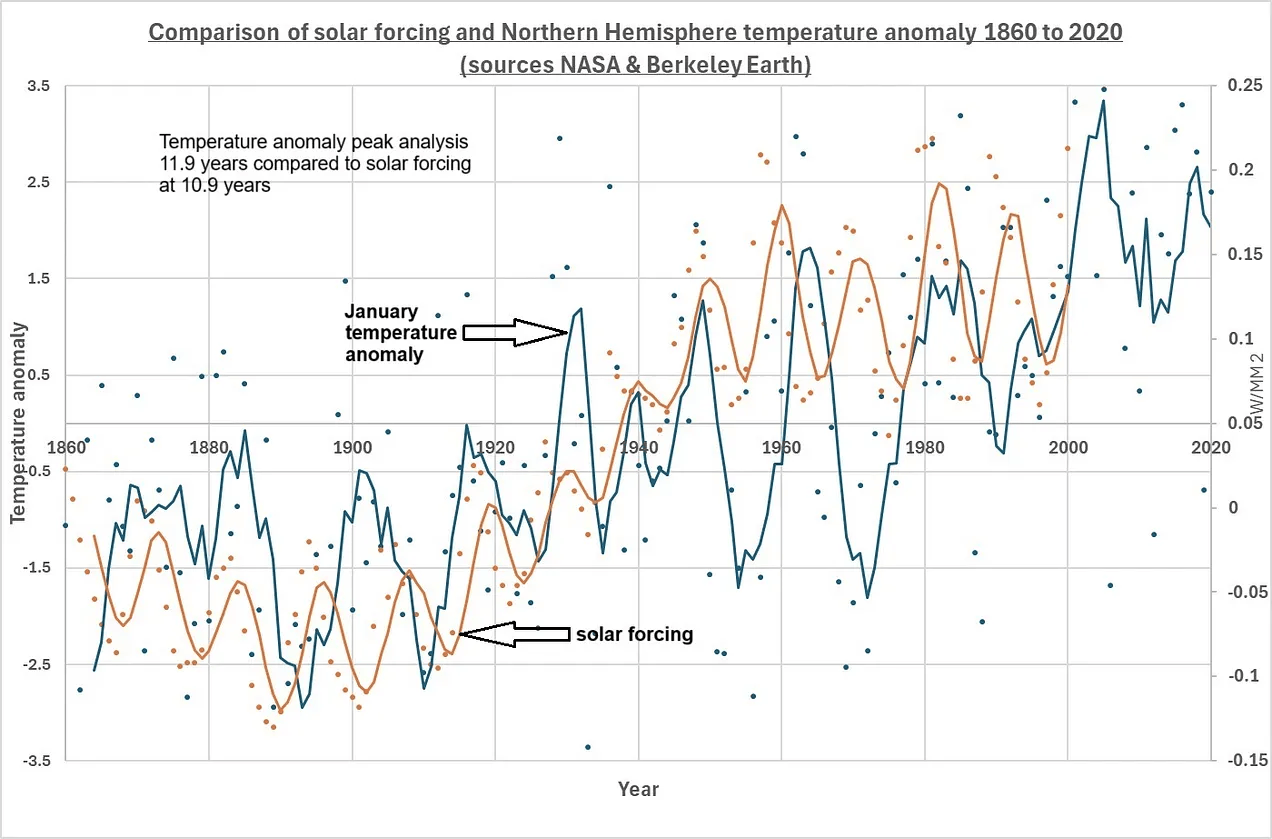
Graph 1 (NASA & Berkeley Earth)
Graph 1 shows the January warming trend (5-year moving average) for the mean of four locations in the northern hemisphere (about 60° latitude) at longitudes spanning the entire globe, with solar irradiance plotted on the secondary axis. They show a clear correlation between solar cycles and temperature, suggesting that global warming is caused directly or indirectly by the sun. Since the entire temperature change (1860 to 2020) is shown in this diagram, the “smoothness” and intensity of the cycle indicate how strong this cause must be. The correlation between the trend of the temperature anomaly and solar forcing (energy input) implies that an amplification mechanism must exist, since the energy input (0.2 W/m²) is not enough to cause a temperature rise of this magnitude.
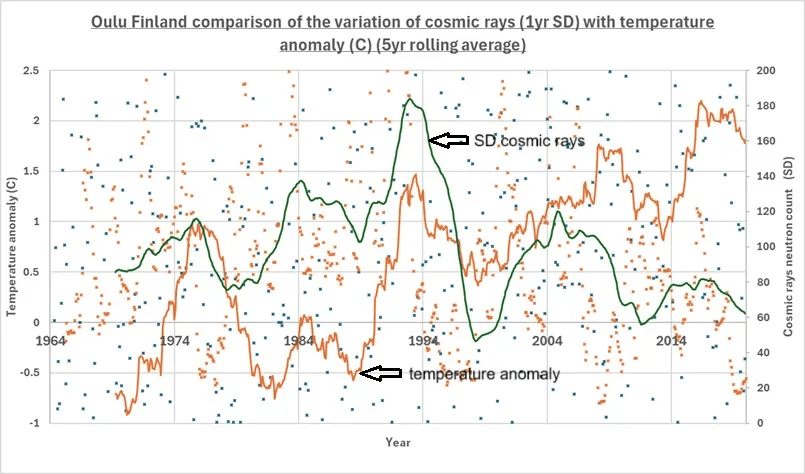
Graph 2 (Berkeley Earth / University of Oulu)
Graph 2 shows a clear visual and temporal correlation between the variation in cosmic radiation (standard deviation) and the temperature anomaly for Oulu, Finland. This agreement supports the proposal that cosmic radiation interacts with our atmosphere, creating cloud condensation nuclei that increase cloud cover and have an overall cooling effect on the climate.
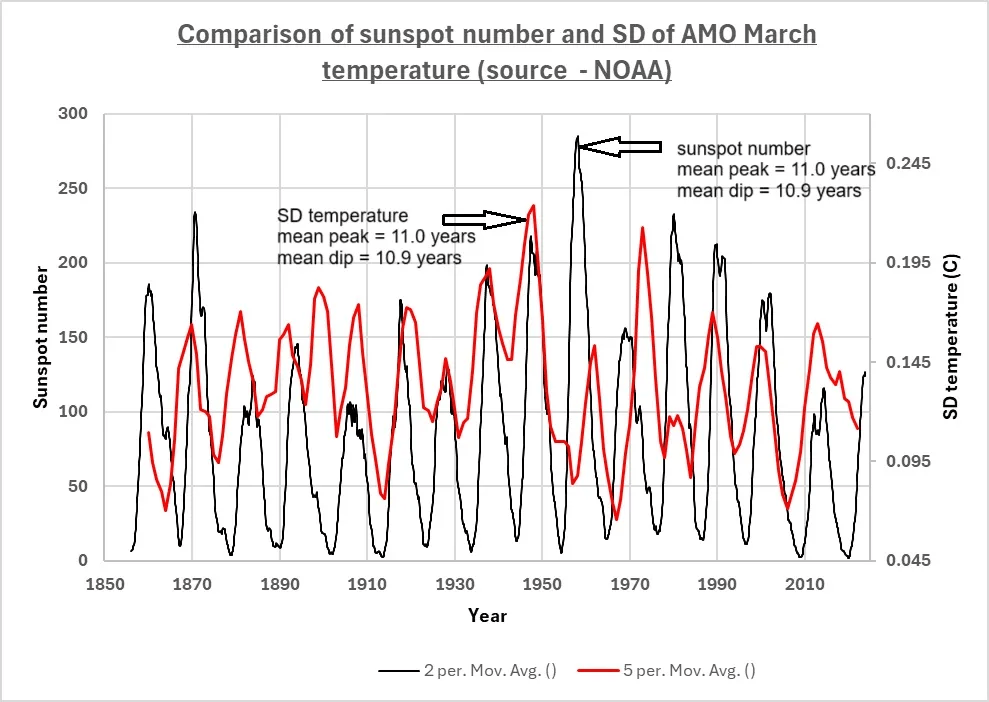
Graph 3 (NOAA)
Graph 3 shows a strong correlation between the variation in sea surface temperature (SD – standard deviation) of the Atlantic Multidecadal Oscillation (AMO) and the solar cycles. The timing of the mean intervals between peaks and troughs matches the solar cycles for the same period exactly. This is evidence that the solar cycles are directly or indirectly the cause of the rise in sea surface temperatures in the North Atlantic.
More graphs in the article by Stephen Andrews.
Conclusions of scientific work
These graphical representations from a considerable number of independent data sources strongly support combining the hypotheses of Henrik Svensmark/Nir Shaviv and Javier Vinós. Both theories propose an amplification mechanism, shown in graphs 1 to 7 above. They do not support the role of carbon dioxide as the cause of the current rise in global temperatures.
On this basis, it is proposed that these graphs, which offer a more plausible explanation for current (and past) climate trends, should replace Michael Mann’s “hockey stick”.
It is also implicit that all measures to reduce carbon dioxide emissions will have no influence on our climate
And here are the videos in which Prof. Nir Shaviv, Prof. Henrik Svensmark and Dr Javier Vinós explain their theories.
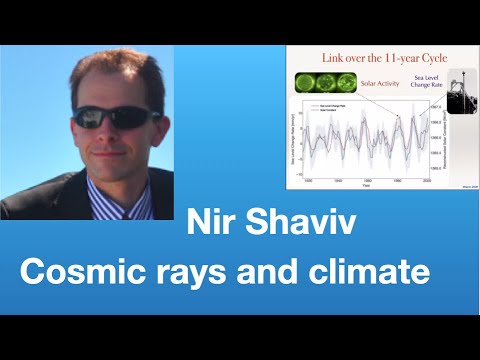
Nir Shaviv: Cosmic rays and climate | Tom Nelson Pod #138

Henrik Svensmark: “It is impossible for me to get funding for this kind of work.”

Javier Vinós: Searching for natural climate change | Tom Nelson Podcast #70
More on the topic
Original article on tkp.at (German)

The blog for science & politics
Notes on content provided by authors
Comments
Loading comments …
Become a member to comment publicly. GAIA members write comments in the members' portal — under their nickname, visible to everyone.