Society for Crisis Preparedness – Newsletter #11


Food supply after a blackout
That is the focus of this newsletter. We shed light on connections that we may not always be aware of in everyday life, because almost everything usually works smoothly anyway. In the event of major disruptions, such as will occur with a supra-regional and prolonged power outage (“blackout”), we should not rely on everything working quickly and smoothly again, even if this is still expected and assumed in many areas. That is a dangerous fallacy with serious consequences.
With this we want to underline once again why we consider the topic of preparedness so important and have made it our core concern. Even though, owing to our experience with blackout preparedness, some of the points refer to Austria, the basic findings certainly also apply to Germany or Switzerland and probably to many other countries in Europe.
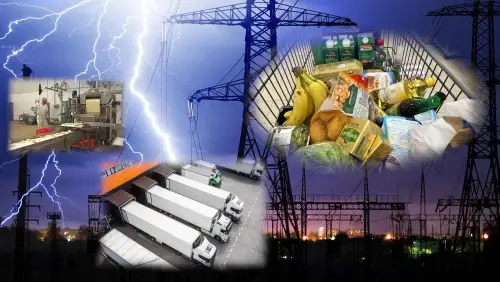
Poorly prepared for food crises
“Austria poorly prepared for food crises – emergency plans for crisis scenarios missing” – so ran one headline about the current Court of Audit report “Food – security of supply” (German). The Court of Audit urgently recommends measures to prepare for crises such as a blackout. And rightly so. The consequences of a supra-regional and prolonged power outage would immediately affect all areas of production and logistics and cause protracted restart problems, which unfortunately is still often underestimated. The basic supply of the population with vital goods and services would be particularly affected.
The Austrian food industry is now looking intensively at the possible effects of a supra-regional and prolonged power outage (“blackout”) or a possible electricity shortage (which we will cover in the next newsletter). Many companies now consider themselves quite well positioned to at least reduce the expected damage and to shut down their operations safely. But it is also clear that there will be considerable difficulties in starting up all production and logistics again, which many customers, suppliers, logistics partners and authorities do not yet seem to be fully aware of.
Warning and informing the public
A big problem is still the uncertainty about how long it will take for a large-scale power outage to be officially confirmed and communicated to the public. Yet every minute counts in limiting unnecessary damage. It is therefore urgently necessary for the authorities to create clarity here and to provide for timely information of the public. Unnecessary delays, and the damage they cause, always have a negative impact on the restart times for supplying the population with vital goods.
Many are also concerned with the question of how a fast and orderly restart can succeed and how everything can be coordinated during the crisis. Without appropriate preparation, agreements and exercises, the expected high communication and coordination effort with limited means of communication can hardly be managed in reasonable time after such an event. That is why agreements and the simplest possible procedures are so important now. In such a serious crisis, only simple things count.
Making use of resources
In the first days after the start of the power outage, large quantities of food will have to be used up urgently, as otherwise, depending on the season, they will quickly become a disposal problem and thus a health problem.
That is why the municipalities in particular are called upon to initiate and coordinate these agreements between the various actors. Inns or canteen kitchens should be involved that can cook larger quantities of food (e.g. thawed chilled goods), either from their own stocks or brought to them by the population for processing to save it from spoiling. After all, every unused resource will be missed later and make coping with the crisis harder.
It cannot be stressed often enough: in many regions where the power outage does not last for several days, the real problem is not the time of the outage itself but the time afterwards, when cooking is possible again but food will still be scarce! By sharing and distributing resources that would otherwise spoil and have to be disposed of, the time until supply resumes can be bridged better and a possible escalation delayed.
Cold chains
The entire cold chain poses a particular problem after such an event. Considerable technical faults are to be expected, especially in food retail and among suppliers. After just three to four hours of power outage, many refrigerated cabinets become maintenance cases and have to be put back into operation by service staff. Because of the very high simultaneity factor, this will certainly take some time and will probably mean that goods requiring refrigeration will only be available to a very limited extent in the first weeks after the outage.
Disposal
Against this background, disposal as a whole is an enormous challenge. Austrian food retailers keep around 200,000 tonnes of fresh goods in supermarkets every day, which in the worst case would have to be disposed of if they cannot or may not be delivered in time. Another estimate assumes up to 30,000 truckloads of perishable goods that might have to be disposed of. That would be three times the amount otherwise disposed of in a whole year. These are completely unimaginable dimensions.
Of course, it cannot be assumed that everything will have to be disposed of, especially not if appropriate precautions have been taken. Nevertheless, the quantities will be well above what we can properly dispose of today with the existing structures and quality requirements. For example, major losses in livestock farming are expected to overload all available disposal and recycling chains. Depending on the season and temperature, catastrophic conditions will threaten after only a few days, which could then quickly lead to a serious health crisis. Nor can this volume simply be stored temporarily, as decomposition processes start immediately with animal waste, making further processing impossible. The only option left is destruction, i.e. incineration, for which the necessary capacity is lacking. Yet the resumption of supply often depends on functioning disposal chains.
Security situation
The security situation also plays an important role in restarting an emergency supply. It will foreseeably deteriorate with every day of standstill, especially if no functioning structures are recognisable, which is hardly to be expected without appropriate preparation. To make matters worse, the population is known to be generally poorly prepared, so attacks on supply facilities such as supermarkets are also to be expected. Once sales facilities have been destroyed, the resumption of supply will take even longer, which is likely to worsen the security situation further.
None of this would be necessary if we dealt more intensively with the topic of preparedness. Here too the municipalities are called upon to become active and take over coordination. Such preparations can only be made at municipal level together with the various actors.
Payment systems
Another serious problem will foreseeably arise with payment systems, and not only with payments directly from customers at the checkout. Considerable problems could also arise in accounting, production or logistics. Nevertheless, it must be possible to restore an emergency supply as quickly and unbureaucratically as possible. Otherwise quite different challenges are to be expected.
Emergency production and emergency supply
Many Austrian companies have now drawn up an emergency production plan so that they can resume emergency production with the raw materials available on site as quickly as possible after the power outage. These are simple products or stored goods that can contribute to the emergency supply of the population as quickly as possible.
However, this can in no way replace individual self-provision. In addition, considerable difficulties are to be expected even after the restart, for example if new raw materials cannot be delivered. That is why it is so crucial that appropriate rationing measures are prepared and communicated now, so that everyone can adjust and make provisions.
Logistics
The central link between all areas is logistics, and thus often external service providers. Here too, complex problems will quickly arise: What information and instructions do the truck drivers have? How should they behave in a blackout? Can the goods still be accepted? How do the drivers get home to their families? Do they have enough fuel in the tank?
If these and other questions cannot be answered satisfactorily, further problems quickly threaten that could delay the restart even more. Without logistics there is no orderly restart, and this includes the fuel supply, which has to be rationed after a power outage until fuel logistics are working sufficiently again. One cog meshes with another, and a chain is only as strong as its weakest link.
Telecommunications and IT systems
The central link between all areas is the telecommunications supply and the IT systems, which are indispensable for permanent synchronisation. Not to forget, for example, building management technology or process control systems in production. In all these areas, considerable damage and disruption are to be expected in the event of a large-scale power outage. Yet without them, neither payment nor ordering or delivery systems work, usually not the fuel supply either, and not even disposal can be organised. Not to mention the internal problems when a company’s own systems fail.
Underestimated restart difficulties
As all previous discussions with the food industry on blackout preparedness have shown, the expected restart difficulties have often been underestimated so far – as in all other areas – because of the complex interdependencies described here.
The enormous coordination effort between the most diverse actors can only succeed through appropriate preparation, planned rationing measures and a coordinated and agreed approach. However, this still requires accompanying, clear safety communication to the public in order to dispel the many false expectations. While many ad-hoc procedures were still possible during the corona pandemic, this course of action will not lead to solutions in a possible blackout.
Self-provision of the population
Once again it follows that a severe supply crisis, such as after a possible blackout, can only be managed if the population is also prepared accordingly. This buffer cannot be replaced by anything and begins with a company’s own employees. If they have not made sufficient provision for themselves, they will not come to work to start up the systems and production again. A vicious circle that is hard to break.
The ability of as many people as possible to provide for themselves for 14 days is therefore the central prerequisite for being able to restart production and logistics processes quickly enough at all and to avoid a catastrophic supply crisis. Preparedness is relatively simple and inexpensive. Nevertheless, because of inadequate safety communication it is still far too often not taken seriously enough. Unfortunately, the consequences of a possible blackout are still too often played down and reduced to the time of the power outage. A dangerous self-deception.
Summary
The problems and dependencies shown represent only a small part of a multitude of connections that are often not sufficiently taken into account. A big problem during the restart will be the extremely high simultaneity factor. This applies both to missing spare parts and to the insufficient availability of service providers. The restart will therefore take much longer than many actors expect today.
The necessary safety communication and awareness-raising must therefore be broader and continuous. They are not only the task of state bodies but also of every manager for their staff. Individual, short-lived campaigns reach far too few people. The question is whether we will become active in time or whether we want to keep putting the problem on the back burner until reality catches up with us. The last few years in particular should have taught us that big and serious surprises are possible and can also occur in clusters. So let us work together to become crisis-fit as quickly as possible!
Kind regards,
Herbert Saurugg and Sandra Kreitner

For years I have been publishing extensive analyses of what happens in the event of a blackout on my website.
Since 2019 I have also been cooperating with GAIA. Besides guest articles, my newsletters are also passed on to interested readers as they appear.

Notes on content provided by authors
Comments
Loading comments …
Become a member to comment publicly. GAIA members write comments in the members' portal — under their nickname, visible to everyone.