Society for Crisis Preparedness – newsletter #12


Underestimated consequences of a possible electricity shortage
This newsletter deals with the focus topic “Underestimated consequences of a possible electricity shortage”. Although there are currently no concrete signs that we will have to reckon with so-called “brownouts” in the coming months, we would nevertheless like to point out their far-reaching and often underestimated consequences.
Not only in France but also here, brownouts are being prepared as a regulatory measure to prevent grid overload. With such events, therefore, the question is not their probability but whether we could cope with them. For if there has been one constant over the last four years, it has been the big, unexpected surprises. With this we want once again to underline why we consider preparedness so important and have made it our core concern.
Rapid forgetting curves
While in autumn 2022 the topic of blackouts and a possible electricity shortage was intensively discussed and prepared for, these topics have hardly been present in public in 2023. The mild winter of 2022/23 without the expected energy supply problems has pushed these topics into the background again, even though the basic problems remain. Even if the coming winter looks much more relaxed than could be expected a year ago, we should not lull ourselves into a completely false sense of security.
In 2022 it was the tense gas supply situation that led several countries to plan energy control measures. Today the reasons are rather grid and supply bottlenecks. As a last resort to avoid an unplanned large-scale power cut (“blackout”) due to insufficient generation or transmission capacity, rotating area shutdowns lasting several hours are being prepared (so-called brownouts). The energy industry is coordinating with the authorities, and various contingency regulations are being drawn up. The message is: we are prepared. But is that really true, and what consequences would such energy control measures have?
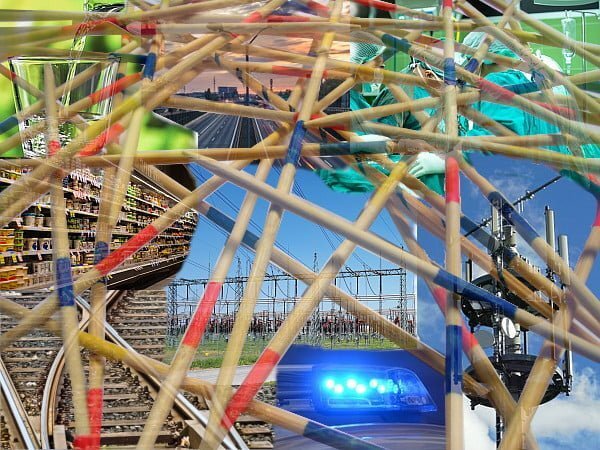
Like a blackout, the topic of brownouts goes far beyond a temporary power cut and is often underestimated. Planned area shutdowns would, as with a blackout, lead to far-reaching interruptions to infrastructure, communications, logistics and supply, with serious consequences.
Several stages
In Austria and Germany a three-stage procedure has been prepared. In Switzerland, stage 1 is divided in two.
In stage 1, the public is called upon to save electricity. If necessary, usage restrictions or bans are also issued. In Switzerland this would already be stage 2: there, electricity-intensive applications such as the use of saunas or illuminated advertising would be prohibited at an intermediate stage. Stage 1 was more or less declared at the end of March 2022 and has not been lifted since, even though it has so far only been communicated in a very low-key way.
In stage 2, large consumers would be subject to quotas and would have to reduce their electricity consumption accordingly, which is not easily possible everywhere. In Carinthia there are therefore agreements between companies that those which cannot easily reduce their consumption will still cover their needs, while other companies that can reduce theirs more easily will forgo their quota in return. A very sensible approach. If these quotas are not enough, stage 3 would have to be ordered.
In stage 3, electricity quotas would be allocated to the federal states in Austria. The resulting shortfall could then lead to temporary area shutdowns. Different shutdown zones have been prepared in the federal states for this purpose.
While in Austria the federal government – the Federal Ministry for Climate Action, Environment, Energy, Mobility, Innovation and Technology (BMK) – is responsible for the regulation on measures, implementation lies with the federal states, which is also reflected in the procedure. Carinthia plans two zones, Tyrol and Salzburg three, and Upper and Lower Austria six, each with four hours of shutdown. Because of its greater complexity, Vienna is to have four zones with six hours of shutdown. The specific variants will certainly depend on the amount of energy to be saved and the period required. The duration of the shortfall will also determine whether longer-lasting rolling shutdowns may become necessary.
In Switzerland, for example, it is also expected that after a blackout damage to equipment may occur that could likewise make such rolling power cuts necessary.
Implementation
A possible load shortfall should, in principle, become apparent several days in advance. For this purpose, the transmission system operator responsible for the system – in Austria, Austrian Power Grid (APG) – continuously prepares load coverage forecasts. If load can no longer be covered by own generation capacity or imports, the climate ministry would have to issue a corresponding regulation on measures, which would then have to be implemented by an implementing regulation of the respective state government. These processes are prepared. The same applies to communication with energy-intensive companies, which would be the first to have to reduce their demand in stage 2. What is missing, however, is information for the rest of society about the necessary steps and consequences in stage 3, and in some cases already from stage 2 – because the reduced production capacity of large companies will not remain without consequences either.
In Germany, the Federal Network Agency rates the risk of controlled shutdowns in winter 2023/24 as low; it says there are enough precautionary mechanisms. The Federal Office of Civil Protection and Disaster Assistance (BBK), on the other hand, does not rule out controlled shutdowns in winter 23/24 either. The danger would be greatest in January and February 2024. In the event of an electricity shortage, power would be switched off across Germany in a regionally distributed, controlled and time-limited way. Besides shortages of primary energy sources, irremediable bottlenecks in the power grid are seen as a risk. Power would then fail only where corresponding power plant capacity is lacking – likewise in a controlled and time-limited way. With its StromGedacht app, the transmission system operator TransnetBW offers a tool that enables everyone to see the current state of the grid and to help stabilise it through load shifting, i.e. targeted changes in usage behaviour.
Missing safety communication
All these risk assessments, however, assume only foreseeable and manageable events. Even though there are currently no concrete signs that we could find ourselves in this situation next winter, we should have learned from the experience of recent years: surprises come more often than you think. Even if the gas and electricity supply currently appears stable, unexpected events such as major cold snaps or acts of sabotage against critical infrastructure – such as the attack on the Nord Stream 1 and 2 gas pipelines – can very quickly lead to critical situations for which we are currently hardly prepared. We should also always be aware of international logistical interdependencies. Even if a country such as Austria is not directly affected by an immediate energy shortage in another country, the knock-on effects from the affected regions can very quickly hit other regions too.
Effects of an electricity shortage
As with a blackout, an electricity shortage would lead to massive supply problems from stage 2 onwards. In Switzerland, for example, from stage 3 (quotas) passenger rail transport would be suspended, with correspondingly serious impairments in all areas of life. Employees, for example, would only be able to come to work to a limited extent. From stage 4 – or stage 3 in Germany and Austria – all rail traffic would have to be stopped. Even in a single region, this measure would certainly have cross-border effects. Logistics in particular would face serious consequences. In the affected regions, as with a blackout, telecommunications would fail within 30 minutes, so that neither emergency calls nor the synchronisation of logistics etc. would work. As several incidents in recent months have shown, even short power cuts are often enough to cause chaos in data centres. At the same time, more and more companies store their data in the cloud, so a quick restart after the power cut can hardly be expected – not to mention the complex mutual dependencies in our just-in-time logistics. Various business areas depend on central data centres. If these fell within the shutdown zone, all users who still have electricity would also be affected.
As with a blackout, logistical chaos could arise within a very short time, impairing the basic supply of essential goods and services to the population. Even though electricity shortages and load shedding are a lesser evil than an unplanned large-scale power cut, even short, planned restrictions would have massive consequences. So far, however, these have neither been discussed nor are there corresponding preparations outside individual government departments or the energy industry. It must therefore be doubted that the contingency plans will simply work.
The short- and long-term effects depend on the initial situation and on whether such a measure has to be carried out once, over several days or over a longer period. It should not be overlooked that such area shutdowns can cause considerable voltage, frequency and current fluctuations that can damage sensitive equipment (IT systems, building or process control technology, etc.). Serious damage to the telecommunications infrastructure (mobile, landline, internet) can also occur, and, as with a blackout, considerable problems with restarting would have to be expected.
In addition, there are many different responsibilities, and corresponding coordination is not evident everywhere. While regulation in the official sphere is a matter for those responsible for energy, responsibility for the consequences lies with security and civil protection. As always, there is light and there are positive exceptions, but there are also shadows and dark spots. And as with the blackout scenario, what matters is not whether individual players or sectors are well positioned and prepared, but whether society is able to cope with the far-reaching consequences of such an interruption to supply.
Preparedness
Comprehensive preparedness, as called for in the blackout scenario, would also help here to mitigate the expected consequences. If many people can supply themselves for at least 14 days, logistics chains are relieved and disruptions can be remedied more quickly. On the other hand, the municipal crisis management structures, which have hardly been addressed in planning so far, would also be massively challenged here. Even with a power cut of only four hours, it would have to be ensured that water supply and wastewater disposal are maintained, that there are contact points for passing on emergency calls (“self-help bases”), that emergency medical care can be maintained and that emergency food supplies are prepared.
Even a four-hour power cut can cause considerable problems if, as is to be expected, refrigerated display cases in supermarkets need servicing and cannot be put back into operation. If perishable food cannot be handed out in time, a major disposal problem very quickly arises, to which there are currently hardly any answers. Or what happens in kindergartens, schools and other essential areas? What effect would that have on the availability of parents in important institutions such as organised care or emergency services? As you can see, we quickly come back to the topic of blackout preparedness. So it can only be stressed once again at this point: sound blackout preparedness also helps in many other possible scenarios, and we would do better to prepare than to be unpleasantly surprised. For if, as is currently being warned, there are massive bottlenecks in gas supply from 2025, we will very quickly find ourselves in a similar situation. The outlook for crises is therefore not getting better. We can keep hoping for luck, or take responsibility in good time and prepare for further surprises.
This also includes requesting the relevant information through official channels instead of waiting for someone “at the top” to call for action – because by then it is often too late. It is to be feared that information will be withheld until there is no other option, and that there will then certainly be too little time for one’s own considerations. As we know from recent events, risk communication is often delayed until unprepared crisis communication becomes necessary. This applies in municipalities just as much as in companies. Among the population, prudent action is not encouraged; instead, overreactions and panic buying are rather left to happen, which in turn increases the risk of chaos. Do we want to let it come to that?
Summary
As so often, there is no simple black-and-white view on this topic either, and there may also be other facets. Last summer, for example, a major transformer in Austria failed because of overload from too much PV electricity being fed in. At the current rapid pace of expansion, such events are likely to occur more often in future – which can also happen through the opposite effect, namely too high a load from electric cars and heat pumps. Until now, precise monitoring in the distribution grids was usually not necessary. This is now changing rapidly, and what is missing is not only rapid grid expansion but also the digitalisation needed to monitor and control equipment better. So it is not only about the big events. Smaller disruptions can also very quickly have unpleasant effects.
The problems and dependencies shown here are only a small part of a multitude of connections and dependencies that are often not sufficiently taken into account. In a possible electricity shortage, too, many problems similar to those of a possible blackout are to be expected when restarting, even if not with full severity. This applies both to missing spare parts and to the insufficient availability of service providers. Restarting and a return to normal will therefore take considerably longer than many players expect today.
The necessary safety communication and education must therefore be broader and more continuous. It is not only a task for state bodies but also for every manager as part of their duty of care for their employees. And as we keep experiencing and hearing back, people are generally very grateful for this clarity and honesty. That creates trust and increases the chance that in a crisis – in whatever form – better cohesion and the right reactions are possible.
The clarity that hardly any help can be expected from elsewhere is also often shocking at first, but at the same time this clarity also creates the basis for the necessary self-efficacy. For if you know that hardly any support can be expected from outside, you are probably more willing to roll up your sleeves and help find solutions. This also includes, as with other assaults, addressing uninvolved people directly and moving and guiding them to act.
So let us continue working together to become crisis-proof as quickly as possible! Raise the topic of preparedness in your private and professional environment and, like us, stay uncomfortable.
Warm regards Herbert Saurugg and Sandra Kreitner




For years I have been publishing extensive analyses of what happens in the event of a blackout on my website.
Since 2019 I have also been cooperating with GAIA. Besides guest articles, my newsletters are also passed on to interested readers as they appear.

Notes on content provided by authors
Comments
Loading comments …
Become a member to comment publicly. GAIA members write comments in the members' portal — under their nickname, visible to everyone.