Dark Doldrums in Europe


Electricity prices rise to 2,748 euros per MWh
Dr. Peter F. Mayer, tkp.at (German)
We currently have proper autumn-winter weather with fog and the accompanying lack of wind. Below the fog, temperatures stay close to freezing. Wind turbines stand still, photovoltaics delivers somewhere between 1 and 10 percent of installed capacity for a few hours. Heating systems are running at full power, lights are on most of the day, and the power supply is balancing on the edge of a blackout.
Since the beginning of the week we had little wind at first and, initially, still some sunshine, which however decreased from day to day. The sun is low, so photovoltaics delivers less energy, and over fewer hours each day. “Renewable” energy is thumbing its nose at EU propaganda and hardly “renews” itself at all. With the Green Deal, the EU Commission’s energy policy relies more and more on photovoltaics and wind, which are least available precisely when electricity is needed most. At the same time, oil and natural gas infrastructure is being dismantled (German) and power plants running on hydrocarbons are being shut down.
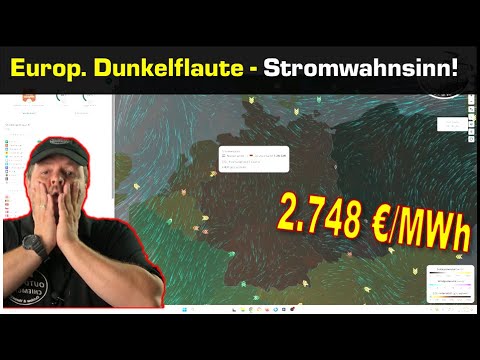
The result is rising energy prices and the danger of blackouts. The video below reports that the persistent dark doldrums in Germany have now pushed wholesale prices to 820 euros per MWh, and in the Netherlands even to 2,748 euros per MWh. Even the Austrians had to pay 720 euros per megawatt hour, although they produced more than they consumed themselves. And that simply shows how our entire European power grid is becoming ever more unstable.
Average spot prices in 2024 were about 80 to 90 euros per MWh. Before the self-made energy crisis (the Ukraine war is a most welcome diversion), the wholesale price was between 35 and 45 euros for years, and the final industrial price around 50 euros.
Anyone who thinks the price of 2,748 euros is crazy enough should be warned about what is coming from 1 December 2025. From then on, when capacity is exhausted, a scarcity factor will be added to the balancing price. The effects of this measure would have been considerable had it been in force today, since the prices of the last 100 MW in the balancing merit order are extrapolated linearly to offset the total imbalance. That gives a theoretical maximum price of up to 68,000 euros per MWh. That is the EU’s energy policy.
Germany imported 1.16 GW from Austria, 585 MW from Switzerland, 3.55 GW from France, even more GW from Belgium, 1.26 from the Netherlands, 0.5 from Denmark, another 0.5 from eastern Denmark, from southern Sweden, 209 MW from Norway, 1 GW from Poland and 2 GW from the Czech Republic. So every one of Germany’s neighbours is currently supplying electricity, because there is nowhere near enough.
Solar is currently delivering just 7.44% of installed capacity. To make up for it, a great deal is done with coal: 19.2 GW from coal and another 13.6 GW from natural gas.
Both Germany and the Netherlands had to draw on their very last reserves to avoid a blackout.
The policy of the EU, and above all of the Greens in Germany, is more of the same: more wind, more solar and less secure energy. But in dark doldrums, zero times a hundred of what we already have is still too little or nothing at all.
Future developments, especially in Germany, will be decided by which happens faster: deindustrialisation or the dismantling of the energy supply. If deindustrialisation proceeds faster, energy prices will remain constant or even fall. But if, for example, the dismantling of gas distribution networks or filling-station networks is pushed ahead faster, energy costs will rise faster, partly because of the costs of the then necessary expansion of the power grids and the dismantling of the gas networks.
Commentary by Outdoor Chiemgau / MrBlackout (German)
Von der Leyen goes one better when it comes to incompetence and ill-conceived policy:
Montel News reports on recent statements by von der Leyen:
“We will unlock Europe’s enormous potential of renewable energy and make it available to our industries to help them decarbonise,” she said in a video message to the Renewable Hydrogen Summit in Brussels on Thursday.
Von der Leyen has asked her new team of EU commissioners to present the deal for clean industry within 100 days of the start of her five-year term. This could be as early as the end of February if the European Parliament confirms the commissioners this month and they take up their work in December.”
There is nothing “renewable” about hydrogen either. It has to be produced with an extremely high energy input, liquefied at great expense, transported and secured against leaks, because otherwise the resulting oxyhydrogen (“Knallgas”, literally “bang gas”) does what its name says.
By the way, did you know that the claim that oil is a “fossil fuel” was a ploy by the Rockefellers to create the impression of scarcity and so make it easier to agree a higher world market price for oil? Hydrocarbons also occur where there can be no question of plants or animals, for example in the methane lakes of Saturn’s moon Titan. Or on asteroids.
On Earth, too, methane (natural gas) and crude oil come predominantly from the depths of the Earth and are practically inexhaustible for our purposes. All this is explained very well in the book “The Deep Hot Biosphere: The Myth of Fossil Fuels” by Thomas Gold.
Original article on tkp.at (German)

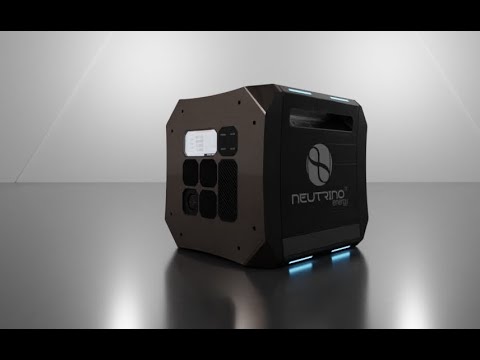
Controllable renewable energy
We need baseload-capable renewable energy
Regulating the power grid swallows vast sums – and the cost keeps rising. With every additional non-controllable renewable energy source connected to the grid, the effort required to stabilise it increases too. Organisationally, this is a huge effort in the European interconnected grid. More decentralised energy generation could bring relief – but only if it is controllable, i.e. baseload-capable.
Local energy generation at the point of consumption offers, among many other advantages, above all relief, and so helps stabilise the central structures. At a global level, decentralised energy production is even a key answer to numerous future challenges.
Neutrinovoltaics information page

Notes on content provided by authors
Comments
Loading comments …
Become a member to comment publicly. GAIA members write comments in the members' portal — under their nickname, visible to everyone.