Electricity generation solely from wind and solar systems is not feasible


People act as if all you had to do was build enough wind and solar plants.
Dr. Peter F. Mayer, tkp.at (German)
That way, after all, demand could be met. But that’s not how it works. The absurdity becomes clearer every day. Nevertheless, in countries like Germany and Austria our future is being bet on it.
In Austria, a NetZero 2040 paper described as a “study” appeared recently, according to which it would be effortless to switch all heating systems to heat pumps and to secure electricity generation with wind turbines. Even quick rough calculations show that the goal could only be achieved if the population were drastically reduced. More on this in this article on the “energy transition” and population reduction (German).
Let us look at the latest figures from Germany. According to Statista, Germany consumed 511.59 TWh of electricity in 2021 (the last year given, although the figures have changed little from year to year recently). Dividing this by 8,760 (the number of hours in a year) gives an average power draw in Germany of 58.3 GW. So can you simply build 58.3 GW of wind and solar generators to supply Germany with electricity?
Certainly not. In fact, Germany already has far more wind and solar generating capacity than 58.3 GW but cannot get anywhere near all its electricity from these sources. In June 2023, Germany had 59.3 GW of generating capacity from wind turbines alone and (at the end of 2022) a further 67.4 GW of generating capacity from solar plants. The sum of the two is 126.7 GW – which would be more than twice Germany’s electricity demand at midday on a sunny and windy 21 June.
According to Clean Energy Wire, however, the share of electricity from wind and solar in Germany in the first three quarters of 2023 was only 52%. Capacity that seemingly suffices to deliver twice consumption in reality delivers only half. This is because supply does not come at the same time as demand, and the wind/solar energy system has no mechanism for shifting supply to a time that matches demand.
And why doesn’t Germany simply double its wind/solar generation so that these sources rise from 52% of consumption to 100%? Because it doesn’t work that way. If they double wind and solar generation, then at midday on a sunny, breezy 21 June they will have over 250 GW of generation – more than four times what they need – so they have to throw away or give away the rest.
But on a windless January night they will still have nothing and need full back-up from another source. If you multiply wind/solar capacity by 10 or even 100 (known as “overbuilding”), the cost of the system rises exponentially, but it will never be enough to keep the lights on all the time. Or you can try to store the surpluses to make up the deficits, but that too multiplies the cost of the system exponentially.
At this point we should refer to the various heating laws and EU regulations (German) and those of Germany, as well as the push to switch to electric cars. As explained in the article on the “energy transition” cited above, electric cars will need around two thirds of current electricity generation in addition. On top of that comes two to three times as much again for running heat pumps on a cold winter day, which are of course supposed to replace all gas and oil heating completely. This demand does not exist in summer, of course, but it very much does in cold winters.
The advocates of renewable energy and the governments committed to “net zero” are therefore engaged in gigantic self-deception. They have developed a completely misleading metric for comparing the cost of electricity from different sources, which they call the “levelised cost of electricity”. Reports claiming to calculate this levelised cost are published by various organisations, above all the investment bank Lazard and the International Renewable Energy Agency (IRENA). Here is IRENA’s 2022 report containing the alleged costs of renewable energy for 2021, entitled “Renewable Power Generation Costs in 2021”.
Key quote from page 17:
In 2021, the global weighted-average levelised cost of electricity of new utility-scale solar PV and hydropower plants was 11% lower than the cheapest new fossil-fuel-fired power generation option, while the cost of onshore wind was 39% lower.
And here is their key chart:
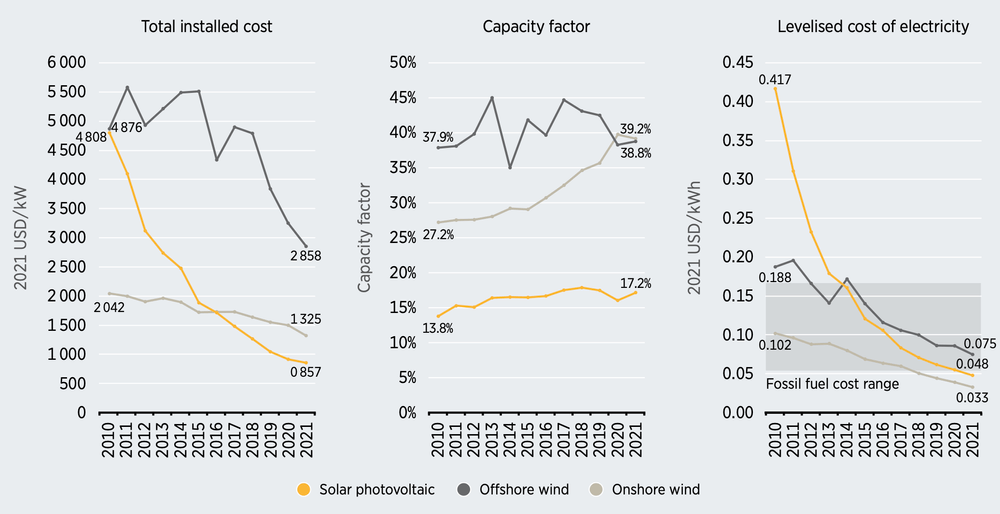 Incredible! Solar costs less than 5 cents per kWh, and onshore wind is even cheaper at 3.3 cents per kWh. And how much of the cost of overbuilding or energy storage to create a system that works 24 hours a day, 7 days a week, 365 days a year without the support of fossil fuels is included in these figures? The answer: precisely nothing.
The fact is that building a wind/solar/storage system without fossil-fuel back-up makes electricity not cheaper than a system based mainly on fossil fuels, but more expensive. And the additional costs are not a small amount like 10, 20 or 30 per cent. It is more like a factor of 10 or 20. Nobody knows exactly how much, because there is no working demonstration project anywhere in the world where the costs could be measured and extrapolated.
Once you start eliminating fossil fuels from the system, the costs of energy storage and/or overbuilding will far outweigh everything else. The costs of the wind turbines and solar panels themselves become relatively insignificant. As already mentioned, around 50% of electricity generation in Germany comes from wind and solar, with capacity so far overbuilt by a factor of two and almost no storage. With the next round of capacity expansion, should it happen, they will be glad to reach 60% of electricity from renewables; and each further round of expansion brings less useful electricity and more that has to be thrown away. Meanwhile, storing electricity in quantities that matter for keeping the power on all year round is ruinously expensive.
Even so, on a cold winter day it is not possible to come anywhere near covering consumption, as the data for 1 December show:
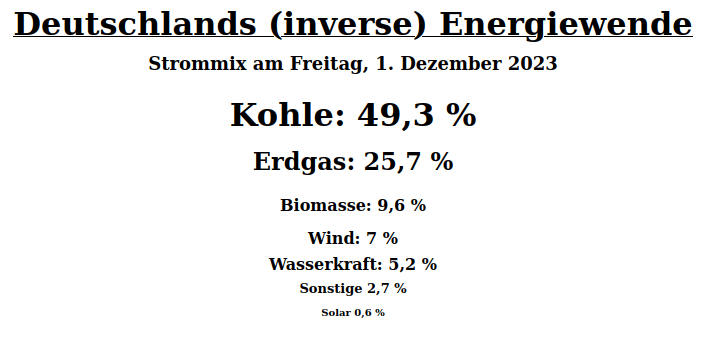
Even with twice the capacity, only 24.4% would have been covered. With widespread heat pumps and a switch to electric cars, however, the share would fall to well below 10%.
In the real world of investment decisions, the costs are becoming ever clearer. At the end of November, Greg Ip published an article in the Wall Street Journal headlined “Why No One Wants to Pay for the Green Transition”.
Extract:
Investors and consumers are balking at the cost of replacing fossil fuels with renewables, pointing to the painful economic consequences of climate action… . In recent years, Washington and Wall Street began to fantasise that the transition to net-zero emissions could be an economic windfall… . This year the fantasy ended… . [The economics of the transition to net zero remain fundamentally grim: someone has to pay for it, and shareholders and consumers decided this year that it won’t be them.
The bottom line is that the only way to build this wind/solar system is government subsidies – gigantic, massive government subsidies on a scale far beyond anything ever seen in human history. And even then it will only work if you have back-ups in the form of hydrocarbon-fuelled power plants. Or if the population is drastically reduced.
Original article on tkp.at (German)

Decentralised energy
Graphene-based neutrinovoltaics offers a scientifically proven way of generating baseload-capable, environmentally neutral renewable energy. This could slow down the subsidised expansion of weather-dependent wind/solar systems.

Notes on content provided by authors
Comments
Loading comments …
Become a member to comment publicly. GAIA members write comments in the members' portal — under their nickname, visible to everyone.