Neutrinovoltaics taken up by China’s media


Neutrinovoltaics is gaining international attention
Neutrinovoltaics is increasingly being noticed internationally. Several Chinese-language publications have recently looked at our technological approach and placed it in the context of current developments in particle physics, materials science and industrial application.
At the centre of this coverage is a question that has also shaped our work for years: can permanent, so far largely unused ambient impulses be converted into electrical energy? This is exactly where neutrinovoltaics comes in. Unlike classic photovoltaics, it does not depend on direct sunlight. Our approach considers a broader spectrum of natural and technical influences – including neutrinos, cosmic background radiation, muons, thermal motion and low-frequency electromagnetic fields – as triggers for electrical charge separation in specially developed nanomaterials.
Where did the scepticism come from?
From the outset, scepticism towards neutrinovoltaics had an understandable physical background. Classic objections were based mainly on two arguments.
First: neutrinos interact extremely rarely with normal matter. They have a very small mass, carry no electric charge and pass through enormous amounts of matter almost unhindered. This gave rise to the obvious question: how can energy be obtained from a particle that practically cannot be stopped?
Second: as early as the 1930s, Hans Bethe and Rudolf Peierls described the extremely small cross-section of neutrinos. In other words, the probability of a single interaction is so low that, from the classical point of view, technical use long seemed practically impossible.
These objections were not irrational. They followed the measurability, materials technology and the idea of the time that energy generation must be based on direct absorption or clear interaction.
The decisive change of perspective
Neutrinovoltaics starts at a different point. It does not try to “stop” neutrinos. It looks at the effect of extremely weak, permanent impulses in a suitable volume of material.
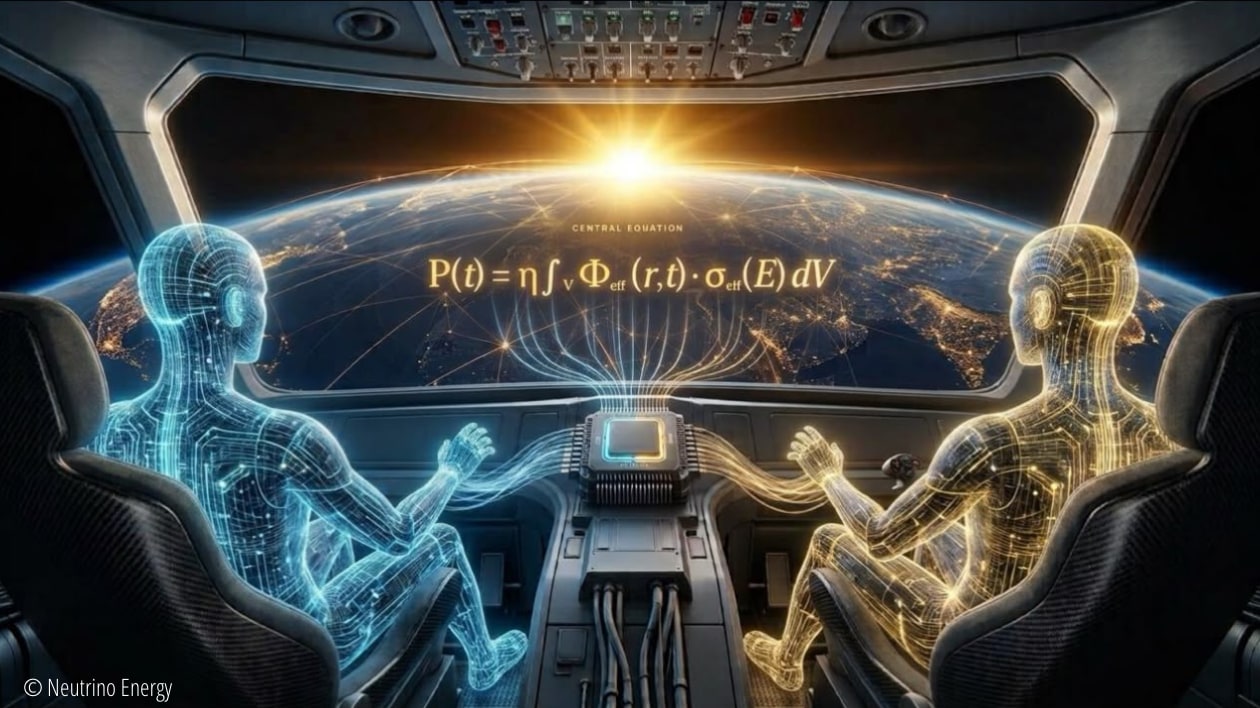
Holger Thorsten Schubart’s mathematical approach describes this change of perspective through a master equation in which the focus is not the individual interaction but the sum of many very small impulses within a three-dimensional nanomaterial. The decisive factor is the volume integral:
The statement of this equation is fundamental: if the individual impulse is vanishingly small, what decides is not the single event but the totality of interactions in an optimised volume of material. Billions of particles and ambient impulses strike matter every second. In ordinary materials this effect remains undirected and technically unused. In specially constructed nanostructures it can give rise to a directed process of vibration and charge separation. The difference therefore does not lie in claiming that neutrinos would suddenly interact strongly. The difference lies in the material architecture. Graphene, doped silicon and multilayer nanoscale structures create conditions under which the smallest excitations can be translated into directed electrical effects.
From theory to materials technology
The Chinese publications take up various scientific reference points. These include coherent elastic neutrino-nucleus scattering, known internationally as CEνNS. This phenomenon describes an interaction in which a neutrino can interact with an atomic nucleus as a whole. Experiments such as COHERENT and LUX-ZEPLIN provide important data on this and broaden the understanding of extremely weak particle interactions.
For us, this scientific progress is of fundamental importance. It shows that processes that were barely measurable for a long time can today be observed, described and technologically classified more precisely. Neutrinovoltaics is not based on a single isolated interaction, but on the interplay of several permanent ambient impulses with suitable material systems.
The material architecture is therefore decisive. Our technology uses multilayer nanostructures, in particular based on graphene, doped silicon and other functional layers. Graphene has exceptional electrical and mechanical properties. In combination with silicon and targeted doping, material systems are created in which the smallest impulses can contribute to directed vibrations, charge separation and thus to electrical voltage.
International research on graphene, Dirac fluid properties, charge carrier dynamics and nanoscale heat transport confirms how much potential lies in new classes of materials. For neutrinovoltaics this is a central point: the energy source is not the only issue. The real technological achievement lies in generating a stable, usable electrical output signal from weak, permanently present impulses.
Why the development matters
The original scepticism was based on a classic question: how can an almost unstoppable particle be made technically usable? Today’s answer is: not by blocking, but through coupling, resonance, material design and summation.
This is exactly where the paradigm shift lies. Nature supplies permanent microscopic impulses. The task of technology is to order these impulses in suitable structures in such a way that a macroscopically measurable electrical effect results. This is no contradiction to physics, but an extension of the technical view: from the individual interaction to the collective effect in the material.
The step from two-dimensional to three-dimensional material structures is also decisive. Larger active surfaces, optimised layer architectures and more precise coupling of the materials allow efficiency and scalability to be developed further. This is exactly the area in which Neutrino Energy is working on the industrial implementation of neutrinovoltaics.
The coverage from China shows that our approach is increasingly understood internationally as part of a new energy debate. While solar and wind energy continue to play important roles, they remain dependent on location, weather, time of day and grid infrastructure. Neutrinovoltaics takes a different path: continuous, silent and decentralised energy generation that is intended to work independently of direct sunlight.
We do not see this development as being in opposition to existing renewable energies, but as a complement. A resilient energy future will not consist of a single technology. It will emerge from an intelligent interplay of different systems – from solar and wind to storage and new forms of continuous base energy.
This is exactly where we see the role of neutrinovoltaics: as a technology for more decentralisation, more security of supply and more energy independence. The international attention confirms that the scientific and industrial questions behind it are today being discussed more widely.
Of course, the path from physical principles through materials development to industrial application is demanding. But new energy technologies always emerge where research, engineering and social need meet. Neutrinovoltaics stands exactly at this interface.
Our goal is clear: we want to think of energy supply as quieter, more independent and more decentralised. Not as an abstract vision, but as concrete technological development based on modern materials science.
Conclusion:
The recent Chinese publications show that neutrinovoltaics is receiving increasing international attention. For Neutrino Energy this is an important signal: the discussion about future energy supply is broadening – away from purely central and weather-dependent systems, towards new concepts of permanent, decentralised energy generation.
The earlier scepticism was scientifically understandable. But it was based on considering individual interactions. Neutrinovoltaics starts from the sum of many weak impulses in intelligently designed nanomaterials. That is where the technological core of our approach lies.
We are working to take this approach further towards industrial application. Our aspiration remains the same: scientifically sound, technologically ambitious and geared towards a future with more energy self-sufficiency.
Sources
The starting point for this article is several Chinese-language publications on neutrinovoltaics, including on Weibo and other Chinese media platforms. Scientific reference points are current research on CEνNS, graphene, nanoscale charge transport and material-based energy conversion.
Notes on content provided by authors
Comments
Loading comments …
Become a member to comment publicly. GAIA members write comments in the members' portal — under their nickname, visible to everyone.