Electricity is not enough for heating in cold winters


To “protect the climate” …
Dr. Peter F. Mayer, tkp.at (German)
practically all heating and transport within the EU is to be switched to electricity. That has already failed with the e-buses in Oslo (German), and people were seen on skis in Norway’s streets – as they used to be in Munich, incidentally. In Germany, additional electricity is currently produced with coal. Covering the additional electricity demand for a complete switch is hardly possible, the necessary storage is extremely expensive, and distribution grids, including transformers, would have to be completely rebuilt.
Billions of people around the world have no access to safe sources of heat and electricity. For them, winter can be a death blow. A political war on hydrocarbons (coal, oil and natural gas) makes the situation worse for those who are not protected from freezing temperatures.
The severity of the winter danger has been overshadowed by the prevailing discussion about allegedly man-made climate change. We are flooded with warnings about the dangers of warming. Yet historically, and today too, it is cold that has catastrophic consequences. It has changed the course of history all over the world and driven people into a corner in search of food as plant life dwindled.
The icy cold of winter claims far more lives than the scorching heat of summer, as global analyses of deaths from various natural hazards show. As reported, a study for 2023 conducted in 854 European cities showed that an estimated 203,620 deaths a year are attributable to cold, while only 20,173 are attributable to heat. In comparison, only 1 in 10 deaths due to extreme temperatures was attributable to heat, while the majority was due to cold. The regional distribution shows that the colder it is, the more the imbalance shifts.
Fear of warming aside, the cold of winter will not let up and will continue to test humanity’s survival mechanisms. Since August 2023, snow cover in the northern hemisphere (dark blue line) has been at or above the 57-year average (dashed).
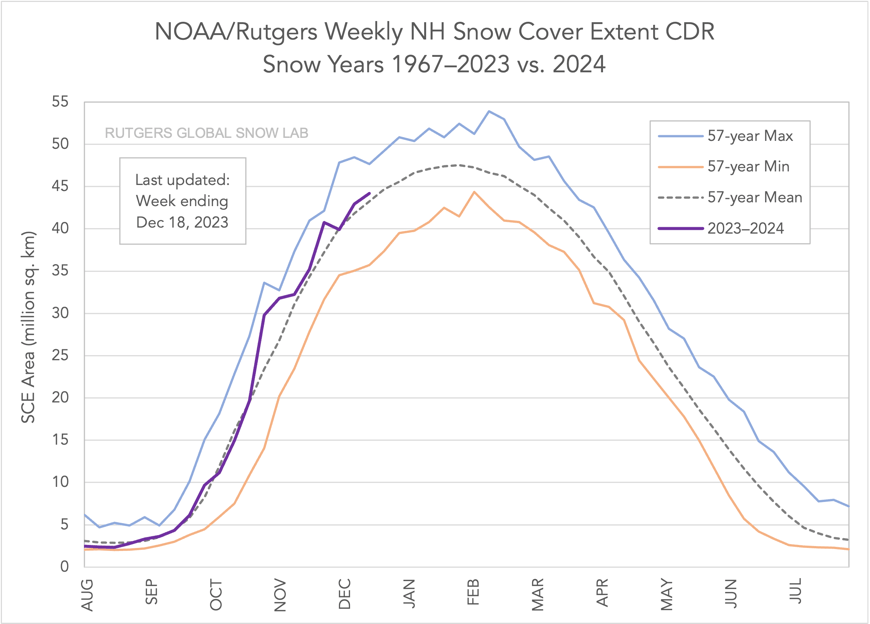 NOAA stands for National Oceanic and Atmospheric Administration, a US government agency. Rutgers University runs a snow lab.
Pseudoscience endangers people with absurd energy policy
Since climate science has been co-opted by a worldwide political crusade against allegedly man-made global warming, countries may be poorly prepared for the coming winter weather.
In regions with particularly harsh winters and limited access to reliable sources of heating, the danger of death and illness due to policies against fossil fuels is great.
In places like Mongolia, where economic hardship and energy supply meet, staying warm in winter is a constant concern. This year the country’s electricity imports from Russia were interrupted, leaving millions of people without electricity in the middle of winter.
At minus 35 degrees Celsius, the people of Mongolia were left to fend for themselves. To brave this harsh climate, they depend on only two important energy sources: domestic electricity generation from abundant coal reserves and the direct use of coal to heat homes. On sub-zero, snow-covered winter days, neither wind nor solar energy can guarantee a continuous energy supply.
The scenario is similar in other countries of the region. Destitute communities in Afghanistan depend on coal to get through the winter. In Kyrgyzstan, the unreliability of hydropower leads to a constant need for coal. In Uzbekistan and Kazakhstan, too, people depend on coal to keep warm, although Kazakhstan is increasingly turning to gas.
Hypocritical politicians who fly around the Western world in private, CO2-emitting jets find it easy to campaign for the abolition of fossil fuels. But their activism blatantly ignores winter’s icy grip on distant communities.
These differences can also be seen in Europe. The study mentioned above shows a clear difference between East and West. The further east you go, the higher the vulnerability, but cities with slums such as London are also more affected. The social component – poverty – plays the decisive role. The share of cold deaths is lowest in the West, but even there it is around 7 times as high as heat deaths. And it is precisely these people who would be hit hardest by the EU’s policy of making energy more expensive and switching to electricity.
The world’s largest study (German) on climate-related mortality links a total of 5 million deaths a year to abnormal temperatures. Of these, 4.35 million are cold deaths and 0.45 million heat deaths. A study in Europe had already shown this ratio.
Original article on tkp.at (German)


Decentralised energy

Neutrinovoltaics based on freely oscillating graphene offers a scientifically proven, viable way of generating baseload-capable, environmentally neutral renewable energy. This could also slow down the subsidised expansion of weather-dependent wind farms.

Notes on content provided by authors
Comments
Loading comments …
Become a member to comment publicly. GAIA members write comments in the members' portal — under their nickname, visible to everyone.