Free education: are welcome individual cases enough?

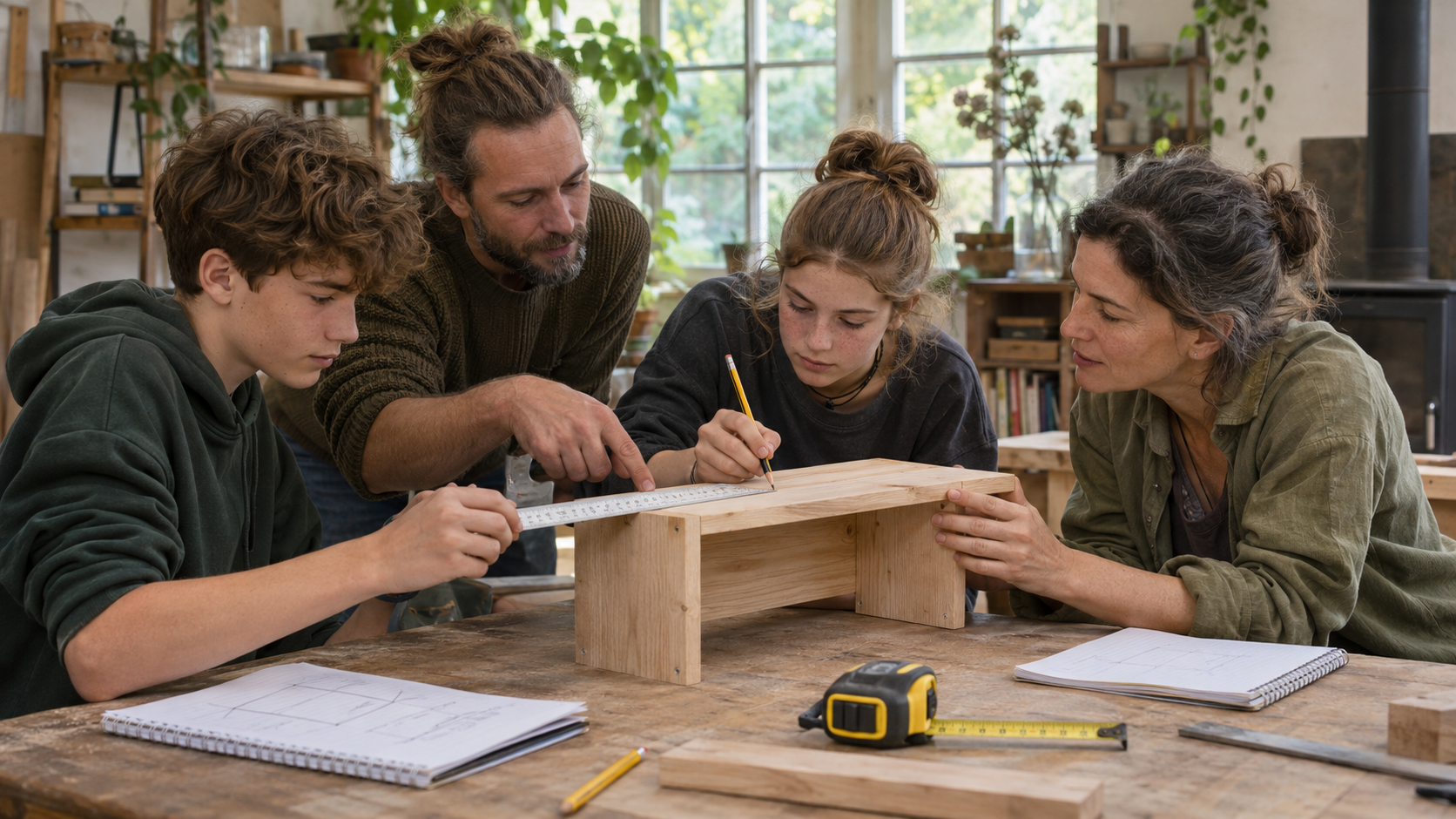
A child who finds their own path of learning. An educational initiative in which young people flourish. Adults who create new possibilities with courage and heart. Such examples are welcome. They show that education can be done differently. Yet an uncomfortable question remains: Are welcome individual cases enough to sustain a society?
This question also applies to the field of free education. Anyone who criticises existing structures and wants to forge new paths must be measured by what emerges from it in everyday life. For the children, for communal living and for the supply of everything we need to live.
Education must arrive in real life
The starting point is a report in the OÖ-Nachrichten (an Upper Austrian newspaper) on young people’s basic skills and the political debate that followed. The difficulties with reading and arithmetic mentioned there lead to a fundamental question: What does it mean for our everyday lives when essential foundations are missing?
Being able to read a text is one thing. Understanding its meaning, recognising connections and deriving sensible decisions from it is another. It is similar with mathematics. Comparing prices, calculating quantities, planning expenses or assessing an offer: we need such abilities long beyond our school years. The question of priorities also belongs on the table: How do we ensure that children develop solid German skills while they are already learning another language? What matters is that the foundations are truly secure.
The quality of education shows in whether people can understand their lives and shape them responsibly.
Free education, too, must question itself
Free education comes with a great aspiration: to strengthen young people in their independence and to enable learning from interest, experience and their own motivation. From this arises responsibility. Individual successful life paths are encouraging. But they do not yet answer how such opportunities can work reliably for many people. The criticism explicitly concerns us adults as well. How do we deal with differences of opinion? Do we keep our commitments? Can we listen, accept criticism and resolve conflicts? Social and emotional competence does not arise automatically from feeling connected to a free educational path. It takes practice, self-criticism and the willingness to change our own behaviour. Children notice very precisely whether our daily lives match our convictions.
Who keeps our daily lives running?
Food has to be grown and distributed, houses maintained, tools made and people cared for. Behind all this stand knowledge, work, organisation and cooperation. Anyone who wants to shape a self-determined future should therefore also understand economic foundations: How do binding agreements come about? What does commercial law mean in practical life? How does logistics work? And how do we arrange a fair exchange of value between people who contribute different services? These questions belong at the heart of education. They affect every community that wants to endure. Adults in particular are called upon to acquire an understanding of these connections and to model them in everyday life in a way that others can follow.
Will robots take this over in future?
A report by ORF Oberösterreich (the Upper Austrian regional broadcaster) tells of a company in Linz that develops humanoid robots for certain work processes. They are meant to be deployed, among other places, where staff are lacking or tasks are especially strenuous. This prompts a pointed question: Are we hoping that machines will eventually make up for what we fail to achieve in education and cooperation? Technology can take work off our hands. Which tasks make sense, how we distribute responsibility and how we want to live together are things we still have to decide ourselves.
Conclusion: freedom needs people who shape it
Free education has the potential to strengthen self-determination, independence and freedom. This requires solid basic skills and people who take responsibility. Welcome individual cases may be the beginning. Our aspiration should reach further: together creating conditions in which many people can think independently, act reliably and contribute to communal life.
What is needed, therefore, are answers – and above all people who are ready to start doing things together. In learning, in economic activity and in our daily dealings with one another.
Notes on content provided by authors
Comments
Loading comments …
Become a member to read and write comments. GAIA members read and write comments in the members' portal.
Become a member Already a member? Read the comments in the portal →