L. K. Rumyantsev, PhD, interviews Holger Thorsten Schubart

Holger Schubart: “I know how to convert the energy of invisible radiation fields into electricity”
Obtaining electricity under the influence of neutrinos, which pass through every cm² of the Earth’s surface in a stream of 60 billion particles per second – is that a solvable problem or a fantasy? My conversation with Holger Thorsten Schubart, president of the Neutrino Energy Group, touched directly on the technical side of Neutrino Energy’s new energy project and neutrinovoltaic technology, showed the cosmopolitan businessman’s view of the current situation in the world and helped me to understand some of his character traits a little better.
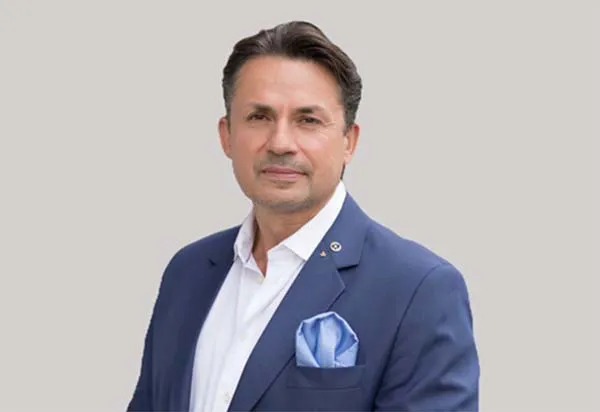
About Holger Thorsten Schubart: doctor of economics, entrepreneur and scientist, mathematician, who together with a group of like-minded people developed neutrinovoltaic technology – a way of generating electricity through the thermal Brownian motion of graphene atoms, neutrinos and particles of the surrounding radiation fields of the invisible emission spectrum. He knows how to convert energy from cosmic neutrino particles, which international teams of scientists have been trying to “catch” with expensive equipment in Antarctica for years.
 Mr Schubart, what is the special secret of your technology?
Schubart. The secret lies above all in the naturalness of this energy and in the Neutrino Energy Group’s invention of a super-strong multilayer material with increased vibration of the graphene atoms. Everyone knows from school physics that there is thermal Brownian motion of the atoms and molecules of substances. The scientific task was to create a material that can convert various radiations, in particular neutrinos, into electric current. In our work we relied not only on our own experimental data but also on published experimental and theoretical work by external scientists to determine the direction of our research. I would like to point out that our analysis was based on fundamental findings:
- A neutrino has mass.
- Neutrinos interact with the nuclei of atoms of substances, as the experiments of the COHERENT collaboration show. The lower the atomic weight of the material examined, the more clearly the effect of neutrinos, which have mass, manifests itself.
- The strongest vibrations of the atoms of substances are observed when materials are produced with dimensions of less than 10–20 nanometres, i.e. 5,000 times thinner than a human hair (conclusion of Prof Vanessa Wood and her team at ETH Zurich, the Swiss Federal Institute of Technology).
These published scientific data enabled us to create a theoretical justification for the scientific results our group of scientists achieved in developing a multilayer nanomaterial. To preserve the integrity of the nanomaterial and ensure processability, we applied it to a thin metal foil. The optimum composition of the nanomaterial for maximum efficiency contains 50–75% graphene, the rest being doped silicon. This composition and combination of layers allows the passage of neutrinos, with their super-penetrating ability, to impart additional micro-vibrations to the graphene atoms. These additional micro-vibrations are enough to amplify the atomic vibrations of the super-hard 12-layer nano material and to translate the atomic vibrations into resonance, which is transferred to a metallic carrier, and the resulting energy is converted into direct current. I see the need to clarify that we do not “catch” neutrinos but only use a small part of the neutrino energy to generate additional micro-vibrations. Just as a wind turbine does not catch the wind, our material does not catch neutrinos.
And the special secret is that we should not make things bigger, more complex and more dangerous, but look for small and flexible solutions. Large gigawatts of energy consumption are ultimately only losses and maintenance costs; they are a technological legacy going back to the century before last. In the coming decades we will be able to organise a constant, secure energy supply by developing small, decentralised power generation plants, without having to expand high-voltage lines.
What is the most successful project of your life?
Schubart. Of course it is the neutrinovoltaics project, and the fact that next year the first licensed commercial production of 5–10 kW Neutrino® Power Cubes will take place is very important to me, even though we are still at the very beginning of our journey. We are expanding our circle of business partners with the aim of maximising the production of Neutrino Power Cubes in the coming years. In addition, we are continuing research and development to adapt neutrinovoltaic technology to the needs of electric vehicles, river and sea-going vessels, etc. I am confident that our development will be used wherever energy is needed.

What was your least successful project?
Schubart. Also the neutrinovoltaics project, because I am frustrated every time I realise that there are so many innovative scientific solutions that can improve our lives, and how difficult and laborious it is to put them into practice, like our neutrinovoltaic technology.
What is your special distinguishing feature as a person?
Schubart. It is always very difficult to assess oneself. I think others have to give that answer. In any case, I feel well prepared for the task I have to accomplish to the best of my knowledge and conscience and with all my strength.
Are you rich?
Schubart. Exactly. I am rich in knowledge and rich enough to satisfy all my daily needs. I learned years ago that it is enough to eat once a day and that you can’t take anything with you to the grave.
I try not to see money as something that accumulates in a bank account, but as a way of setting things in motion and achieving my goals. And I have indeed succeeded in getting many projects off the ground, but looking at the future and the challenges ahead of us, I am still too poor to use and implement all the scientific possibilities open to us and to support many projects that really improve the life of all humanity.
How do you assess the current situation in the energy sector?
Schubart. I see two structural problems as the cause of the current situation. First, more and more energy is needed for the growth of the world economy. Second, there is little that governments can currently do to accelerate the transition from fossil fuels to clean energy sources. I would like to stress that no country, not even Russia, will be able to stay out of the “climate agenda”, because a new economic era is coming in which the owners of clean energy technologies will have development priority. I am pleased to say that we have very strong partners worldwide who support our vision of energy development in the 21st century. I am sure that our project will give a strong impetus to further development in the alternative energy sector.
Would you like to give our readers something to take away?
Schubart. I really don’t want to lecture anyone or prescribe the right way to live, but I would like to encourage everyone to think about how important geopolitical conflicts that lead to political instability are for humanity. In reality they can be avoided if we do not have to fight over the remaining resources of fossil fuels, because inexhaustible energy is all around us and there is enough for everyone.
The Neutrino Energy Group
The Neutrino Energy Group is a German-American research group. Its aim is to find ways to harness the power of the invisible radiation spectrum. As fossil fuels are limited and climate change requires the development of alternative and CO2-neutral energy sources, this research group is dedicated to an urgent problem. It has succeeded in creating a dense substance that can interact in a specific way with neutrinos and other invisible radiation. This unique substance is used to build the first neutrino photovoltaic cells for power generation. Vapour-deposited layers of silicon and doped graphene are applied to the carrier layer to make the end product. The thickness of these layers is in the nanometre range. When neutrinos and other invisible radiation strike this substance, they generate both horizontal and vertical impulses. It is crucial that the doped materials have the right layer thickness. At the optimum layer thickness, the atomic vibrations caused by the impulses are brought into resonance. As a result, an electric current can be detected in the substrate material. The hypothesis states that the amount of energy that can be harvested depends on the distance travelled in the process. With this approach it will soon be possible to charge electrical devices anywhere in the world without needing a socket or a cable. Simply “collecting” energy from the environment is a viable option. As a result, humanity will have access to an endless supply of clean energy, which will help to slow or halt global warming.
The Neutrino® Energy Group works with a worldwide team of scientists and various international research centres. They research applications for converting invisible radiation spectra of the sun, including neutrinos – high-energy particles that reach the Earth incessantly and can be converted into electrical energy.
The image rights lie with the author of the press release.
Notes on content provided by authors
Comments
Loading comments …
Become a member to comment publicly. GAIA members write comments in the members' portal — under their nickname, visible to everyone.










