Neutrinovoltaics: The global map of research


The Schubart master formula as a map
Thousands of researchers. Different disciplines. Different countries. Several decades of scientific work. And yet many of these paths today lead to a common conceptual centre: the Schubart master formula. It does not claim to have invented the underlying physics. Rather, it describes a framework in which established findings from particle physics, materials science, graphene research, thermodynamics and nanotechnology are brought together in a common structure.
At the centre is the question:
How can weak, continuously present energy and momentum flows from the environment be statistically integrated in a nanostructured energy converter and made electrically usable?
The starting point: the weak force becomes measurable
A decisive building block of this research map is coherent elastic neutrino-nucleus scattering, CEνNS for short. As early as 1974, Daniel Freedman predicted that under certain conditions neutrinos can interact not only with individual nuclear components but with an entire atomic nucleus as a coherent unit. The cross-section increases approximately with the square of the number of neutrons. For heavy nuclei, this means a significant enhancement compared with simple single-particle estimates.
In 2017, the COHERENT experiment at Oak Ridge National Laboratory confirmed this prediction experimentally. A physical process that had been known theoretically for more than four decades but was difficult to demonstrate experimentally was thus actually observed. The researchers involved were not thinking of energy integration, graphene or decentralised power systems. They were studying fundamental physics. But their result became one of the paths that today visibly converge on the larger map.
Graphene: motion on the atomic scale
At the same time, a seemingly independent line of research developed: the study of graphene and two-dimensional materials.
Professor Paul Thibado and his team at the University of Arkansas observed free-standing graphene membranes at room temperature. The result: graphene does not remain static. It shows continuous nanoscale motion of its own, triggered by thermal fluctuations of the environment. In combination with a rectifying structure, these movements were able to generate measurable electrical signals — the PDF cites a value of up to 10 picowatts per membrane.
Here too, the original focus was not energy infrastructure or large-scale applications. It was about fundamental questions at the boundary between classical and quantum mechanical descriptions of matter. But taken as a whole, this research provides a further building block: mechanical motion at the nanoscale can be transduced electrically.
Neutrinos have mass and therefore momentum
Another path leads through the Nobel Prize physics of 2015. Takaaki Kajita and Arthur McDonald received the Nobel Prize for the experimental proof of neutrino oscillation. It follows that neutrinos have mass. And particles with mass can transfer momentum.
The individual momentum transfer is extremely small. But it is real, physically describable and experimentally accessible. The PDF gives as an order of magnitude about 65 billion neutrinos per square centimetre per second that continuously pass through the Earth’s surface — regardless of time of day, weather or shading.
For neutrinovoltaics, this is precisely the conceptual transition: it is not about an isolated single interaction, but about integrating weak quantised energy and momentum flows over large numbers of nanoscale coupling points.
The convergence: many roads, one common intersection
From a bird’s eye view, a pattern emerges:
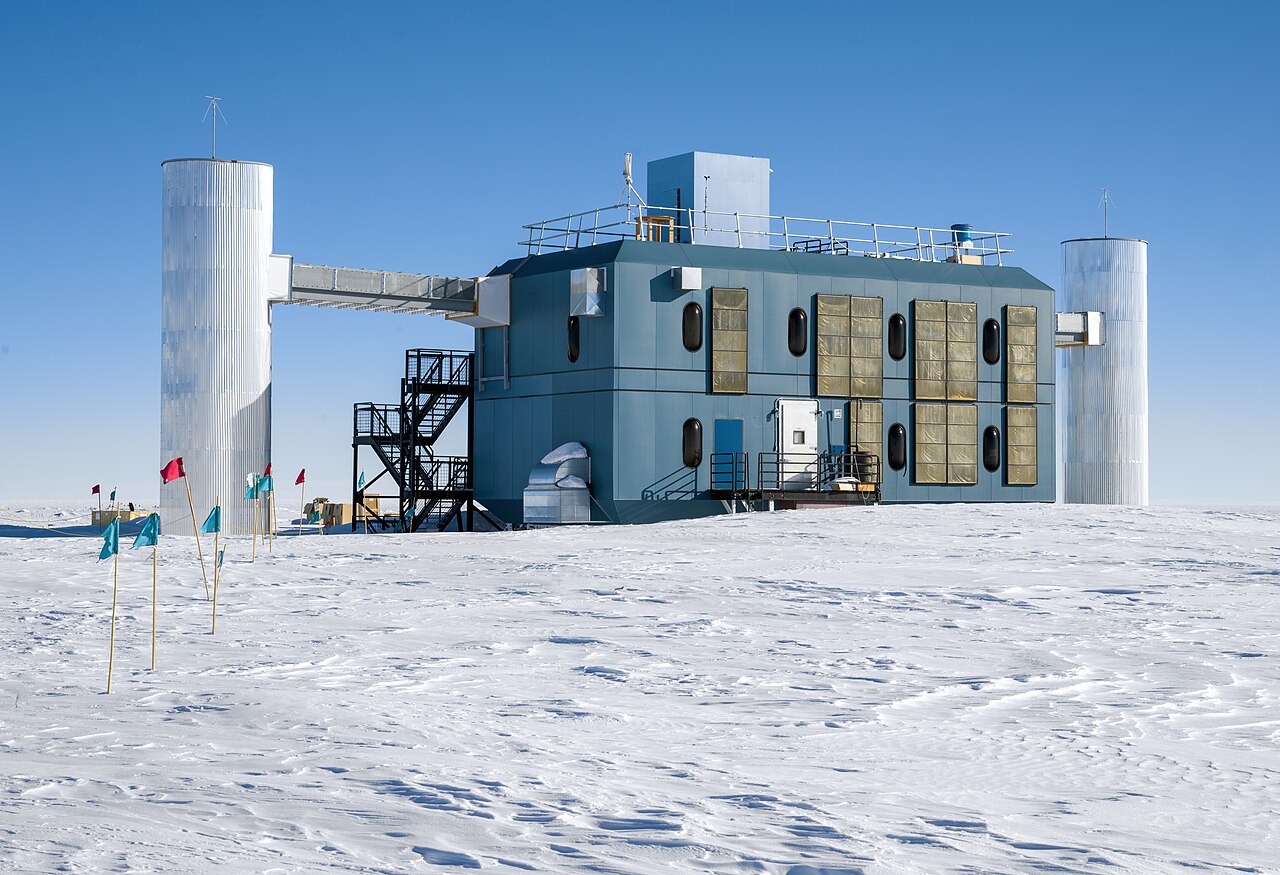
Neutrino physics confirms mass, oscillation and momentum transfer. COHERENT and CONUS+ provide experimental data on coherent scattering. JUNO refines flux and oscillation data. KM3NeT and IceCube broaden the understanding of cosmic neutrino spectra. Graphene research shows nanoscale vibrations and electrical transduction. Materials science and non-equilibrium thermodynamics provide models for coupling, fluctuation and the formation of direction in asymmetric structures.
These research groups did not work towards a common goal in a coordinated way. That is precisely the message of the research map: it does not show planned cooperation, but a structural convergence of independent lines of research.
The Schubart master formula
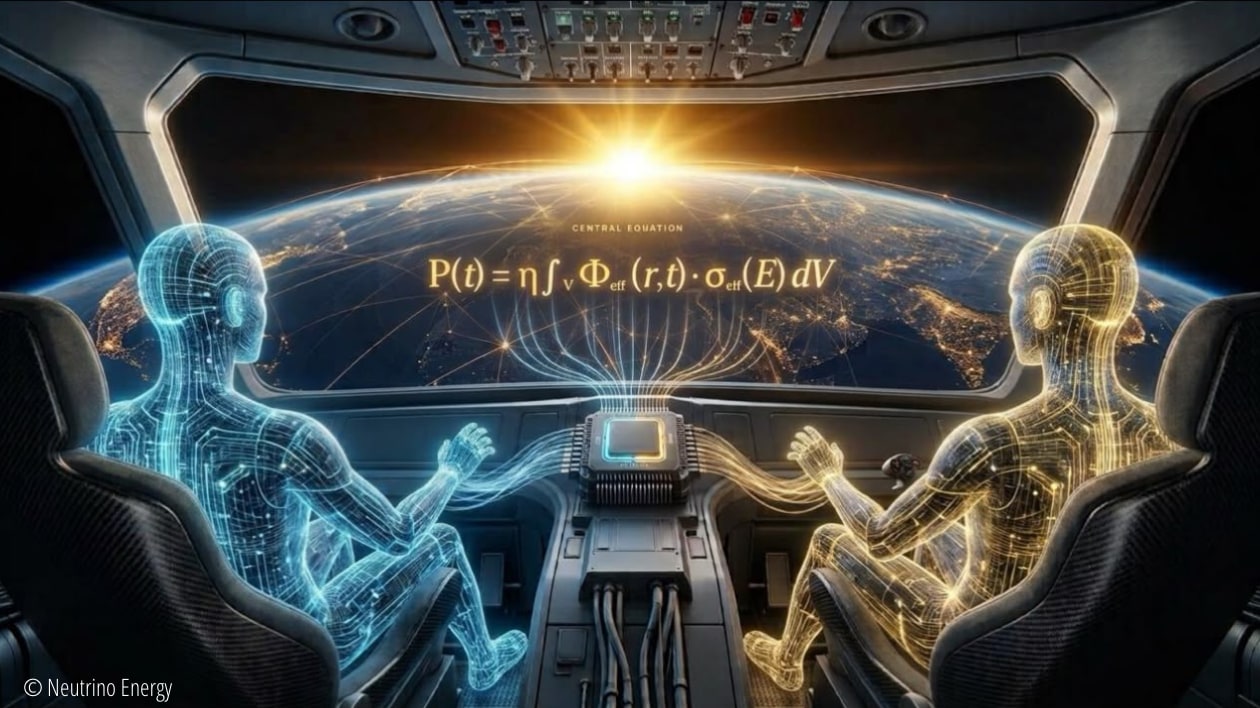
At the centre of this convergence is the Schubart master formula:
The formula describes the continuous electrical output of a system that integrates multi-channel ambient flows over an active volume of material and converts them into directed electrical current through an asymmetric nanoscale architecture — limited by thermodynamic efficiency conditions.
Where:
- P(t) stands for the time-dependent electrical output power.
- η for the efficiency factor of the conversion.
- Φeff(r,t) for the effective flux from various ambient channels, including neutrinos, cosmic muons, electromagnetic background fields and thermal gradients.
- σeff(E) describes the effective coupling or cross-section.
- V stands for the active material volume of the nanostructured conversion platform.
Every term of this equation has a counterpart in the scientific landscape. The flux term is supported by measurements from neutrino and environmental physics. The coupling term refers to experimental scattering data. The volume integral points to the three-dimensional, nanostructured material architecture. The efficiency term remains bound to the laws of thermodynamics.
Not a perpetual motion machine but an energy integrator
The decisive point is important both linguistically and physically: the Schubart master formula does not describe “free energy” or energy from nothing. It describes an integration model for real, weak, quantised energy and momentum flows.
In this understanding, NEUTRINOVOLTAIC systems are nanostructured energy converters. They complement macroscopic energy converters with nanoscale processes. Their technological logic is not to convert individual neutrinos directly into appreciable electrical power, but to statistically sum many weak individual effects via suitable material architectures and read them out electrically.
That is the paradigm shift: from event detection to energy integration.
The living map of research

The research map is not static. Every new measurement from JUNO can refine the flux term. Every new paper on graphene, phonons, plasmons or non-equilibrium systems can refine coupling and transduction paths. Every improvement in material architecture can feed new parameters into the overall model.
Let us draw a comparison with great scientific frameworks:
- The periodic table did not invent chemistry, but gave it a structure.
- The double helix did not create genetics, but provided a visual and conceptual grammar for existing and future discoveries.
In a similar way, the Schubart master formula is intended to provide a framework in which existing and new findings on ambient energy conversion can be systematically classified.
Mathematical consistency instead of product promises
The document refers to Monte Carlo simulations and multi-parameter assessments that test the internal consistency of the model against established experimental physics. A statistical significance of 5.9 to 6.0 sigma is cited. At the same time, the document makes clear: this is not the certification of a commercial product, but a statement about the mathematical coherence of a framework in relation to the physical data on which its terms are based. This distinction is central.
The formula is not an advertising promise. It is an integration framework. Its strength lies in considering different scientific results not in isolation, but as a coherent structure.
Conclusion: the physics was never hidden
The basic physics behind neutrinovoltaics has not been newly invented. Neutrino oscillation, CEνNS, graphene motion, thermal fluctuations, nanoscale transduction and thermodynamic limits are independent fields of research.
What is new is bringing them together.
The Schubart master formula relates these fields of research to one another. It makes visible how independent scientific roads lead to a common point: a nanostructured energy integrator at the quantum level that considers weak quantised energy flows not as isolated individual events, but as continuously summable contributions in an active volume of material.
The physics was never hidden. It had just not been put together for this purpose before.
Sources
Notes on content provided by authors
Comments
Loading comments …
Become a member to comment publicly. GAIA members write comments in the members' portal — under their nickname, visible to everyone.