Neutrino Energy: announcement of extensive field tests


Neutrino Energy announces field tests for its graphene-based fuel-free power generation technology
The neutrinovoltaic project for generating electricity without fuel has reached an important milestone: field trials of the Neutrino® Power Cube generators with an output of 5 to 6 kW will begin soon.
Between 100 and 200 participants will be able to take part in the tests. The generators will be installed in the homes of residents in Austria, who will soon be able to apply for the experiment. The experiment will last 6–9 months. It is important to note that the Neutrino® Power Cube was developed for off-grid operation and cannot be used in parallel with the power grid.
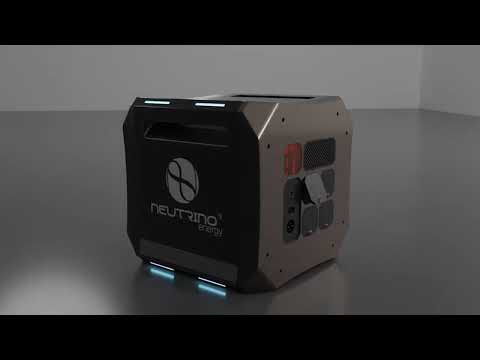
Our aim in the tests is to examine the Neutrino® Power Cube with an output of 5–6 kW in everyday use. We want to find out how it performs for users under different working conditions and voltages. After the field trials, we must make sure that all preliminary tests with the Neutrino® Power Cubes have been completed before we can start industrial series production. The first Neutrino® Power Cubes will be manufactured in Switzerland, where several production facilities are being converted for fuel-free generators.
The Neutrino® Power Cubes are relatively compact and are built in the form of a control cabinet. The cabinet consists of two parts: a power generation section with 6 modules and a section for the control system. The power generation section measures 800 x 400 x 600 mm and weighs about 50 kg. The control section houses inverters to convert the generated direct current into alternating current at 220 V and 380 V. There is also a DC connection for direct connection of computers and other devices.
Once all tests have been completed and the fuel-free generator has been certified, the science and technology company Neutrino Energy Group will hold an official presentation. The company’s president, mathematician Holger Thorsten Schubart, commented on this decision:
We work with pedantic precision. Our engineers and technicians take care of every detail, be it the design or the technical implementation. We understand the interest and curiosity of everyone who would like to see our working model as soon as possible.
However, we would like it to be taken into account that our products are an absolutely unique leap innovation. It is therefore of great importance to carry out a comprehensive series of tests and product certifications first. The working model will be shown to the public when we make that decision. And only we decide the timing, because there are also plenty of “preventers” who would love to see this project fail.
The first Neutrino® Power Cube pre-series is currently being prepared for field trials in Austria. Work is going according to plan. Full funding of all further development steps is covered by our current equity. We developed the project with our own funding and involved only a few partners in the early years (small shareholders < 2%).
We are currently not looking for further financial support. However, we are open to interesting offers for an industrial rollout and international distribution in connection with the introduction of our technology in the coming years. We welcome partners who drive our development forward and improve it with ideas and interesting proposals.

Holger Thorsten Schubart
CEO of the Neutrino Energy Group
Neutrinovoltaics basics
The core knowledge of the Neutrino® Energy Group is based on a special material consisting of alternating layers of graphene and silicon with alloying elements. Experimental data have shown that the properties of graphene, a two-dimensional material, differ greatly from those of graphite, a three-dimensional material. Every two-dimensional material is unique and offers a wide range of applications.
Graphene, discovered by the 2010 Nobel laureates in physics, has revolutionised solid-state physics. It has extremely high electrical conductivity (a million times higher than copper) and high charge carrier mobility. In graphene, the atoms are bonded to one another in a two-dimensional plane, with one electron free to move in the third dimension. Under a high-resolution microscope, you can see that the graphene layer shows vibrations similar to waves on the surface of the sea. These vibrations are amplified by energy and thermal fields. Theoretical studies show that the coupling between electrons and photons is the source of this process. It suppresses the bending of the graphene and amplifies unusual fluctuations.

The presence of “graphene waves” makes it possible to generate electric current. The quality of the graphene application influences the amplitude and frequency of these waves. They are most pronounced in a single layer of graphene. If the graphene application is disturbed and several layers are applied on top of each other, the amplitude and frequency of the “graphene waves” decrease. The harmonic vibrations of these waves, which pass into resonance, are essentially the work needed to influence the movement of the graphene atoms and the energy of the surrounding radiation fields.
Notes on content provided by authors
Comments
Loading comments …
Become a member to comment publicly. GAIA members write comments in the members' portal — under their nickname, visible to everyone.










