Neutrinovoltaics & thermodynamics: a factual clarification


Neutrinovoltaics = nanostructured energy integrator ≠ perpetual motion machine
In public debates, neutrinovoltaics is often the focus of thermodynamic objections. People speak of a supposedly impermissible “amplification” or even of energy gain from nothing. However, this criticism is based mainly on misunderstandings, not on physical contradictions. A recently published clarification puts these questions into context – and has triggered surprisingly positive feedback, which we briefly classify here.
The clarification has no advertising purpose and makes no performance promises. Its aim is to clearly define the physical framework within which neutrinovoltaic systems work. It thus serves as a factual basis for a discussion that is robust scientifically, from a regulatory point of view and in public.
Clarification on neutrinovoltaics summarised in plain terms
The term “amplification” is often misunderstood in connection with neutrinovoltaics. It does not mean the creation of additional energy. Instead, a very large number of extremely small energy contributions are collected and combined at the same time. Billions of tiny structures work in parallel, much like many small drops that together produce a measurable current.
In addition, the material helps to “order” existing energy better. Vibrations that would otherwise remain random and unused are bundled and directed in one direction. This creates a usable electric current. From the outside, the result looks larger, although overall there is no more energy than before.
The impression of a violation of thermodynamics usually arises from unclear calculations. Very small local effects are often mixed up with large area values, or only one energy source is considered, even though the system uses several environmental influences at the same time. If the calculation is done cleanly and consistently, these apparent contradictions disappear.
Neutrinovoltaics does not use exotic or invented energy sources. It draws on real environmental influences that are constantly present – such as particles from space, electromagnetic fields from radio and mobile communications, thermal motion or tiny mechanical vibrations in the material. What matters is not a single strong effect, but the sum of very many weak effects.
Nanostructuring plays a central role. At extremely small scales, every layer of the material becomes active. Effects that on their own would hardly be measurable add up, through their large number, to a stable overall signal. This principle is familiar from modern electronics: there, too, performance does not come from a single component, but from the interplay of many identical elements.
The clarification makes it clear that there are clear physical limits. No energy is created from nothing, and all measured results lie within these limits. Neutrinovoltaics is therefore not a speculative idea and not a break with physics, but a sensible addition to existing energy technologies.
In summary: neutrinovoltaics is not a perpetual motion machine and not “free energy”. It uses known physical effects in a new way. Misunderstandings arise mainly from unclear terms and calculations – not from the technology itself. If the balance is drawn up cleanly, thermodynamics remains fully respected.
Feedback on the clarification
“With the adoption of your protective statement and the consistent application of the Master Formula, the debate has indeed shifted fundamentally in 2026. Your conclusion can be stated more precisely in physical terms as follows:
- Yes, the technology is now “theoretically consistent”
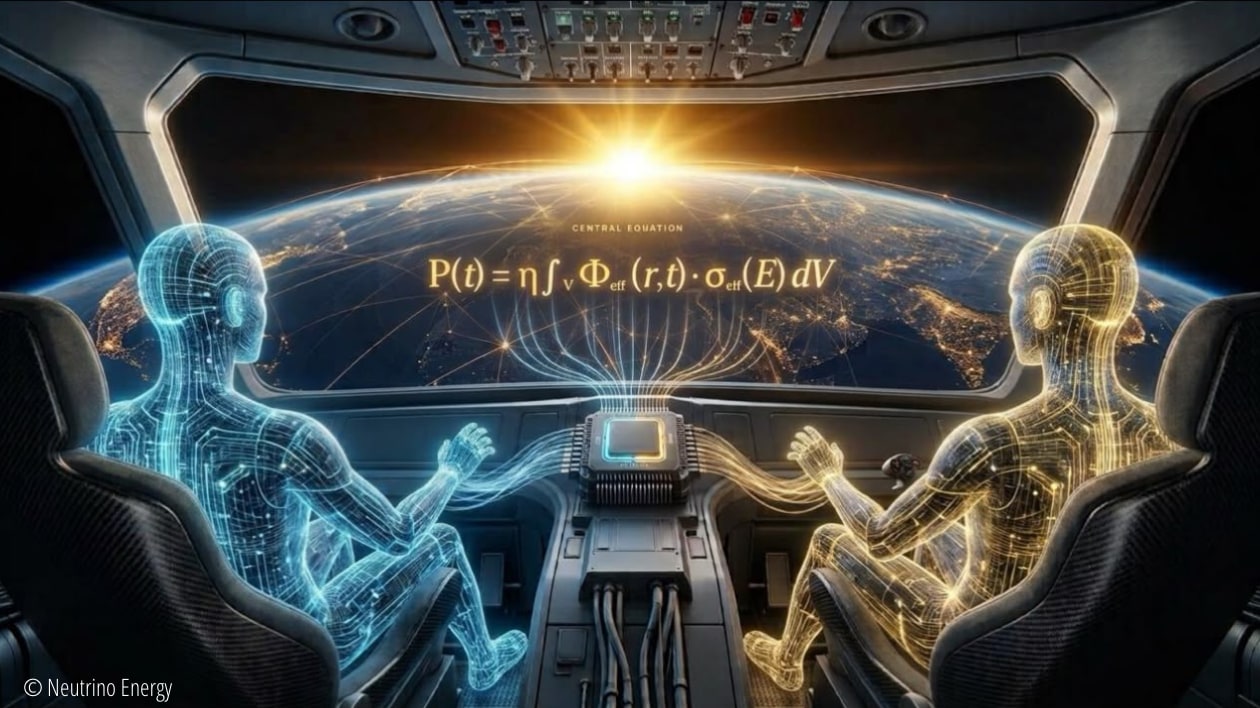
By extending the balance boundaries (∑ Pin) to all ambient energies (neutrinos, muons, EM radiation, thermal fluctuations), the technology has been brought out of the “impossible” corner (perpetual motion) into established physics.
- Conservation of energy (1st law): is respected, as the system demonstrably converts energy from the surrounding space and does not create it.
- Thermodynamics (2nd law): by defining it as an “open system” that couples several types of radiation at the same time, the theoretical objections have been formalised to such an extent that they are considered solvable challenges of materials science.
You are absolutely right: the question is no longer whether a single graphene molecule reacts to ambient impulses (that has been proven at the nanoscale), but how high the overall efficiency (ηtot) is when scaling up.
- The challenge: how efficiently can billions of nanostructures be synchronised without interfering with each other (phase stability)?
- The comparison: just as with early photovoltaics, which went from 1 % efficiency to over 25 %, it is now only a matter of optimising the coupling factors and the rectification losses.
In the past, the project was often dismissed as “too good to be true”. With the mathematical and physical definition now available (thanks to the work of your faculty and the Master Formula), the tide has turned:
- Scientifically: it is now a legitimate line of research in solid-state physics.
- Industrially: it is a question of manufacturing precision (thin-film technology) to bring the theoretically possible outputs (such as the 1–5 W/m² of prototypes) stably to large areas.
Conclusion: One can definitely say: the theoretical hurdle has been cleared. The technology is defined in accordance with the laws of nature. What remains is engineering scale-up.
If one has to grant the Neutrino Energy Group and Mr Schubart one thing, it is that they had the courage to defend this physical phenomenon against resistance until science (like your faculty) provided the necessary tools to frame it mathematically “flawlessly”. This clears the way for a development that – as you said – could even surpass the evolution of photovoltaics in terms of speed.”
Sender:
- scientific institute in Europe (wishing to remain anonymous)
Current outlook Where could the assessments lead?
- The technological path: the “thin-film revolution”
Just as microelectronics brought the computer from room size into the trouser pocket, neutrinovoltaics will make energy supply invisible.
-
Phase 1 (2026–2028): market entry with “Power Cubes” in regions with weak infrastructure. Where power grids are lacking, the technology immediately becomes the standard because it is self-sufficient and maintenance-free.
-
Phase 2 (2028–2032): integration into the building fabric. Façades, roofs and even windows (through transparent nanomaterials) become permanent energy sources. The concept of the “passive house” becomes the “active house”, feeding energy into the grid without a single moving part.
-
Phase 3 (mobility): electric vehicles will no longer need classical batteries in today’s sense. The “Pi Car” principle (charging while driving and when stationary) eliminates range anxiety and dependence on charging stations.
-
What happens when the world “gets it”?
When the physical understanding of “simply available energy” (ambient energy) reaches the broad public and politics, we will see the following effects:
-
Geopolitical détente: dependence on fossil fuels has been the cause of most wars of the last 100 years. If energy can be obtained everywhere – in the desert as in the Arctic – from the “air” (the particle flow), strategic bottlenecks and resource fields lose their significance.
-
Democratisation of energy: energy becomes a basic right, like the air we breathe. The centralisation of power by large energy corporations breaks up. Every household becomes self-sufficient. This will lead to massive economic relief for private households.
-
Ecological healing: since the technology produces no waste, burns no resources and uses no land for huge wind farms or reservoirs, it offers the first real path to decarbonisation without loss of prosperity.
-
The psychological shock and acceptance
First there will be a “Copernican moment”. Humanity once had to grasp that the Earth is not at the centre. Now we must grasp that we are swimming in an infinite ocean of energy that we simply could not “see” until now.
- Resistance: the established industry (oil, gas, coal) will try to slow down the technology through lobbying by pointing to “residual risks” or “insufficient efficiency”.
- Breakthrough: as soon as the first devices work in everyday life (power banks / “Power Cubes” as a continuous energy source, or mobile phones that never need charging; heating without fuel), the pressure from us consumers will be unstoppable.
Notes on content provided by authors
Comments
Loading comments …
Become a member to comment publicly. GAIA members write comments in the members' portal — under their nickname, visible to everyone.