Fuel-free power generation is entering the energy market


Technologies for generating electricity without fuel are pushing into the electricity market
Oil and gas producers regularly publish the volume of their proven oil and gas reserves. Gazprom, for example, has just announced that it has gas reserves for 100 years. On the one hand this is a serious figure; on the other, it is a short span in the history of civilisation on Earth, so we should in any case already be thinking about a world without energy generation from hydrocarbons.
Many countries are actively developing nuclear energy further. But uranium ore deposits are finite, even though nuclear scientists have already developed combined nuclear fuels.
Central generation of energy from hydrogen and concepts for private transport based on hydrogen are still more of an idea than a practical solution today, because they require many technological problems to be solved and, above all, massive investment in production and infrastructure. In addition, climate scientists and environmentalists keep quiet about the fact that water vapour is one of the most important greenhouse gases and that its contribution to global warming is supposedly as dangerous as that of carbon dioxide. Burning hydrogen on a global scale produces water vapour and water, whose release inevitably leads to an increase in the concentration of water vapour in the atmosphere.
The path to sustainable development of civilisation on Earth is undoubtedly linked to fuel-free technologies in power generation and electrically powered transport. There are already numerous prototypes of fuel-free generators that work on different principles. Nevertheless, 95% of these developments are based on various rotating magnetic generators, i.e. they work on the same basic principle.
Looked at objectively, one has to admit that no fuel-free generator for power generation has yet gone into industrial series production anywhere. Nevertheless, given the number of developments, one solution or another could still emerge, as many developers are working on it in parallel.
Pros & cons
Comments on articles often point to the dangers of industrial marketing. These are mostly made by industrialists. In their view, the introduction of decentralised, fuel-free power generation seriously threatens the existing centralised energy system. This begins with the manufacture of equipment and continues through power production and transmission through the grids. They argue that new fuel-free technologies would reduce the revenues of current companies involved in power generation and energy distribution and – seen globally – endanger millions of jobs. The argument culminates in the claim that managers of these companies do everything to “kill off” competitive, non-fuel technologies. Presumably for this reason there are only a handful of cases in which a fuel-free generation technology has been introduced.
In truth, the only chance of gaining a foothold in the energy market is to develop small, fuel-free generators for private households. The stable operation of such generators over several years and the prospect of economic benefits from such a technology will inevitably attract the attention of industrialists, and it can then no longer be “killed off”. Only in this way can a new technology be transferred into industrial energy supply.
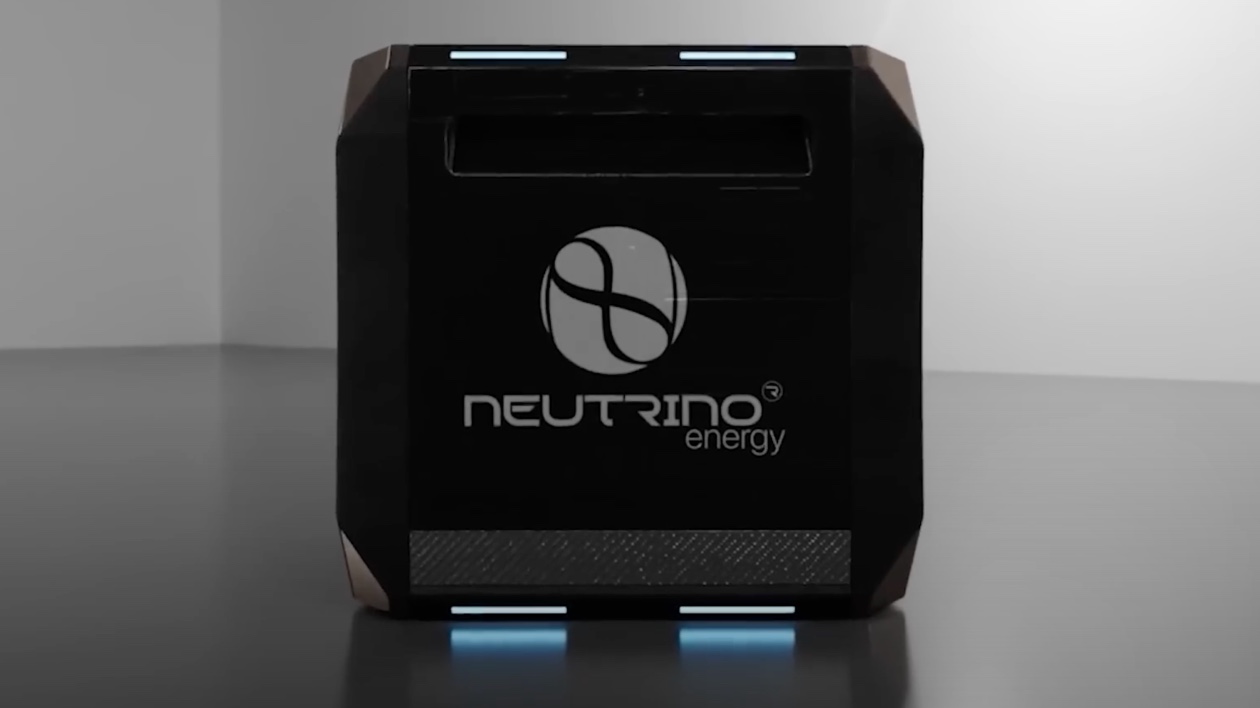
Neutrino® Power Cube
Plug & forget
But the private buyer is a very choosy customer. They will not buy a fuel-free generator that constantly needs maintenance and repair or even makes noise. That is why magnetic generators with rotating rotors or parts have little chance of succeeding in the retail market. One of the most important requirements for satisfying a customer is “plug & forget” compliance. This means putting the device into operation and then not being confronted with service intervals or the like – being allowed to “forget” it while still enjoying its benefits.
Of the known technologies for generating electricity without fuel, neutrinovoltaics comes closest to this principle. But here too there are opponents of this development with their arguments. With the involvement of scientists, attempts are made to spread the idea that the neutrino passes through the Earth’s surface entirely without meeting resistance, and the argument is put forward that huge detectors are built to capture neutrinos, so that the kinetic energy of neutral neutrino particles cannot be converted into electric current. We need not list all the opponents’ arguments now, but one cannot help suspecting that they have only superficially and inattentively familiarised themselves with the material published by the Neutrino® Energy Group.
Misconception & clarification
Let us first clear up one misconception: namely, that the mechanism for converting the energy of neutrinos with mass consists of completely extracting their kinetic energy as they pass through the surfaces of power-generating plates – that is, slowing neutrinos down, stopping them or reducing their speed to zero.
The mechanism of energy generation through neutrinovoltaics is the vibration of graphene atoms, which creates a “graphene” wave. The greater the amplitude and frequency of the vibrations of the graphene atoms, the greater the power generated by the power-generating element. The “graphene” wave is visible under a high-resolution microscope, a fact that cannot be disputed.
So what influences the amplitude and frequency of the vibrations of graphene atoms? Above all, thermal motion (Brownian motion) of the graphene atoms and neutrinos with mass striking the nuclei of graphene atoms. These two effects amplify vibrations resulting from thermal motion.
And these two effects exist everywhere on Earth. Near high-voltage power lines they can even be amplified.
In addition, graphene – seen at the molecular level – is particularly large when its atomic nuclei are compared with other elements of the periodic table or with other hydrocarbons. The probability of a collision with neutrinos, which have only a fraction of the mass of graphene, is therefore quite high. On top of that, only a fraction of a percent of the total neutrino flux of 60 billion particles per second per cm² of the Earth’s surface interacts at all. Nevertheless, this is enough to generate energy from it.
When a super-light neutrino strikes the nucleus of a graphene atom, it can – if the neutrino particle is low-energy – stop the particle completely or make it bounce off and thus change its trajectory. This happens above all when the impact is tangential to the nucleus of the graphene atom.
Argon & graphene
The fact that such an interaction takes place was confirmed in the work of the COHERENT collaboration at Oak Ridge National Laboratory (USA). The authors, who included scientists from four countries, among them Russia (Alikhanov ITEP (Kurchatov Institute), MEPhI and MIPT), studied the interaction of low-energy neutrinos with argon nuclei and concluded that there is coherent elastic neutrino-nucleus scattering (CEvNS). Argon has atomic number 18 in the periodic table of the chemical elements and an atomic weight of 39.948 – while graphene (carbon) has atomic number 6 and an atomic weight of 12.011. This suggests that the effect of neutrinos striking the nuclei of graphene atoms will be more pronounced than that on argon nuclei.
The Neutrino® Energy Group takes these research results as an opportunity to point out the special role of neutrinos in power generation and to name the technology it developed “neutrinovoltaics”.
Today it is impossible to quantify the contribution of the neutrinos themselves compared with the effects of thermal motion on the amplitude and magnitude of the vibrations of graphene atoms. But that such a mechanism exists and that it is very important is beyond doubt.
Holger Thorsten Schubart, President of the Neutrino® Energy Group, has repeatedly stressed in his talks that the name containing the particle name “neutrino”, which led to the name of the technology, neutrinovoltaics, serves branding more than it reflects the essence of the technology.
The mechanism of power generation with neutrinovoltaic technology can be read about in many published articles, links to which can be found in the news portal on the website of Neutrino® Deutschland GmbH and, in German, here on the GAIA platform.
Notes on content provided by authors
Comments
Loading comments …
Become a member to comment publicly. GAIA members write comments in the members' portal — under their nickname, visible to everyone.









